 Greg Saunier
Chris Riley has started a "3D Printing Basics" series and this second video is to learn how to do CAD design with Fusion. As always with Chris it's well explained and covered.

Chris Riley has started a "3D Printing Basics" series and this second video is to learn how to do CAD design with Fusion. As always with Chris it's well explained and covered.
Slow hotend reaction time and slicer/firmware not ready to compensate the speed and temperature is what takes me a step back on all this fast 3d printing hypes. This tech is promising and would make fast 3D printing compatible with quality and strong layer bonding.
However, the road might be long as it's blocked by patents and the software side might be very dependant on the hardware (so we would need reliable automatic calibration). 1/2

I never recommend or use CF filaments for the reasons mentioned in this video. Some people also develop skin irritations. I saw macro images in the past but never saw a study about what you could breathe, better to not think about it. And yes, this also negatively affects the properties of the filament. If you need more rigidity, consider aluminum, another filament type or imagine a different design.
📽️ https://youtu.be/RLt9l6YxvHk

Many projects, developers and designers in the #3Dprinting community are working passionately and freely to advance this technology. Perhaps you have a little money to support some of them? That would be a great contribution for the community! ♥️🙏
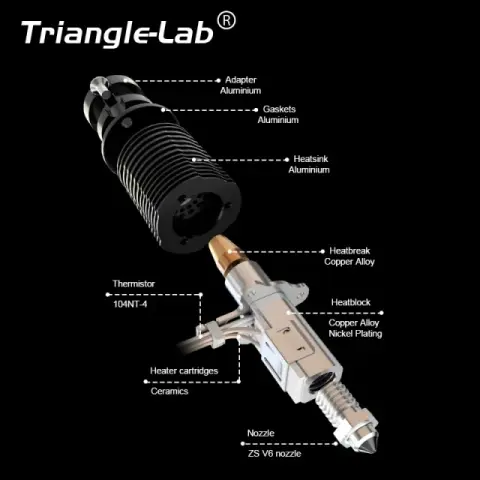
How is this #hotend supposed to work efficiently?
1. The heatbreak is assembled inside the heatsink which creates a warmer environment for it (no fesh air)
2. The hot block is bolted to the heatsink which is again warming up the surrounding of the heatbreak
3. There is a lot of mass between the fins and the heatbreak tube. Ideally you want fins and airflow as close as possible to the heatbreak
4. As usual no recommended fan specs, what did they use for testing then?


The new Ultimaker Factor 4 3D printer has a Print Process Report and I really like this! 3D printing is not as reliable as a subtractive manufacturing like CNC machining. So it's very useful to have a report at the end of the print showing additional data. It is truly missing in the FFF industry!
More info ➡️ https://ultimaker.com/learn/introducing-print-process-reporting/
#3dprinting #3dptech #3dPrintingTech #reliability #Ultimaker #factor4

High speed 3D printing aficionados, be careful when you increase the nozzle temperature for higher flow rates ⬇️

Thanks to Adrian Bowyer, I learned today that 3D printing was invented in the 30s'. And it has started with the 3D printing of a house! It was already very impressive and advanced with several reinforcement techniques and almost being able to close the roof. 🤯
📽️ watch it here: https://www.youtube.com/watch?v=Dl9rhG5BPrM
Source: https://twitter.com/adrianbowyer/status/1783783089770000417
#3dprinting #patent #3dptech #construction #concrete #3dPrintedHouse #Construction3dPrinting


I wish we could find a better solution than grub screws for attaching pulleys to shafts in 3D printing. Small-scale requirements make it difficult to use other industrial systems.
Grub screws often loosen under the effect of vibration even with Loctite. They also introduce eccentricity. And the tip of the grub screws marks the shaft, making it difficult to remove the pulley.
Any idea how we could improve this?
#3dprinting #3dptech #3dprinting_tech #pulley #motion #belt #grub_screw @3dprinting

1/2 I regularly talk about the risks of using electronic components or control boards from stores like Aliexpress for your 3D printers. Recently, several YouTubers discovered that the fuses were not up to specs! ☠️🔥
📽️ https://www.youtube.com/watch?v=YwjSZ-g1qa0
This is also true for low cost 3D printers, they will cut everywhere they can and that could include the fuses.
#3dptech #3dprinting_tech #3dprinting @3dprinting #aliexpress #safety #electronic

