Roger Schürch

@schuemaa
0 Followers
56 Following
24 Posts
Assistant Professor in the Department of Entomology at Virginia Tech. This is a private account, though toots will mainly reflect topics around work, so evolution, ecology, and entomology. R on Emacs enthusiast for reproducible analyses, interested in Org-mode.
Current PositionAssistant Professor, Department of Entomology, Virginia Tech
Webhttps://schurch.ento.vt.edu/
Come see Elizabeth speak about ant fungal bacterial coevolution (or not!) in North American fungus-gardening ants! VCC 224 at 10:54 am Monday Nov 14! #EntSoc22

Twitter might be going down. @beatty is trying to preserve the Science Twitter Graph.

Go to https://opencheck.is/scitwitter, provide your Twitter handle and your @ORCID_Org ID - that's it!

Just for fun, I visualized the network: http://leonlotter.de/twittergraph/graph.html
When I ran the code a few minutes ago, we had already around 600 nodes and 5000 edges in the network!

#Science # Twitter #TwitterMigration #network #graph #networkscience #scicomm #datavis
@cognition @neuro @phdstudents

(1/2)

OpenCheck

Very pleased to see that @firefoxx66 can start her own lab at @SwissTPH.

I’m very grateful to have had the opportunity to work with @firefoxx66 in my group during the last 2 years, and I’m looking forward to continuing collaborations.

Congratulations, @firefoxx66!🍾🎉
---
RT @firefoxx66
🎉Coming in 2023: The Hodcroft Lab!!🎉
I'm so so excited to announce that my @snsf_ch Starting Grant was funded!
I'll be focusing on the amazing world of …
https://twitter.com/firefoxx66/status/1592081382314065920

Dr Emma Hodcroft on Twitter

“🎉Coming in 2023: The Hodcroft Lab!!🎉 I'm so so excited to announce that my @snsf_ch Starting Grant was funded! I'll be focusing on the amazing world of #Enteroviruses at the fantastic @SwissTPH as an Assistant Prof! 💰👩🏻‍🎓🦠🧬 Schweiz, ich bleibe! 🇨🇭❤️ 1/3”

Twitter
I'm not at #EntSoc22 in Vancouver, sadly - but four students from my lab are there, presenting on aspects of #Entomology and #InvasionEcology. If you're there, check out their talks (thread):
6/6 - So, do we find more, and maybe more diverse #NativeBee species, in regions of the Virginia landscape that have been indicated by #HoneyBees to be “good”? Join #PhD student Rob Ostrom (@[email protected]) on Tuesday 1:30 to 1:45 to learn more!
5/6 - In addition, because #HoneyBees are generalist foragers, we hypothesize that we ought to be able to use them as #BioIndicators for #NativeBees: Landscapes where honey bees find profitable food should be able to support native bees as well. For example, in England @[email protected] and I have found that honey bees were pointing their nestmates to a nature reserve mainted primarily for butterflies (https://doi.org/10.1016/j.cub.2014.03.072).
4/6 - This unique data sets allows us to study how #HoneyBees use these landscapes and some of the work we have been doing around that question is published (https://doi.org/10.1002/ecs2.4228; https://doi.org/10.1002/ece3.8979; https://doi.org/10.1098/rsbl.2022.0155).

3/6 - In a project led by @[email protected], in 2018 and ‘19, students Brad Ohlinger, Mary Silliman and Taylor Steele decoded more than 11,000 honey bee waggle dances in three landscapes in #Virginia to study where bees forage. For example, this video shows day by day #HoneyBee #foraging in a row crop system around the Tidewater AREC in #Virginia.

https://youtu.be/UYe-gNlzjZc

Honey Bee Foraging around Tidewater AREC, Virginia

YouTube

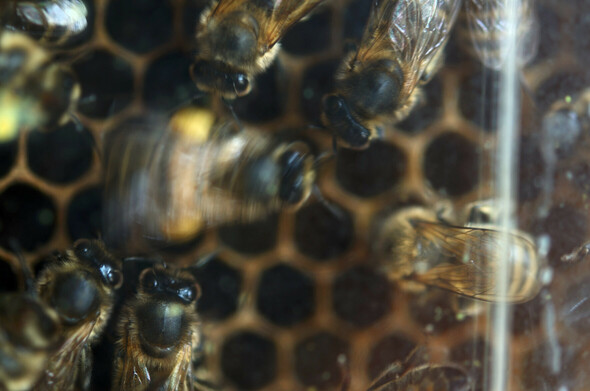
2/6 - In the figure-of-eight dance, these foragers tell their nestmates how far away from the hive and in what direction they have found nectar or pollen. By filming the dances and manually decoding the information contained in the dance, scientists can also study where honey bees find their food.

https://youtu.be/cgZDuL4e4ds

Single Honey Bee Waggle Dance

YouTube

1/6 - As people are traveling to #EntSoc2022 in Vancouver I wanted to take the opportunity to advertize the talk of my #PhD student Robert Ostrom. Using #HoneyBee #WaggleDances as #BioIndicators he is trying to predict native #bee #abundance, #richness and #diversity.

Honey bee foragers that have found a profitable resource will perform waggle dances when back in the hive. This was first scientifically described by Karl von Frisch (reviewed here: https://rdcu.be/cZvHq).

The dance legacy of Karl von Frisch