Peter Humburg

131 Followers
109 Following
427 Posts
@juergen_hubert What is going on there with the confusion about the place? The story says it takes place at the Brocken only to turn around at the end and say, actually it all happened at Rammelsberg instead.

Update: I ended up doing something along the lines suggested by @nrennie but then it turned out that it isn't possible to hide chapter headings that way (at least not as far as I can tell). So now I'm also using profiles (as suggested by @gavin) to exclude entire chapters when needed. It works nicely now.

Thanks for the help everyone!

#QuartoPub #rstats

@nrennie I was wondering whether I should do something like that. I think I avoided it because it looks a bit ugly and I was hoping metadata would provide a more elegant solution. But I can see that this should work (thanks for confirming that!).
If the profile approach doesn't work out this is probably what I'll do.

#QuartoPub #rstats

@gavin I hadn't really considered that. Looking at it now it seems like I could just set up a different profile for each include and then mix them at run time. I'll give that a go tomorrow.

#QuartoPub #rstats

@gavin hmm, that's a gid thought. I've done similar things in the past (back when it was RMarkdown), but I'm not sure chunk options will work here.

Basically, I have a few parameterized .qmd files that get repeatedly included in another file (with different parameters) to create a chapter of a longer report. Sometimes I'll have to skip some of the includes and sometimes I have to skip the entire chapter.

I thought .content-hidden would be a convenient way to do that.

#QuartoPub #rstats

I'm struggling a bit with using metadata in quarto. I have a project that includes some custom metadata of the form

key1:
key2:
key3a: true
key3b: false

and so on. I would like to be able to overwrite some of these when rendering to modify which parts of the document are included in the output via
{.content-hidden unless-meta="key1.key2.key3a"}

I've tried to do that using something along the lines of

quarto render -M key1.key2.key3a:false, but that appears to have no effect.

Any advice on how to make this work, or how to achieve the same effect in a different way would be much appreciated.
#quartoPub #rstats

@djnavarro @nxskok this is gold! Now I need to find an excuse to teach my daughter about Taylor Series.

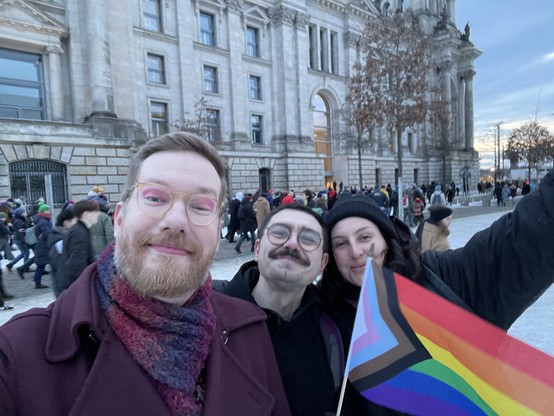
I’m an immigrant to Germany having moved here 14 years ago. I gained my citizenship in 2020. Most of my friends here are immigrants. My partner is an immigrant. It’s been truly frightening to hear the far-right planning mass deportations of naturalised citizens.

But 1.5 million people marched against that today. 350,000 demonstrated in #Berlin alone. That gives me so much hope. Tolerant people are not a minority, and we won’t let them frame it that way. Never, ever again.

Now ban the AfD.

@thomasfuchs I agree with that. Although that isn't something all general search engines do, as far as I can tell. It also doesn't really impact usability that much (at least in this case). For me, the second result was a link to an alphabetical list of African countries, which provides the correct answer.

There are plenty of reasons to avoid Google and too be concerned about the nonsense LLMs pump out, I was just pointing out that this didn't seem like a particularly solid argument for either of those issues to me.

@thomasfuchs I'm not saying you should keep using Google but I think it is worth pointing out that the snippet highlighted by Google is actually from a YCombinator post that highlights the problem with Chat GPT.

Not that there aren't issues with the results returned here, but I think the lesson from this isn't so much "LLMs ruin internet search" (although that may also be true) but "don't rely on skimming of search results if you want reliable answers". I'd expect that to be true for any search engine. The problem is that the Google snippets encourage you to do exactly that.