Mara Mather

606 Followers
39 Following
68 Posts
A research career is such an adventure for the curious mind. I feel so lucky to be able to continually learn and explore. I’m currently most fascinated by the noradrenergic system and how to optimize its function, especially in the aging brain.

@NicoleCRust

Also now found this table:

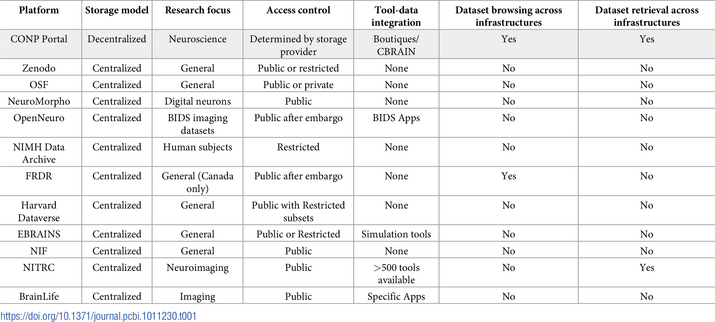
Overview of commonly used #datarepositories in the #neuroscience community and their features:

CONP Portal
Zenodo
OSF
NeuroMorpho
OpenNeuro
NIMH Data Archive
FRDR
Harvard Dataverse
EBRAINS
NIF
NITRC
Brain Life

https://doi.org/10.1371/journal.pcbi.1011230.t001

The Canadian Open Neuroscience Platform—An open science framework for the neuroscience community

The Canadian Open Neuroscience Platform (CONP) takes a multifaceted approach to enabling open neuroscience, aiming to make research, data, and tools accessible to everyone, with the ultimate objective of accelerating discovery. Its core infrastructure is the CONP Portal, a repository with a decentralized design, where datasets and analysis tools across disparate platforms can be browsed, searched, accessed, and shared in accordance with FAIR principles. Another key piece of CONP infrastructure is NeuroLibre, a preprint server capable of creating and hosting executable and fully reproducible scientific publications that embed text, figures, and code. As part of its holistic approach, the CONP has also constructed frameworks and guidance for ethics and data governance, provided support and developed resources to help train the next generation of neuroscientists, and has fostered and grown an engaged community through outreach and communications. In this manuscript, we provide a high-level overview of this multipronged platform and its vision of lowering the barriers to the practice of open neuroscience and yielding the associated benefits for both individual researchers and the wider community.

Reading #fMRI methods when it's not your field sounds like a psychedelic voyage:

"Functional scans were collected using a T2*-weighted echo-planar imaging sequence with a multi-band acceleration factor of 4. A field map with dual echo-time images was acquired to correct for geometric distortions due to susceptibility-induced field inhomogeneities. Structural scans were acquired using a T1-weighted MPRAGE sequence with 1x1x1mm voxel resolution. We discarded the first six volumes to allow for scanner equilibration."

#Neuroscience

source: Generative replay underlies compositional inference in the hippocampal-prefrontal circuit by #BehrensLab

Finally made the jump to neuromatch so time for re-#introduction:

Hi #ScienceMastodon! I'm a neuroscience PhD working in science administration. During my PhD, I studied emotion and decision-making in patients with chronic focal brain damage and those undergoing surgery for epilepsy.

After my PhD I completed the AAAS Science and Technology Policy fellowship and made the jump from bench to science policy. These days I'm involved in cognitive and affective #neuroscience as it relates to #aging and #Alzheimers.

Just published today - a description of our publicly available dataset (N>150) with resting-state fMRI, PCASL, MRS, and emotion regulation and decision tasks + physiological measures (HRV, blood pressure, pulse, respiration, and end-tidal CO2) https://www.nature.com/articles/s41597-023-02396-5
Multimodal neuroimaging data from a 5-week heart rate variability biofeedback randomized clinical trial - Scientific Data

We present data from the Heart Rate Variability and Emotion Regulation (HRV-ER) randomized clinical trial testing effects of HRV biofeedback. Younger (N = 121) and older (N = 72) participants completed baseline magnetic resonance imaging (MRI) including T1-weighted, resting and emotion regulation task functional MRI (fMRI), pulsed continuous arterial spin labeling (PCASL), and proton magnetic resonance spectroscopy (1H MRS). During fMRI scans, physiological measures (blood pressure, pulse, respiration, and end-tidal CO2) were continuously acquired. Participants were randomized to either increase heart rate oscillations or decrease heart rate oscillations during daily sessions. After 5 weeks of HRV biofeedback, they repeated the baseline measurements in addition to new measures (ultimatum game fMRI, training mimicking during blood oxygen level dependent (BOLD) and PCASL fMRI). Participants also wore a wristband sensor to estimate sleep time. Psychological assessment comprised three cognitive tests and ten questionnaires related to emotional well-being. A subset (N = 104) provided plasma samples pre- and post-intervention that were assayed for amyloid and tau. Data is publicly available via the OpenNeuro data sharing platform.

Nature
RT @danamsmall
Dr. Brenda Milner. A towering figure in neuropsychology for over half a century and my academic grandmother. Amongst her many achievements, I just learned from this article, she survived the Spanish flu as a girl and COVID - twice at 104 years old. https://apple.news/AF3WXoKxPQUa48bAt3iml2A
At 104 years old, memory scientist Brenda Milner seems to remember almost everything — The Globe and Mail

Brenda Milner only recently retired, right around her hundredth birthday, from the world-famous Montreal Neurological Institute, where for 70 years she helped map the brain

RT @nschawor
the institute storage rooms just keep on giving, found some beautiful old scientific posters there:
"electrical stimulation points in the human cortex" (1931)
RT @d_senkowski
Exciting talk on noadrenergic modulation of rhythmic neural activity and selective attention by Martin Dahl @mj_dahl on the last day of the #DGKN in Hamburg.

New preprint!

"About time? The role of time perspective in the priority for positive over negative emotion in attention"

This paper with Briana Kennedy examines when positive pictures grab attention more than negative pictures in the emotion-induced blindness paradigm.

https://psyarxiv.com/wgdkx/

RT @erpbootcamp
Applications now being accepted for the 10-day UC-Davis/SDSU ERP Boot Camp, which will be held July 31 – August 9, 2023 in San Diego, California. Applications are due on April 1. Admissions decisions will be announced in early May. Please RT! https://erpinfo.org/summer-boot-camp
UC-Davis/SDSU ERP Boot Camp — ERP Info

ERP Info