Just made a coffee, or rather .. I ground the beans, tamped them, installed the portafilter, left, came back emptied the portafilter without actually making any coffee. Let's try that again!
Not my finest moment.

| Website | https://www.lxalln.com |
Just made a coffee, or rather .. I ground the beans, tamped them, installed the portafilter, left, came back emptied the portafilter without actually making any coffee. Let's try that again!
Not my finest moment.
There’s a powerful moment that happens every time you build your own PC. After your chosen components are slotted into place, every connection is double-checked, and each wire is neatly tucked away, you close the case and power on your new machine. Then you (hopefully) see that first loading screen, as a proud sense of ownership washes over you. It can be an addicting experience, but until last week I’d never enjoyed that experience with a laptop...

1000 richest people are approched. "The end of the world is here. Time to go to your doomsday bunker", they are told. The billionaires nodded. They knew this was coming. They were prepared.
So they gathered their loved ones and locked themselves in luxury bunkers. No contact to outside world.
10 years later they emerge. The world has healed. The air is breathable, people are happy. "What was the catastrophy?" they ask the first person they meet.
She screams: "THEY GOT OUT!!!"
There we go - the technological #enshittification pandemic has also reached Philips #Hue.
Apparently they weren't making enough money by selling bulbs at $50/70 each. They'll now force you to log in through their app to the bridge too, or all of your bulbs will just stop working.
What this means, among the other things, is that tons of unofficial integrations that have been built over the years (phue being one of them, which I contributed to in the past, and is also used by Platypush to interact with Hue bridges) are also likely to stop working once you upgrade your bridge's firmware. Those integrations leverage the old push-the-pairing-button mechanism to pair with the client, but now in-app authentication through a registered account seems to be a requirement - and I definitely have better things to do with my time than reverse engineer again their shitty authentication flow and push a PR to phue.
Philips Hue (sorry, Signify B.V.; Philips has actually given up on building anything, they're just waiting for everybody who works there to retire) has joined the long wagon of companies that have realized that scooping up as much data as they can from their users (that probably includes at what time you usually wake up and go to sleep, from your bedroom lights patterns, or how often you go to the toilet) and selling it to data brokers provides a much steadier revenue stream than selling actual products that people want (even if those products are already quite pricey). And they don't care if fullfilling their new missions of being a mere data collector rather than a tech company means to literally break overnight the lights in the houses of millions of customers.
Of course, I was kind of prepared for this. I have #Platypush installed on a RPi with a Zigbee dongle and zigbee2mqtt, and it already does the job for a bunch of Hue, Ikea and other cheap Zigbee lights. That's all you need to make your own Zigbee bridge. #HomeAssistant and #OpenHAB are other popular options.
But it'll still take me a while to unpair a few tens of Hue devices in my house that are still connected to my Hue bridge (which I purchased a decade ago btw), and reconfigure tens of groups, scenes and automation routines on my self-managed bridge instead.
I used to love being a software engineer, building things and solving problems. Now being an engineer sucks, even as a hobby, and I don't feel anymore like this is what I want to do with my life.
It's not up to me to decide what to build anymore. It's up to Spotify killing their streaming libraries, Twitter or Reddit killing their API, Hue breaking their products if you don't log in through their app, YouTube coming up with ways to break youtube-dl on a daily basis, Google breaking your browser extensions, Red Hat and Docker turning suddenly hostile towards the FOSS community that made their fortunes, Messenger periodically logging out your alternative clients and locking your account, an increasing number of companies who insult the large community of unpaid volunteers that builds against their ecosystems as "free-riders" and make it their business mission to break their implementations, and the list could go on forever.
I'm no longer working with ecosystems built by companies who genuinely want to build good things that people want to use, who treat the community of developers around them as an asset rather than a liability, and even sport "don't be evil" among their core values. I'm working in an industry that continuously takes hostile stances against the FOSS community, unofficial clients, and anything that doesn't fit neatly into the quarterly vision for profitability outlined in the PowerPoint deck of a sociopath product manager with no tech background, and who couldn't care less if they are selling IoT devices or bricks. And I have to dodge these attacks on a daily basis, one line of code at the time, for the hundreds of integrations available in the projects I maintain or contribute to, just to keep things working without losing features overnight.
I wake up the morning thinking "how will tech companies decide to fuck me up today just to get one more byte about me to sell to data brokers, and which activities will I be forced to put aside in order to write some code that fixes the UX-breaking shitshow that one of their greedy managers has decided to put up today in an effort to beef up their quarterly bonus with a +1% uptick in revenue?"
Congratulations, motherfuckers. Your broken business models have broken tech for everyone.
Modern TVs have dimming features that can adjust backlight power in specific parts of the screen, sometimes even at the individual pixel level.
We wanted to see whether adapting BBC content could make use of these features and reduce energy consumption.
https://www.bbc.co.uk/rd/blog/2023-08-sustainability-energy-saving-radio-tv-led-graphics
#sustainability #television #technology #tech #broadcasting #LED #OLED #FALD
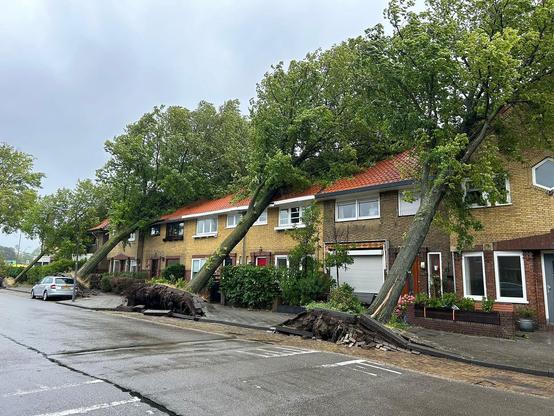
In the Netherlands, the trees were leaned against the houses to prevent them from falling down during the storm.
Photo credits: Storm damage in Harlem by Pieter Perquin
PS: Because I was asked a lot: No, they didn't really do that on purpose, but I was making a little fun about it because it looks as if they did ...
 Jason Evangelho 🐧🎒
 BBC Research & Development
 hannah aubry
 Gemma 👽
 Fabio Manganiello
 Luke LeBrun
 Robert Lemke