Ksenija Bazdaric

14 Followers
31 Following
36 Posts
she/her; Editor in Chief of the European Science Editing , #EASE journal; https://ese.arphahub.com/#openscience #researchintegrity #psychology #sciencecommunication

Open peer review is explored by @ksenijab, Editor-in-Chief of the @EASE journal European Science Editing.

There are many variants, like open reports and opt-in open identities at PLOS ONE, reviewer discussion at Frontiers, open involvement, and post-publication peer review. Open review allows transparency, inclusiveness, and trust in journals. Attitudes vary by field (including being affected by its community size) and country.

🧵
#OpenPeerReview #PeerReview #OpenResearch #PUBMET2024

Article processing charges suppress the scholarship of doctoral students

https://ese.arphahub.com/article/124173/

Article processing charges suppress the scholarship of doctoral students

The open access movement has drastically reconfigured the financial burdens of scholarly publishing. Yet, the influence of a marketized scholarly publishing system on doctoral education remains unexplored. I reflect on my own PhD candidature to illustrate how article processing charges disempower doctoral candidates. I argue that the current open access publishing model unfairly advantages candidates with personal, familial and/or institutional wealth. The inequalities imposed on doctoral students by our sectors’ current publishing habits ultimately bias who will be paid to produce and safeguard knowledge in the future. Doctoral students can no longer be ignored in debates over open access publishing.

European Science Editing

We are very pleased to have been awarded the DOAJ Seal for our journal, European Science Editing.

The #DOAJ Seal is awarded to journals that demonstrate best practice in #OpenAccess publishing, including long-term preservation, use of persistent identifiers, discoverability, reuse policies, and authors' rights.

Congratulations to the Editor-in-Chief, @ksenijab, and all her Editorial team.

#EuropeanScienceEditing #DirectoryofOpenAccessJournals #JournalPublication #JournalEditing

we need to collaborate not compete in order to beat publication crisis says @matthodgkinson at pubmet conference

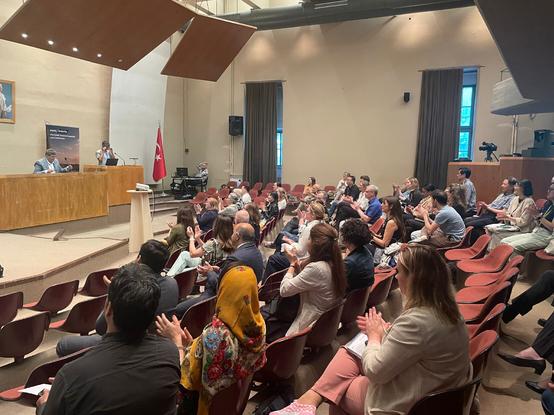
The EASE conference hall audience at ITU in Istanbul. We're also being joined online by EASE members from around the world.

Photo via https://twitter.com/EASEeditors/status/1664284499218399237

#EASEevents #Conference2023 #Istanbul

EASE on Twitter

“#Session1, focusing on the topic of "what does good science publishing look like?" by Joan Marsh is currently underway. This particular session is of great significance to the academic community as it broadens our understanding of what constitutes a quality scientific publication”

Twitter
Inclusion in clinical research: cross-sectional study assessing potential barriers to informed consent in randomized controlled trials published in top general and internal medical journals

Objective: Racial and ethnic minority groups are underrepresented in clinical research. Racially diverse individuals that speak languages other than English or have limited proficiency may be hindered from participation in randomized clinical trials (RCTs) through eligibility ...

Gender balance and geographical diversity in editorial boards of Geochimica et Cosmochimica Acta and Chemical Geology in Eur Sci Ed at: https://ese.arphahub.com/article/89470/ #gender #diversity #equality #journaleditors #geochemistry @openscience #globalsouth #globalnorth
Gender balance and geographical diversity in editorial boards of Geochimica et Cosmochimica Acta and Chemical Geology

Background: Members of editorial boards of academic journals are often considered gatekeepers of knowledge and role models for the academic community. Editorial boards should be sufficiently diverse in the background of their members to facilitate publishing manuscripts representing a wide range of research paradigms, methods, and cultural perspectives.Objectives: To critically evaluate changes in the representation of binary gender and geographic diversity over time on the editorial boards of Chemical Geology and Geochimica et Cosmochimica Acta, flagship geochemistry journals, respectively, from the European Association of Geochemistry and the Geochemical Society – Meteoritical Society partnership.Methods: The composition of editorial boards was ascertained as given in the first issue of each year, over 1965–2021 for Chemical Geology and 1950–2021 for Geochimica et Cosmochimica Acta, and members of the editorial boards were coded for their country of affiliation (the country of origin may have been different) and for their binary gender.Results: Gender parity, limited to men and women, and the number of countries of affiliation increased steadily between the late 1980s and 2021. However, the geographic distribution remained dominated by affiliations from North America and Western Europe. The editor-in-chief or board of editors had a significant impact on the diversity of the editorial boards, and both geographic and gender diversity may evolve with nearly every newly appointed editor. However, the persistently substantial under-representation on editorial boards of affiliations outside North America and Europe is of concern and needs to be the focus of active recruitment and ongoing monitoring. This approach will ensure that traditionally low geographic diversity is increased and maintained in the future.Conclusion: Improving diversity and inclusion of editorial boards of academic journals and strengthening journal and disciplinary reputations are mutually reinforcing. Instituting a rotating editorship with emphasis on embedding broader geographic networks and more equitable international recruitment could ensure sustained and wider geographic representation and gender balance of editorial boards and promote originality and quality of published research, representing our global communities.

European Science Editing

We recognize the value of negative/null results and want to celebrate them by awarding authors who share their negative/null results as #prerprints!

Enter the competition and win $1,000! 🏆
❗️ Deadline: 14 January 2023.
Learn more:👇
https://buff.ly/3TXL7NC

ASAPbio competition: Make your negative result a preprint winner - ASAPbio

Do you have data buried in your lab notebooks that did not prove your hypothesis but would be useful to your scientific field? Or perhaps inconclusive results due to technological limitations which would be relevant for others to avoid duplicating efforts?  Preprints allow sharing of all research works in a flexible format; this includes negative…

ASAPbio

On Monday 12th December, EASE launched its new EASE Awards programme with five categories of awards:

Best European Science Editing Papers
Best Conference Poster (at the 16th EASE Confernce in Valencia)
Community Contributor
Rising Star
Pau Award

Details of the Awards, prize winners, and a link to the video of the event on the youtube channel is now live on the EASE website, including details of what is in store for the Awards next year.

https://ease.org.uk/about-us/ease-awards/

EASE Awards - EASE

EASE
According to our editor Tom Lang there ate 12 types of abstracts https://ese.arphahub.com/article/85616/ #sciencecommunication #medicalwriting #reporting @dnjournals
Scientific abstracts: Texts, contexts, and subtexts

In their 4000-year history, abstracts have taken several forms and represented a variety of documents. The scientific journal emerged in the 1600s and gave rise to what would become the modern scientific abstract. Here, I describe the contexts in which abstracts evolved, address the subtexts of opinions about their purpose, and review the texts of 12 kinds of abstracts. For most readers, articles do not exist beyond abstracts. However, the quality of abstracts is often poor. Inaccuracies are common, serious, widespread, and long-standing. Abstracts should inform only the choice of what to read and never what to do.

European Science Editing