In this Correspondence article in European Science Editing, Joshua Wang discusses how retractions do not just correct the scientific record, but serve as crucial datapoints that inform meta-research and research education.

Read it in the journal now: https://doi.org/10.3897/ese.2024.e140235

#Retractions #MetaResearch #EuropeanScienceEditing #JournalEditing #PublicationEthics
The insights lost from ambiguous retraction notices


European Science Editing

@bahar and Mario Malički have just published their structured peer review checklist in European Science Editing. lt helps researchers to ensure they provide thorough and constructive feedback for each section of a manuscript they review. They also suggest how journal editors and publishers can leverage the checklist throughout their peer review process.

https://ese.arphahub.com/article/137675/

#PeerReview #JournalEditing #EuropeanScienceEditing #AcademicPublishing #ScholarlyPublishing #Checklists #Elsevier

Structured peer review: implementation and checklist development

To address the low overlap between reviewer comments and the publication recommendations they make, as well as to suggest guidance on what kind of peer review report would benefit journals and editors the most, we introduced structured peer review to Elsevier journals and analyzed its effect in our June 2024 paper: peerj.com/articles/17514/ . To further promote the implementation of the structured peer review process and help reviewers prepare thorough review reports, in this paper, we present our set of structured peer review questions in a checklist format.

European Science Editing

In this new Correspondence article in European Science Editing, Joshua Wang discusses how retractions do not just correct the scientific record, but serve as crucial datapoints that inform meta-research and research education.

Read it in the journal now:
https://doi.org/10.3897/ese.2024.e140235

#Retractions #MetaResearch #EuropeanScienceEditing #JournalEditing #PublicationEthics
The insights lost from ambiguous retraction notices


European Science Editing

What are the features of predatory journal lists?

A recent Review in European Science Editing compares and contrasts the lists to better understand how useful each list is at characterizing unethical journal activity, and the value of the information they provide in helping authors and the academic community to easily identify such journals.

https://ese.arphahub.com/article/118119/

#AcademicJournals #PredatoryJournals #BeallsList #Cabells #Kscien #EuropeanScienceEditing #PredatoryPublishing #PublicationEthics

Lists of predatory journals and publishers: a review for future refinement

Although predatory publishers are increasingly recognized, universally accepted criteria for defining predatory journals are lacking. These journals challenge the scholarly community by blurring the line between legitimate and questionable publishing practices. Several lists and reports of predatory journals have been published, which offer valuable insights; however, they are not devoid of criticism. Beall’s list, although criticized for its inclusion criteria, is currently managed anony-mously and updated infrequently. Cabells’ list uses an extensive array of inclusion criteria, some of which are similar to those used in Beall’s list. Several of these cri-teria are redundant and fail to detect predatory practices, and using all of them in evaluating a journal is seldom practicable. Kscien’s list has emerged as a promising alternative for identifying predatory publishers or journals. However, it requires refinement, potentially through creating a distinct list supported by unequivocal evidence, such as accepting a fake manuscript (ascertained through a sting opera-tion). The present review seeks to catalyze research on identifying predatory jour-nals and publishers by comparing existing lists and suggesting new techniques for detecting predatory practices.

European Science Editing

Article processing charges (APCs) for open access publishing unfairly advantage those with personal, familial, and/or institutional wealth, argues Joshua Wang at Queensland University of Technology, Brisbane.

In this Viewpoint in European Science Editing, Wang says the APC model suppresses the scholarship of PhD students, and disempowers them, and this must be addressed.

https://ese.arphahub.com/article/124173/

#PhDLife #OpenAccess #EuropeanScienceEditing #AcademicPublishing #EquityInOpenAccess #OApublishing

Article processing charges suppress the scholarship of doctoral students

The open access movement has drastically reconfigured the financial burdens of scholarly publishing. Yet, the influence of a marketized scholarly publishing system on doctoral education remains unexplored. I reflect on my own PhD candidature to illustrate how article processing charges disempower doctoral candidates. I argue that the current open access publishing model unfairly advantages candidates with personal, familial and/or institutional wealth. The inequalities imposed on doctoral students by our sectors’ current publishing habits ultimately bias who will be paid to produce and safeguard knowledge in the future. Doctoral students can no longer be ignored in debates over open access publishing.

European Science Editing

A novel metric could indicate a journal's editorial standards, integrity, and responsiveness on ethical issues.

In this Review in European Science Editing, Bor Luen Tang of National University of Singapore proposes a score of editorial team efficiency in handling pre- and post-publication issues, highlighting a previously unquantified value to uphold the integrity of published research.
https://ese.arphahub.com/articles.php?id=120611&journal_name=ese

#JournalEditing #PublicationEthics #EuropeanScienceEditing #ResearchIntegrity
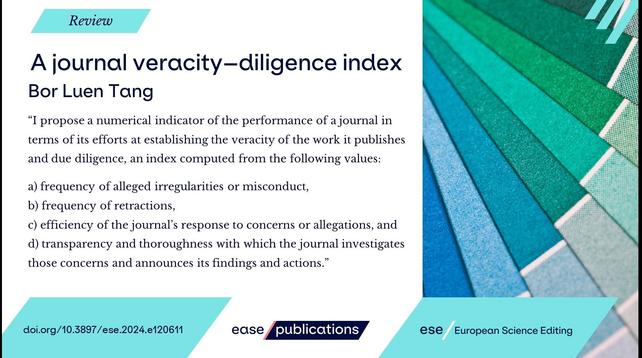
A journal veracity–diligence index

Inaccuracies, false information, and fraudulent work in scientific publications could cause indirect harm, lead to significant negative socioeconomic impacts, and erode public trust in science. Journals – and publishers – play an essential role as gate-keepers in ensuring the veracity of published scientific literature. However, beyond corporate pride and integrity, there is usually no legal obligation or formal regulatory requirement for journals to ensure the veracity of the work they publish or be efficient and transparent in any investigative proceedings. Here, I propose a numerical indicator of the performance of a journal in terms of its efforts at establishing the veracity of the work it publishes and due diligence, an index computed from the following values: a) frequency of alleged irregularities or misconduct, b) frequency of retractions, c) efficiency of the journal’s response to concerns or allegations, and d) transparency and thoroughness with which the journal investigates those concerns and announces its findings and actions.

European Science Editing

What are the features of predatory journal lists?

Mainly examining lists from Beall, Cabells, & Kscien, a review in European Science Editing looks at how useful each list is at defining unethical journal activity and how they help spot such journals. The review includes practical recommendations to bridge gaps in the lists and make their assessment more robust.
https://doi.org/10.3897/ese.2024.e118119
#AcademicJournals #PredatoryJournals #BeallsList #Cabells #Kscien #EuropeanScienceEditing #PredatoryPublishing

Lists of predatory journals and publishers: a review for future refinement

Although predatory publishers are increasingly recognized, universally accepted criteria for defining predatory journals are lacking. These journals challenge the scholarly community by blurring the line between legitimate and questionable publishing practices. Several lists and reports of predatory journals have been published, which offer valuable insights; however, they are not devoid of criticism. Beall’s list, although criticized for its inclusion criteria, is currently managed anony-mously and updated infrequently. Cabells’ list uses an extensive array of inclusion criteria, some of which are similar to those used in Beall’s list. Several of these cri-teria are redundant and fail to detect predatory practices, and using all of them in evaluating a journal is seldom practicable. Kscien’s list has emerged as a promising alternative for identifying predatory publishers or journals. However, it requires refinement, potentially through creating a distinct list supported by unequivocal evidence, such as accepting a fake manuscript (ascertained through a sting opera-tion). The present review seeks to catalyze research on identifying predatory jour-nals and publishers by comparing existing lists and suggesting new techniques for detecting predatory practices.

European Science Editing

Integrating Indonesian research institutions into The National Research and Innovation Agency of Indonesia (BRIN) was linked to an increase in the growth of research publications and the number of reputable journals they appeared in.

New bibliometric study published in the EASE journal, European Science Editing, by Setiowiji Handoyo, Poppy Indah Dwi Prastiti, & Iwan Ridwan Stiaji: https://doi.org/10.3897/ese.2024.e118015

#Bibliometrics #Indonesia #EuropeanScienceEditing #ResearchAssessment #JournalPublication

Bibliometric analysis of publications trends in Indonesian research institutions: A comparison of pre-integration (2015–2021) and post-integration (2022–2023) periods

Background: Institutional transformation – integrating many disparate research insti-tutes into the National Research and Innovation Agency (BRIN, for Badan Riset dan Inovasi Nasional) – was the most significant reform in the history of institutional gov-ernance in Indonesia. This integration policy aims to enable the state to strengthen the national research and innovation ecosystem and improve the performance of research institutions, one indicator of which is their output of publications reporting the results of research. Objectives: To compare the published output of research institutes before and after the integration of research institutions into BRIN. Methods: Relevant data retrieved through Scopus on 24 December 2023 and span-ning the period between 2015 and 2023 were analysed using Microsoft Excel, and col-laboration networks of authors and of countries were constructed using VOSviewer and examined for co-authors in different countries collaborating with first authors in Indonesia. Results: The number of publications increased annually over the period 2015–2023. However, the annual rate of growth after (2021–2023) the integration of research institutions was higher (36%) than that before (2015–2021) the integration (30%). Conference papers (51%) dominated the pre-integration era, whereas articles (57%) dominated the post-integration era, and the number of reputable journals in which the research was published was greater after the integration. Conclusions: The period after the integration of research institutions saw enhanced research output in terms of the number of research publications, annual rate of growth in that number, and the number of reputable journals in which the publica-tions appeared.

European Science Editing

An engaged journal editor adds to the peer review process: correspondence in European Science Editing from Gina Joubert.

The article gives insights into the ESE reviewing and decision process, framing the experience within the framework of COPE and ICMJE guidance, and the best practices for editorial performance proposed by Sovacool et al. for giving feedback on submissions requiring revision.

https://doi.org/10.3897/ese.2024.e119537

#EuropeanScienceEditing #JournalEditing #PeerReview #EASEPublications

Editorial input on manuscript review feedback

Not applicable.

European Science Editing
New in European Science Editing: Nearly 1/2 of health sciences journals in South Africa don't mention statistics in their instructions for authors or make cursory references. Gina Joubert concludes that editors & publishers must give more detail on reporting requirements for statistical methods in quantitative research articles.
https://doi.org/10.3897/ese.2024.e114734
#EuropeanScienceEditing #EASEpublications #HealthStatistics #JournalPublication #ReportingGuidelines #StatisticalMethods #SouthAfrica #Statistics
Reporting and presentation of statistical analyses: instructions for authors of health sciences journals based in South Africa

Background: Statistical analyses are a key component of quantitative research in health sciences. Objectives: To review the instructions for authors on reporting and presentation of statistical methods by all health sciences journals based in South Africa. Methods: Health sciences journals based in South Africa that publish original quanti-tative research articles were identified using three sources, namely the list of accred-ited South African journals compiled by the South African Department of Higher Education and Training in 2022, relevant journals covered in Scopus, and web pages of major health sciences publishers in South Africa. The list was cross-checked against the listing of journals in Sabinet, an online database covering South Africa, under the category ‘Collection: Medicine and Health’. The instructions for authors given by the journals were accessed through their websites. The form for recording data was based on items listed in the ‘Statistical Analyses and Methods in the Published Literature’ (SAMPL) guidelines. Results: All except one of the 52 journals could be located online. Of the 51, 13 (25%) made no mention of statistics in their instructions, and 11 (22%) made only a gen-eral statement regarding statistical content with no further guidance. The statistical item most frequently mentioned was the P value (45% of journals), whereas the rest of the items appeared in the instructions of 20% or fewer journals. Nine journals (18%) referred to the EQUATOR guidelines, mainly CONSORT (10%). Conclusion: Nearly half of the health sciences journals based in South Africa either did not mention statistics at all in their instructions for authors or made only a cur-sory reference to statistics. The study thus emphasizes that these journals, in their instructions for authors, need to cover in greater detail the reporting and presenta-tion of statistical methods in articles reporting quantitative research.

European Science Editing