On the "aha moment"
As a scientist, I've had the privilege to experience the big "aha" moment a handful of times. Each time, I was struggling to make sense of something and the "aha experience" happened the moment I figured it out. What's remarkable about those moments is how vividly I remember the details of the moment: the color of the paint on the walls; how the room was configured; if I was talking to someone else, exactly where they were sitting ...
I've had other equally compelling findings emerge from my research program that I did not experience in the same way, because the "aha" was figured out by someone else (like a PhD student) and later explained to me. I was as befuddled by those questions, as curious to know their answers and as excited to see those answers figured out! However, I did not experience them in the same way insofar as today I can tell you the answers but not much about the moment I first learned them.
I anticipate that this experience is something universal (and not unique to science). Eve Marder discusses it as something to be cherished (and I agree):
https://elifesciences.org/articles/80711
Does this description of the "aha moment" (also called "Eureka") resonate with you?
@bwyble @DrYohanJohn @christakou
So what do we do? I guess we begin by explicitly stating what those assumptions are for swaths of the field so we can discuss? A bit like the spirit of this very controversial article?
https://www.cell.com/trends/cognitive-sciences/fulltext/S1364-6613(22)00332-1
Big Quantum Bio Meeting featuring Google's Hartmut Neven exceptionally MOVED to Tue, Feb 14, 7am PST in the same zoom room, 617 710 5261!
Hartmut will talk about: Google's hardware efforts towards building a quantum computer + progress on some flavors of quantum computing algorithm + deep questions about how physics intersects with biology, e.g., quantum resources in biology as related to neurological processes.
Exciting! Come learn about #QuantumBiology
@kcarruthers see Stage 2
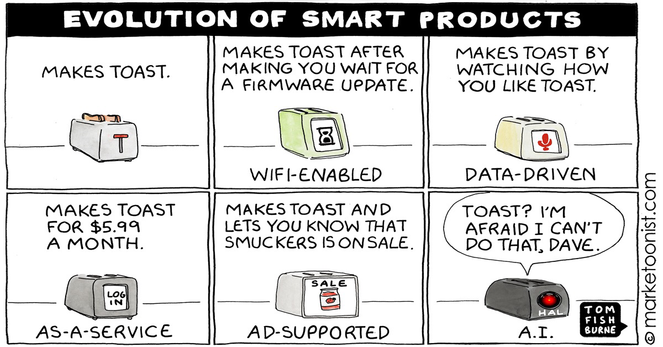
©Marketoonist
@NeuroSchnell @schoppik @NicoleCRust @albertcardona
Interesting way of putting this. It is something one hears over and over again, so I guess people really mean it, despite the fact that the evidence seems to show the contrary: the more journals filter and select, the worse the science published there gets:
https://www.frontiersin.org/articles/10.3389/fnhum.2018.00037/full
I have an hypothesis why intention and results go in opposite directions, but I'd like to know what your inside perspective is?
In which journal a scientist publishes is considered one of the most crucial factors determining their career. The underlying common assumption is that only the best scientists manage to publish in a highly selective tier of the most prestigious journals. However, data from several lines of evidence suggest that the methodological quality of scientific experiments does not increase with increasing rank of the journal. On the contrary, an accumulating body of evidence suggests the inverse: methodological quality and, consequently, reliability of published research works in several fields may be decreasing with increasing journal rank. The data supporting these conclusions circumvent confounding factors such as increased readership and scrutiny for these journals, focusing instead on quantifiable indicators of methodological soundness in the published literature, relying on, in part, semi-automated data extraction from often thousands of publications at a time. With the accumulating evidence over the last decade grew the realization that the very existence of scholarly journals, due to their inherent hierarchy, constitutes one of the major threats to publicly funded science: hiring, promoting and funding scientists who publish unreliable science eventually erodes public trust in science.