Curious if I know anyone who has read this or knows of its chapters' authors.
Cognitive Ontology
Taxonomic Practices in the Mind-Brain Sciences
#cognitivescience #psychology #ontology #philosophy #brain #mind #taxonomy
| jesparent.com | www.jesparent.com |
| JOPRO | www.jopro.org |
Curious if I know anyone who has read this or knows of its chapters' authors.
Cognitive Ontology
Taxonomic Practices in the Mind-Brain Sciences
#cognitivescience #psychology #ontology #philosophy #brain #mind #taxonomy
Super cool. I'd say topology is the royal road to understanding the implications of global properties.
https://www.quantamagazine.org/how-quantum-physics-describes-earths-weather-patterns-20230718/
"To paraphrase the great physicist Richard Feynman, it is safe to say that nobody understands causation. But unlike quantum physics, causation is not a useful calculating device yielding astoundingly accurate predictions, and those who wish to use causal reasoning for any actual purpose do not have the luxury of following Feynman’s injunction to “shut up and calculate”."

We need better models (in cogsci, in psych, in human arenas) about this. (I'm working on some). There needs to be language for there to be literacy, and there needs to be artefacts in that language for the literacy to have relevance in the society. Many people are doing the work, and I'm excited for it. But the actual structure and means for these things will take care and effort to build properly.
#theory #trauma #healing #cogsci #psychology #philosophy #innovation
I often hear that category theory (and/or homotopy type theory) can serve as an alternative to set theory as a foundation for mathematical thinking.
How mainstream is this idea among mathematicians and philosophers of mathematics?
Perhaps @johncarlosbaez can weigh in?
 Michael Levin
 Yohan John 🤖🧠
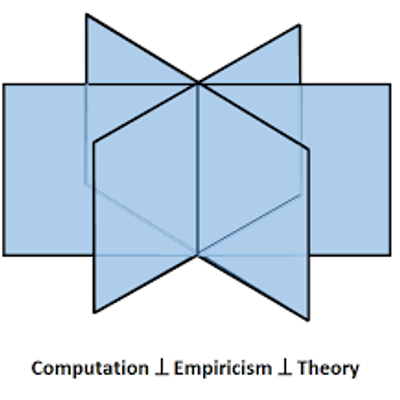 Orthogonal Lab
 Iris van Rooij 💭