68 Followers
63 Following
20 Posts
Senior lecturer in Learning & Teaching. Interested in Open Practices, Data and Policy in Education.
New #OER alert! We have created this set of cards to support fellow mentors in managing difficult conversations and supporting their peers in gaining any level of fellowship with advance HE - Atenas, J., Lessner Lištiaková, I., Copping, M., & Ortiz Granero, C. M. (2025). Mentoring Card Game: Supporting Mentors with Personality Traits Cards and the PSF 2023. University of Suffolk. https://doi.org/10.5281/zenodo.15862376 the cards were created thanks to @bryanmmathers
Mentoring Card Game: Supporting Mentors with Personality Traits Cards and the PSF 2023

This mentoring card game is a dynamic, role-play-based activity designed to enhance the practical and reflective skills of academic mentors, particularly in relation to the UK Professional Standards Framework (PSF 2023). Through conversations, it aims at simulates real-life mentoring scenarios that help participants explore how to effectively support colleagues seeking HEA Fellowship at any level. The game encourages critical engagement with the PSF dimensions while developing mentoring strategies that accommodate a variety of personality traits and communication challenges. Played in pairs, each round lasts approximately 8–10 minutes and begins with one person acting as the Mentor and the other as the Mentee. The Mentee draws a card that defines a particular personality type—ranging from neutral ("Be Yourself") to more challenging traits like “The Know-it-All” or “The Perfectionist”—and acts accordingly during the conversation. Meanwhile, the Mentor draws a PSF Dimension Card (linked to Areas of Activity, Core Knowledge, or Professional Values), and must navigate the interaction by demonstrating understanding of that dimension while effectively supporting the Mentee’s development. Following the discussion, the pair debriefs together to reflect on the strategies used, challenges faced, and how the PSF was integrated. Roles are then switched, and partners rotate for the next round, ensuring diverse interactions. Facilitators play a crucial role in preparing the activity. This includes assembling and printing the card decks and ensuring that participants have access to the PSF 2023 framework, either in print or digitally. Participants are briefed on the purpose of the game, which is to practice mentoring within a safe, supportive, and reflective environment, helping them build confidence and skill in handling complex interpersonal situations relevant to academic development. After multiple rounds, a group reflection is facilitated to identify emerging patterns, share insights about mentoring challenging personalities, and evaluate the relevance of the PSF in mentoring conversations. Participants also consider how this experience can support their own Fellowship applications or academic practice portfolios.This flexible tool is especially valuable for academic developers but can be adapted for broader contexts such as tutoring training, clinical mentoring, peer coaching, and leadership development. Customisation is encouraged, and feedback is welcomed to refine the resource for diverse institutional needs. These cards were created using Remixer (https://remixer.visualthinkery.com/info), a tool by Bryan Mathers at Visual Thinkery, and are an Open Educational Resource (OER) designed to support mentoring in higher education and engagement with the UK Professional Standards Framework (PSF 2023). 

Zenodo
silicon valley be like :

what if your doorbell sold your personal data
what if your taxi sold your personal data
what if your hotel sold your personal data
what if your alarm clock sold your personal data
what if your watch sold your personal data
what if your walkman sold your personal data
what if your

🌱 Everything Starts With a Seed…

And so does inspiring open education!

🏅 Nominations for the 2025 Open Education Awards for Excellence are OPEN! Nominate the open people, resources, or practices that have helped you or your community grow. 🌍

Self-nominations are welcome. Global entries encouraged.
🗓️ Deadline: July 21
🔗 https://bit.ly/3ZlXqca

#OEAwards25 #OpenEducation #Nominate #EverythingStartsWithASeed

I just started preparing for my teaching next year, and I treated myself with some books, including these two I really wanted to own. I aspire to engage with my upcoming PgCAP cohort on the impact of technology in education and democracy from a feminist lens that acknowledges the current world situation beyond the impact in learners but in humanity and the planet and to do so, through critical voices and the work of women, to recalibrate my pedagogy using a Kaleidoscope of views
Call for case studies: Responsible AI for Enhancing Digital Cooperation in the Mediterranean Higher Education. Deadline May 18th, 2025 https://www.uni-med.net/news/call-for-case-studies-ai/ @oeglobal @mahabali @javisamo @Ammienoot
Call for case studies: Responsible AI for Enhancing Digital Cooperation in the Mediterranean Higher Education. Deadline May 18th, 2025 | UNIMED

How is AI shaping teaching and learning in Mediterranean higher education?

UNIMED
Call for case studies: Responsible AI for Enhancing Digital Cooperation in the Mediterranean Higher Education. Deadline May 18th, 2025 https://www.uni-med.net/news/call-for-case-studies-ai/ @oeglobal @mahabali @javisamo @Ammienoot
Call for case studies: Responsible AI for Enhancing Digital Cooperation in the Mediterranean Higher Education. Deadline May 18th, 2025 | UNIMED

How is AI shaping teaching and learning in Mediterranean higher education?

UNIMED
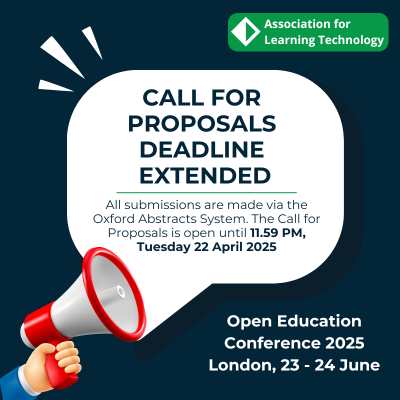
The deadline for submitting proposals to the highly anticipated #OER25 Conference has been extended. Don’t miss the chance to contribute to this important conversation around Open Education and AI in the age of populism. If you have innovative ideas, groundbreaking projects, or impactful research, now is the perfect time to showcase your work. The new deadline to submit proposals is 23:59, Tuesday 22 April 2025. https://buff.ly/vWy4J8y #altc #OER
#OER25 - Call for Proposals

The call for proposals is now open for OER25 - Speaking Truth to Power: Open Education and AI in the Age of Populism. This year's Open Education Conference will take place on 23-24 June in London at the Resource for London conference centre. All submissions are made via the Oxford Abstracts System.

Fresh out of the press: Critical and creative pedagogies for artificial intelligence and data literacy: an epistemic data justice approach for academic practice. Co authored by @jatenas @leohavemann and Chrissi Nerantzi - in this paper we offer guidance on employing open and creative methods for co-designing critical data and artificial intelligence (AI) literacy spaces and learning activities, rooted in the principles of Data Justice. https://journal.alt.ac.uk/index.php/rlt/article/view/3296
Critical and creative pedagogies for artificial intelligence and data literacy: an epistemic data justice approach for academic practice | Research in Learning Technology

Closing this academic year full of gratitude, it has been a great one, moved to a great school with supportive managers and colleagues, my class this year is amazing, got to work with incredible peers, wrote papers with people I admire, got invited to some international gigs, and my kid had a great transition into school, bought a house, and now getting a bit of rest @leohavemann @farrow @Eamon @Ammienoot and many more
New #openaccess publication: Towards AI Literacy: 101+ Creative and Critical Practices, Perspectives and Purposes
Co-edited by @sandra_abegglen
@chrissinerantzi @Toni_M_Arboleda
@jatenas @Chri5rowell @Marianna_Karats with lots of amazing contributions https://zenodo.org/records/11613520
Towards AI Literacy: 101+ Creative and Critical Practices, Perspectives and Purposes

“This collection of AI stories and examples in education exemplifies citizen science at its finest. It captures the authentic voices of individuals who are actively testing and expanding their AI literacy, sharing their experiences to support and inspire others. Through their contributions, they collectively advance our understanding and application of AI in educational settings, showcasing the true spirit of community-driven learning and innovation. Your feedback is encouraged; this story is only beginning".   Dr Margaret Korosec, Dean of Online and Digital Education, University of Leeds This is the second open crowdsourced collection by #creativeHE which presents creative and critical practices, perspective and purposes from educators, researchers and students between September 2023 and January 2024.  We are grateful for all 119 contributions from 22 countries: Argentina, Australia, Bangladesh, Brazil, Bangladesh, Canada, China, Egypt, France, Germany, Greece, Ireland, Israel, Italy, Mexico, Netherlands, Slovenia, South Africa, Spain, United Arab Emirates, United Kingdom, Uruguay. As the collection is made available under the Creative Commons License CC-BY-NC-SA licence, anybody can use the collection as open data to further interrogate the use of AI in Education. Please share any resulting outcomes with the editorial team and the wider community.  The collection has been generously supported by the Imagination Lab Foundation through the Playful Hybrid Higher Education project (https://playhybrid.education/) led by Sandra Abegglen and situated in the School of Architecture, Planning and Landscape at the University of Calgary. Thanks go also to #creativeHE of which we, the editors, are all part of and that has acted as supporter of the creative AI collections from the very beginning. The #creativeHE community hosts all calls and dissemination activities for the AI collections on their website: https://creativehecommunity.wordpress.com/ - A special thank you to Leonor Agüero Vivas for the beautiful design.- 

Zenodo