211 Followers
155 Following
146 Posts
Boosting cool things since last week.
Places 📌PNW-er living in Mississippi
I'm a professional aboutGIS, geology, cartography, conservation, science communication.
I'm a nerd aboutHandcrafts, art, design, reading, writing, long walks, camping, my dog.
The disclaimerNone of the views or opinions expressed here are representative of my employer's views.

Had to explain to some folks how--even they are accurate--you don't want to use certain place names because they are racial epithets/offensive. (there was a wildfire and the nearest landmark was an offensive use, had to delete it off my bot and also ask folks to change it elsewhere). Article in the Christian Science Monitor on this from 2019. The hazards of automation using GIS landmarks. #gis #geography #maps #mapping
https://www.csmonitor.com/USA/Society/2019/0123/Negro-Mountain-Why-offensive-place-names-are-still-on-US-maps

Negro Mountain? Why offensive place names are still on US maps.

What’s in a name? When that name is Runaway Negro Creek, a lot of mythology, and racism, masquerading as history. Why crude names are still on the maps, and how some communities are seeking change.

The Christian Science Monitor
I love the Qin (2007) flow accumulation algorithm in high-relief #topography.
#hydrology #GIS #GISChat #geospatial #geomatics
🛑 Woah...let's not get all crazy now. #GIS
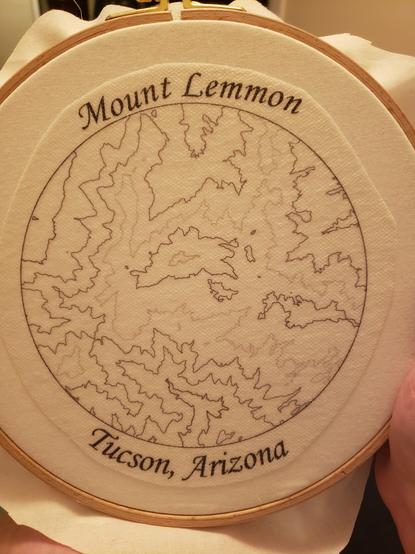
Here's a little embroidery map I'm working on for my brother and sister-in-law. I only had to filter the contour lines, so not much actual #GIS work here. 😅
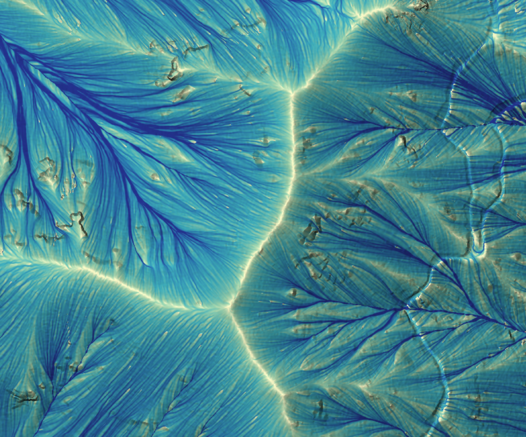
Jouer avec les données d’altimétrie des lits des cours d’eau est mon passe-temps favori du moment. J’ai poussé le vice jusqu’à les transposer sur papier en utilisant le procédé du cyanotype. Tellement fan de ce bleu de Prusse #cartes #gischat #printing
Not responsible
Mt. Rainier looking snazzy on my flight out of Seattle yesterday.

🚨 New #preprint alert!

Using #Landsat imagery and #MachineLearning tools, we estimate forest biomass across New York State from 1990 - 2019. These #maps will help us quantify how much carbon is stored in forests across the state, how that's changed in 30 years, and how we can expect that to change into the future.

Free to read at https://arxiv.org/abs/2304.02632

A very fun project, lead by Lucas Johnson and with Madeline Desrochers and Colin Beier!

#gischat #ecology #remotesensing

Mapping historical forest biomass for stock-change assessments at parcel to landscape scales

Understanding historical forest dynamics, specifically changes in forest biomass and carbon stocks, has become critical for assessing current forest climate benefits and projecting future benefits under various policy, regulatory, and stewardship scenarios. Carbon accounting frameworks based exclusively on national forest inventories are limited to broad-scale estimates, but model-based approaches that combine these inventories with remotely sensed data can yield contiguous fine-resolution maps of forest biomass and carbon stocks across landscapes over time. Here we describe a fundamental step in building a map-based stock-change framework: mapping historical forest biomass at fine temporal and spatial resolution (annual, 30m) across all of New York State (USA) from 1990 to 2019, using freely available data and open-source tools. Using Landsat imagery, US Forest Service Forest Inventory and Analysis (FIA) data, and off-the-shelf LiDAR collections we developed three modeling approaches for mapping historical forest aboveground biomass (AGB): training on FIA plot-level AGB estimates (direct), training on LiDAR-derived AGB maps (indirect), and an ensemble averaging predictions from the direct and indirect models. Model prediction surfaces (maps) were tested against FIA estimates at multiple scales. All three approaches produced viable outputs, yet tradeoffs were evident in terms of model complexity, map accuracy, saturation, and fine-scale pattern representation. The resulting map products can help identify where, when, and how forest carbon stocks are changing as a result of both anthropogenic and natural drivers alike. These products can thus serve as inputs to a wide range of applications including stock-change assessments, monitoring reporting and verification frameworks, and prioritizing parcels for protection or enrollment in improved management programs.

arXiv.org

Seeing how happy my dog is at doggy daycare and boarding makes me worry that I ruined his social life by adopting him from the shelter...

...but I think he knows there are some perks to having a home.

Absolutely the best Acknowledgments section of a paper I’ve read. From https://arxiv.org/abs/2302.03988 #astrodon / h/t @playingwithdust
On Cosmological Low Entropy After the Big Bang: Universal Expansion and Nucleosynthesis

We investigate the sensitivity of a universe's nuclear entropy after Big Bang nucleosynthesis (BBN) to variations in both the baryon-to-photon ratio and the temporal evolution of cosmological expansion. Specifically, we construct counterfactual cosmologies to quantify the degree by which these two parameters must vary from those in our Universe before we observe a substantial change in the degree of fusion, and thus nuclear entropy, during BBN. We find that, while the post-BBN nuclear entropy is indeed linked to baryogenesis and the Universe's expansion history, the requirement of leftover light elements does not place strong constraints on the properties of these two cosmological processes.

arXiv.org