Honglin Bao

38 Followers
68 Following
12 Posts
web: www.hbao.info
Personal Pagehttps://www.hbao.info
Twitterhttps://twitter.com/HonglinB
and that concentration would increase via the feedback loop of researchers choosing highly cited works to read and citing them yet more (like the Matthew effect). However, the practice of rhetorical citing breaks this reinforcing loop by redistributing citations from the few elite-quality papers to a more diverse set that is rhetorically useful in persuading readers or reviewers (like supporting the citers' own claims) in a person-specific manner. #scienceofscience #status #quality #attention
and we show that, surprisingly, rhetorical citing benefits academic community health, deconcentrates attention, and makes it easier to displace incumbent ideas. The proximate explanation for the effect is that the quality of creative products, like papers, is hard to discern and people thus use heuristics to judge them. In a world with substantive citing only, citations and attention would be concentrated among the highest-status papers (quality, citation, etc.),
TL; DR: The scientific community generally discourages authors of research papers from citing papers that did not influence them because such "rhetorical" citations are assumed to degrade the literature and incentives for good work. Intuitively, a world where authors cite only substantively appears attractive. We evaluate this intuition by utilizing agent-based models to construct a counterfactual world with substantive citing only,

New preprint (provocation?)

πŸ“œ"𝐃𝐨 'π›πšπ' 𝐜𝐒𝐭𝐚𝐭𝐒𝐨𝐧𝐬 𝐑𝐚𝐯𝐞 '𝐠𝐨𝐨𝐝' 𝐞𝐟𝐟𝐞𝐜𝐭𝐬?"πŸ“œ
with Misha Teplitskiy
https://arxiv.org/abs/2304.06190
Quick explainerπŸ‘‡ https://twitter.com/HonglinB/status/1648382310155448320
When assessing the pros/cons of a policy, behavior, or norm, one compelling approach is to imagine a counterfactual world without it. This exercise reveals that even well-intentioned norms may not always result in positive outcomes #science #innovation #complexsystems #AgentBasedModels #citation #scientometrics #heuristics #mattheweffect

Do "bad" citations have "good" effects?

The scientific community generally discourages authors of research papers from citing papers that did not influence them because such "rhetorical" citations are assumed to degrade the literature and incentives for good work. Intuitively, a world where authors cite only substantively appears attractive. We argue that manding substantive citing may have underappreciated consequences on the allocation of attention and dynamism. We develop a novel agent-based model in which agents cite substantively and rhetorically. Agents first select papers to read based on their expected quality, read them and observe their actual quality, become influenced by those that are sufficiently good, and substantively cite them. Next, agents fill any remaining slots in the reference lists with papers that support their claims, regardless of whether they were actually influential. By turning rhetorical citing on-and-off, we find that rhetorical citing increases the correlation between quality and citations, increases citation churn, and reduces citation inequality. This occurs because rhetorical citing redistributes some citations from a stable set of elite-quality papers to a more dynamic set with high-to-moderate quality and high rhetorical value. Increasing the size of reference lists, often seen as an undesirable trend, amplifies the effects. In sum, rhetorical citing helps deconcentrate attention and makes it easier to displace incumbent ideas, so whether it is indeed undesirable depends on the metrics used to judge desirability.

arXiv.org

RT @Amit_Goldenb
🚨JOB ALERT🚨 I am looking for a postdoc to work on questions related to technology & emotions at @D3Harvard,@HarvardHBS.

An ideal candidate:
1. Phd in Psych/CS/OB/engin.
2. Proficient in Comp. Soc. Sci., esp. NLP!

Please share and DM for questions!
https://academicpositions.harvard.edu/postings/12218

Postdoctoral Fellow- Digital Emotions Lab- Digital, Data, and Design Institute, Harvard University

The Digital Emotions Lab, led by Dr. Amit Goldenberg, is accepting applications for a Postdoctoral Fellowship. The lab's objective is to investigate the relationship between technology and emotions, as well as groups, with a focus on digital well-being. The primary criterion for acceptance is research excellence and alignment with the lab's proposed projects.The selected fellow will work primarily with Dr. Amit Goldenberg on initiatives related to using technology to assess and modify emotions. The position is best suited for applicants with experience in both designing and conducting experiments. We are particularly interested in candidates with demonstrated expertise in applying computational methods to social scientific queries, such as working with vast datasets, machine learning/AI, and especially Natural Language Processing. We also encourage applicants with a technical background (such as training in Computer Science or Engineering) and limited experimental experience to apply. We strongly encourage first-generation students and members of underrepresented groups to submit their applications. Join us today!The Digital, Data, and Design (D^3) Institute at Harvard is accepting applications for multiple The Digital, Data, and Design (D^3) Institute at Harvard is accepting applications for multiple postdoctoral fellows for academic year 2023-2024 to work on research activities at our research labs. D^3 launched in the summer of 2022 with 12 labs working on research at the intersection of academia and practice. For more information on D^3, please visit https://d3.harvard.edu.

We are safe but there are no words for this. Horrified that this is happening on my campus & in my community. My thoughts are with #MSU students and staff on campus.
@jennawneal keep safe and @zpneal!!!

After encountering a talk & paper (https://arxiv.org/abs/2006.15453) by @nwlandry I thought we could make my paper idea happen. I reached out to see if he'd be interested. He was, and took the lead from there.

So the paper:
1. takes a multiplex network & simulates a diffusion process over it, then
2. decomposes that network into its uniplex layers & runs a diffusion process over each of those separately, then
3. compares the union of simulations in (2) to the results in (1). [4/n]

The effect of heterogeneity on hypergraph contagion models

The dynamics of network social contagion processes such as opinion formation and epidemic spreading are often mediated by interactions between multiple nodes. Previous results have shown that these higher-order interactions can profoundly modify the dynamics of contagion processes, resulting in bistability, hysteresis, and explosive transitions. In this paper, we present and analyze a hyperdegree-based mean-field description of the dynamics of the SIS model on hypergraphs, i.e. networks with higher-order interactions, and illustrate its applicability with the example of a hypergraph where contagion is mediated by both links (pairwise interactions) and triangles (three-way interactions). We consider various models for the organization of link and triangle structure, and different mechanisms of higher-order contagion and healing. We find that explosive transitions can be suppressed by heterogeneity in the link degree distribution, when links and triangles are chosen independently, or when link and triangle connections are positively correlated when compared to the uncorrelated case. We verify these results with microscopic simulations of the contagion process and with analytic predictions derived from the mean-field model. Our results show that the structure of higher-order interactions can have important effects on contagion processes on hypergraphs.

arXiv.org
I know I’m really late to this game, but I suppose an #introduction is in order. Hi! I’m Austin van Loon, a PhD candidate in the soc dept at Stanford University. I like to say I study the cultural foundations of intergroup conflict. I primarily study this is in the context of US political polarization, in which I observe how Democrats and Republicans come to see the world differently as well as the consequences this has for behavior/attitude differentiation and for intergroup relations. 1/3
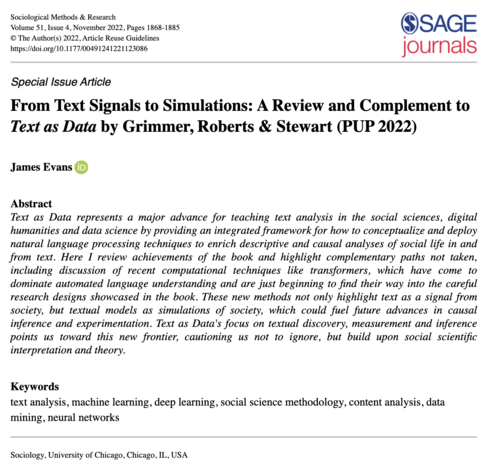
Finally, James Evans reviews Justin Grimmer, Molly Roberts, and Brandon Stewart's book β€œText as Data” (PUP 2022). In evaluating its important contributions, he stresses the untapped scientific potential of text produced (and not just analyzed) by large language models. This is particularly timely given the growing popularity of chatGPT and related text-generation AI. https://journals.sagepub.com/doi/abs/10.1177/00491241221123086 [18/19]