My application for a new home at hachyderm.io has been submitted. Let's see if my signup will be accepted. I'm excited.

goebelmeier has moved
@goebelmeier
- 24 Followers
- 795 Following
- 898 Posts
Please reach out to me at @goebelmeier
 Zeitzeuge _64
 Stephan G. Humer
Rant: Da sitzen sie, mit ihren fetten Ärschen, ihren Pensionsansprüchen, ihren geerbten Häusern, Kindern mit kostenlosem Studium, Reisefreiheit, etwas Kohle auf dem Konto, einer Infrastruktur, die immer noch besser als in 95% aller anderen Länder ist, mit sinkender Kriminalitätsrate - und sie wählen die AfD, weil sie die "Altparteien bestrafen" wollen. Infantiler gehts kaum. #DieAfDisteineSchandefürDeutschland
 Thomas Bee
Seit Jahren hab ich nun @evcc eher lesend im Einsatz, da die @homeassistant und #iobroker Addons für #sma nicht wirklich alle Infos hergeben.
Nun endlich eine gescheite Wallbox installiert und gleich mit der neuen (Beta) UI in evcc geadded.
Works like a charm mit mA Regelung.
Sponsoring und Konfetti waren da obligatorisch!
Best Project ever!
Next Steps:
2.Wallbox vor dem Haus, ebike Steckdose steuern, WAF auf 99,9 steigern 😁
 Lorenz Meyer ✅
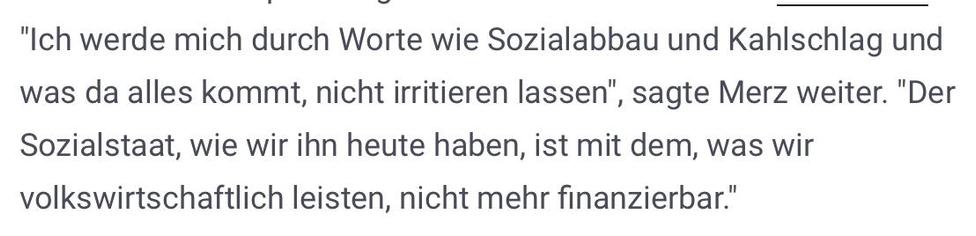
Bundeskanzler Friedrich Merz hat heute mal eben im Vorbeigehen seiner eigenen Bevölkerung den Krieg erklärt
 Tino Eberl
#HVO100 aus #Altspeiseöl ist laut einer neuen Studie im Auftrag der #DUH klimaschädlicher als fossiler #Diesel.
Durch Verlagerungseffekte steigt die Nachfrage nach #Palmöl, was zu #Regenwaldrodung und höheren Emissionen führt.
Die versprochenen 90 % #CO2-Ersparnis entpuppen sich als Täuschung. Die #DUH fordert einen Stopp der Förderung und einen klaren Fokus auf #Elektromobilität statt vermeintlich grüner Scheinlösungen.

Deutsche Umwelthilfe belegt: HVO100 aus Altspeiseöl klimaschädlicher als fossiler Diesel
• Neue Studie im Auftrag der DUH: HVO100 und „Bio“-Diesel aus Altspeiseöl in der Gesamtbetrachtung von der Produktion bis zum Verbrauch noch klimaschädlicher als fossiler Diesel• Versprechen von fast 90 Prozent CO2-Einsparung widerlegt, denn Verlagerungseffekte kurbeln klimaschädliche Palmölproduktion an• DUH fordert Bundesregierung auf, Einsatz und Förderung von HVO100 aus altem Speiseöl im Straßenverkehr zu stoppen
 Engineering Kiosk
Datacenter oder Besenkammer? Die IT im deutschen Mittelstand - Darüber sprechen wir in unserer neuesten Episode mit @pterlisten
Es geht u.a. um
• Technologiewandel: Virtualisierung, Wartungsfenster & Lizenzmodelle
• IT-Systemhaus als Plattform-Team, IT als Handwerk und Software-Entwicklung ohne Devs
• Security, Überzeugungsarbeit und Verständnis von Open Source
• Nachwuchs beim IT-Systemhaus
 Daniele Polencic
📩 A platform lead sent me this message: "We took away control of requests/limits from developers. We ended up with a mob of people with pitchforks at our doorstep."
Their intentions were solid: let developers focus on shipping features while platform engineers optimize the infrastructure—a classic separation of concerns.
Except it backfired spectacularly.
Now they're back at the drawing board, surveying other companies and - here's the key part - actually talking to their developers about what problems they face with resources and how to solve them together.
I bet they're not alone in this struggle. Resource management sits at the intersection of cost control, performance, and developer autonomy.
What's your biggest Kubernetes resource management headache?
🔥 CPU throttling/OOM kills
🎯 Getting devs to set requests/limits
📊 No idea what values to use
🤔 Other (share below)
💡 I've started a series of polls to understand how the community approaches requests and limits. I plan to share my findings in a report so you can use the data to decide the best strategy to tame requests and limits in Kubernetes. The time and effort for this work have been kindly sponsored by Stormforge, the creator of Optimize Live — an Autonomous Rightsizing for Kubernetes Workloads https://ku.bz/ZpZnH2blN
🔥 CPU throttling/OOM kills
🎯 Getting devs to set requests/limits
📊 No idea what values to use
🤔 Other (share below)
Poll ended at .

 Kube Architect
This tutorial teaches migrating an event-driven microservice architecture from Docker Compose to Kubernetes
It provides in-depth insights into stateful/stateless components, networking, storage, and service communication strategies

 Enno Park
Diese Rechenbeispiele Gasheizung vs Wärmepumpe oder Verbrenner vs EAuto kotzen mich so an. Es ist EGAL, ob es sich rechnet. WIR DÜRFEN NIX MEHR VERBRENNEN, wenn wir auf diesem Planeten halbwegs überleben wollen.