@gistinker

30 Followers
162 Following
880 Posts

Dear #history folks: I'm a professional mapmaker (https://somethingaboutmaps.com) and I make a lot of maps for academic press books.

Would you be interested in attending an online talk where I discuss:
• what cartographers are
• why your work might benefit from maps
• how to find a mapmaker
• what it's like to work with one
• how much it might cost
?

If there's enough interest, I might put something together this winter, so please boost this! If it happens, I'll announce it here and on my blog.

I came across this awesome website with (mostly) free to use silhouette images of different organisms - great for scientific publications and presentations! I really appreciate people making/uploading these images for others to use - will probably be using these on graphs in the future. The bee species available are a bit lacking, though.
https://www.phylopic.org/

#science #biology #entomology #bees #research #academia #ScienceResources

Thanks again to @nyalld for adding "chains" as a distance unit in #QGIS

Today I'm using it to find and fix errors in the survey journal for the town of Ulysses that dates from 1790...

Hydroflattening tutorial for LiDAR data using GRASS on Zenodo. Added appendix for Windows users to show how to create a mean ground layer from virtual point clouds in QGIS for input to r.hydro.flatten using the version of GRASS that comes with the QGIS standalone installer. QL2 or better LiDAR data works best.

Another option on Windows would be to use pdal directly to create a mean ground layer, but my pdal expertise does not extend that far, yet.

https://zenodo.org/records/17121433

A Tutorial on Modeling Water Voids in Airborne LiDAR Point Cloud Data to Hydroflatten Water Surfaces in Digital Elevation Models.

This is a step-by-step tutorial on how to use the GRASS r.hydro.flatten Addon to accurately model water surfaces from airborne LiDAR point cloud ground data, including creating a complete DEM .  Directions are given for using the tutorial in both Linux and Windows.

Zenodo
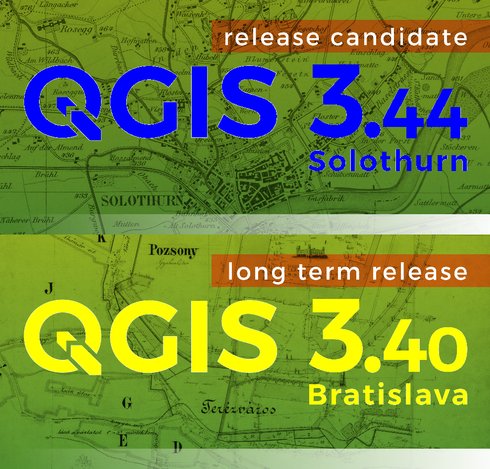
Linux and Windows packages of #QGIS release 3.40.8 "Bratislava" (LTR) and 3.44.0 "Solothurn" (RC) ready on https://qgis.org. Make maps not war!
QGIS 3D for Open Source Digital Twins | Lutra Consulting

Join our crowdfunding campaign to enhance QGIS 3D tools for open-source digital twins, bringing improved performance, features, and community-driven innovation.

On the other hand, if the polygon does not represent a single elevation value, You can convert the polygon to a "stream" by extracting the z values from the DTM for each Vertex and creating a surface from those points ,(masked to the polygon) then run GRASS GIS r.hand, https://grass.osgeo.org/grass-stable/manuals/addons/r.hand.html to flood to 2 meters around the polygon.
r.hand - GRASS GIS manual

r.hand: Performs Height Above Nearest Drainage (HAND) analysis and flood inundation mapping with HAND method.

Something I've been working on for a while. Deriving accurate water surfaces from a raster approach to LiDAR ground points. Excellent work by Dr. Petrosova on writing the GRASS addon, https://youtu.be/5L21o7IubIA
A Raster Method for Hydro Flattening Impounded Water Bodies

YouTube

The Klencke Atlas, first published in 1660 AD, is one of the world's largest atlases. Originating in The Netherlands, it is 1.75m tall by 1.9m wide when open, and so heavy the British Library needed six people to carry it.

It was presented by a consortium of Dutch sugar merchants, represented by Professor Johannes Klencke, to King Charles II of England in 1660 to mark the occasion of his Restoration to the throne.

@drthehistories #Atlas #Netherlands #history #Dutch #BritishLibrary

🎉 Exciting News from the GRASS Community! 🎉

The GRASS GIS PSC has been refreshed, welcoming new members. This marks a significant step in ensuring sustainable governance and fostering innovation in FOSS4G 🌍💡

👏 Let’s welcome the new PSC members and thank all outgoing members for their invaluable contributions. Your dedication has been instrumental in shaping GRASS GIS!

💪 Let’s continue to grow and support the GRASS GIS ecosystem 🌱

https://grass.osgeo.org/news/2024_10_11_refreshing_grass_psc/

@osgeo #foss4g #opensource

GRASS - Bringing advanced geospatial technologies to the world

GRASS is a powerful open-source geospatial processing engine that supports advanced modeling, time series analysis, and spatial data management.

GRASS