RE: https://mastodon.social/@galaxy_map/116580623711682627
Four hours left to vote. The split is more even than I had anticipated.

| Website | https://kevinjardine.dev |
| Posters | https://gruze.org/posters_2024 |
| Tip Jar | https://tiptopjar.com/kevinjardine |
| RedBubble shop | https://www.redbubble.com/people/Galaxy-Map/shop?asc=u |
RE: https://mastodon.social/@galaxy_map/116580623711682627
Four hours left to vote. The split is more even than I had anticipated.
DR4 is a big deal. The brighter stars will have half the parallax errors of DR3, astrometric parameters such as temperature, mass and radius, will be much improved, binary star data will be more reliable and for the first time ever, the release will include a catalog of Gaia-detected exoplanets.
Will Gaia DR4 distance and temperature estimates be reliable enough to detect spiral structure and provide the first detailed hints of what the Milky Way really looks like from the outside? MAYBE!
Here we go! Gaia DR4 now has an official release date: 2 December 2026.
If you have been following the Gaia Mission closely, you will know that DR4 has had a sliding release date, from the end of 2025, to mid 2026 to "end of 2026". But now the date is locked.
These are the things I love in #astronomy: you look at a dwarf planet in our solar system that’s smaller than Pluto and it passes right in front of a star, so you can see how the starlight is blocked as it moves across the star. And the unexpected happens: the light disappears more slowly than you would’ve thought, which could indicate that this little rock has some form of an atmosphere.
„A tiny world beyond Neptune has an atmosphere that shouldn't exist“: https://phys.org/news/2026-05-tiny-world-neptune-atmosphere-shouldnt.html#google_vignette
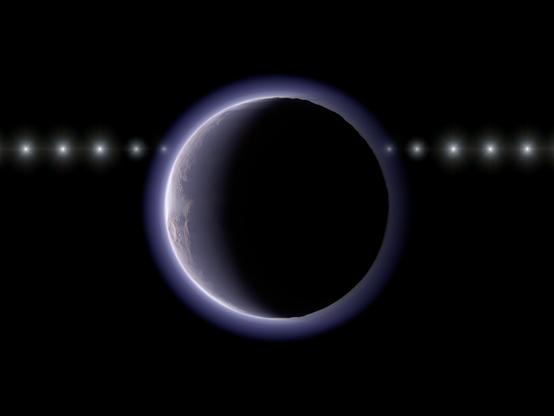
A team of professional and amateur Japanese astronomers have found evidence for a thin atmosphere around a small body in the outer solar system. The object is so small that it should not have a sustainable atmosphere, raising questions about when and how the atmosphere formed. Future observations to better characterize the atmosphere will help solve these mysteries.
RE: https://scicomm.xyz/@JohnBarentine/116296832763875772
Ah. A Nature article that I can actually read. I still don't understand why scientists continue to submit their papers to companies like Nature or Elsevier which hoard vast amounts of research behind expensive pay walls. Can anyone explain?
RE: https://mastodon.nl/@radiotelescoop/116232142442954456
I was kept so busy yesterday that I did not realize there was a photographer! Hurray. You can view the HI4PI VR world here:
https://horizon.meta.com/world/861023933332578/?hwsh=whV7CXalho
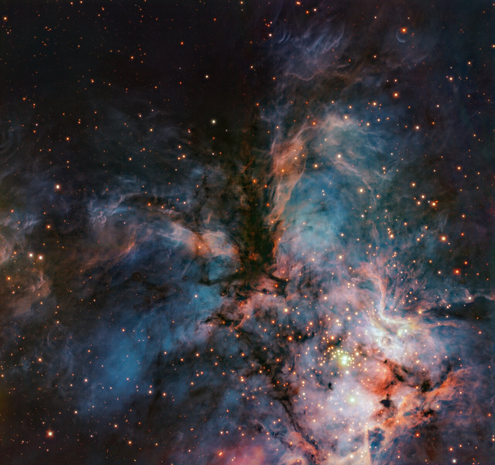
A cosmic hawk and its starry eyasses 🐦
What looks like a hawk spanning its wings above massive newly born stars is the RCW 36 nebula.
Now, a team of astronomers has used, yes, the HAWK-I instrument on our VLT to study the very dim stars called brown dwarfs hidden in the nebula and how they form: https://www.eso.org/public/images/potw2609a/
📷 ESO/A. R. G. do Brito do Vale et al.

 Prof Heino Falcke
 JA Westenberg
 ESO
ESO