Galaxy Map

@galaxy_map
1.2K Followers
290 Following
2.5K Posts
The first accurate and detailed maps of the Milky Way and ways to visualize them, including VR.
Websitehttps://kevinjardine.dev
Postershttps://gruze.org/posters_2024
Tip Jarhttps://tiptopjar.com/kevinjardine
RedBubble shophttps://www.redbubble.com/people/Galaxy-Map/shop?asc=u
I think it will be a tour of the galaxy within 3 kpc. That distance will mostly ensure that the objects we visit will be well studied and have names.

VR museums like this are popping up all over the place. I'm working on a starship experience that will showcase Gaia DR4 and will be available early next year. I'm hoping that some of these Location Based Experiences (LBE) will be interested.

https://www.amsterdamnow.com/en/culture/entr-museum-experience-amsterdam-anno-1675-in-vr/

ENTR Museum: Experience Amsterdam anno 1675 in VR

On the Oosterdokskade, you'll experience a state-of-the-art, sensory journey along the boundaries of art, technology and history at ENTR Museum.

Amsterdam NOW
@tammojan Not surprising! All the early famous hydrogen maps have the galactic centre down.
@emily_s Or do three versions of the atlas? Rotating images is easy. Rotating text labels not so much.

RE: https://mastodon.social/@galaxy_map/116580623711682627

Four hours left to vote. The split is more even than I had anticipated.

I'm organizing an atlas of the Milky Way that will be based on Gaia DR4, HI-GAL, masers and several other sources. What is your preferred map orientation? Galactic centre:
Up (infrared astronomers)
31.8%
Down (radio astronomers)
31.8%
Right (optical astronomers)
27.3%
Left (just to be different)
9.1%
Poll ended at .
I'm organizing an atlas of the Milky Way that will be based on Gaia DR4, HI-GAL, masers and several other sources. What is your preferred map orientation? Galactic centre:
Up (infrared astronomers)
31.8%
Down (radio astronomers)
31.8%
Right (optical astronomers)
27.3%
Left (just to be different)
9.1%
Poll ended at .

DR4 is a big deal. The brighter stars will have half the parallax errors of DR3, astrometric parameters such as temperature, mass and radius, will be much improved, binary star data will be more reliable and for the first time ever, the release will include a catalog of Gaia-detected exoplanets.

Will Gaia DR4 distance and temperature estimates be reliable enough to detect spiral structure and provide the first detailed hints of what the Milky Way really looks like from the outside? MAYBE!

Here we go! Gaia DR4 now has an official release date: 2 December 2026.

If you have been following the Gaia Mission closely, you will know that DR4 has had a sliding release date, from the end of 2025, to mid 2026 to "end of 2026". But now the date is locked.

https://www.cosmos.esa.int/web/gaia/data-release-4

Data Release 4 - Gaia - Cosmos

Gaia

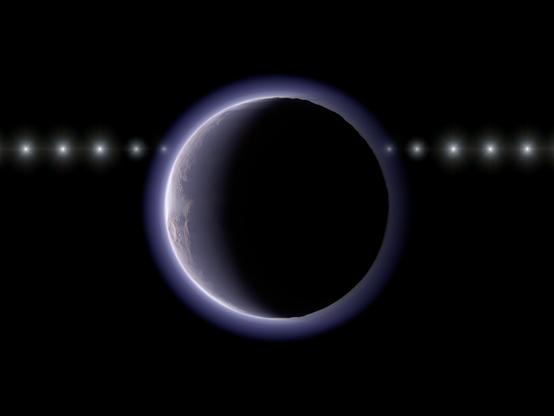
These are the things I love in #astronomy: you look at a dwarf planet in our solar system that’s smaller than Pluto and it passes right in front of a star, so you can see how the starlight is blocked as it moves across the star. And the unexpected happens: the light disappears more slowly than you would’ve thought, which could indicate that this little rock has some form of an atmosphere.

„A tiny world beyond Neptune has an atmosphere that shouldn't exist“: https://phys.org/news/2026-05-tiny-world-neptune-atmosphere-shouldnt.html#google_vignette

#Astrodon

A tiny world beyond Neptune has an atmosphere that shouldn't exist

A team of professional and amateur Japanese astronomers have found evidence for a thin atmosphere around a small body in the outer solar system. The object is so small that it should not have a sustainable atmosphere, raising questions about when and how the atmosphere formed. Future observations to better characterize the atmosphere will help solve these mysteries.

Phys.org