 Carl T. Bergstrom
Why is AI research so much sexier than education research? Sure it’s cool to study how machines learn but wait until you hear about PEOPLE.

Doug Blank
@dsblank
- 319 Followers
- 624 Following
- 166 Posts
Professor Emeritus, Bryn Mawr College. Now Head of Research at Comet ML. Interested in open social web, machine learning, artificial intelligence, analogies, and robotics.
 petersuber
I'm very glad to see farmers win the right to repair their tractors. It's a win for consumers against bogus #IP objections from manufacturers.
https://www.bbc.com/news/business-64206913

 James M Branum - יעקב מתתיהו ☮
Most predictable headline ever...
#Law #AI #Lawyer
Lawyer apologizes for fake court citations from ChatGPT | CNN Business
https://www.cnn.com/2023/05/27/business/chat-gpt-avianca-mata-lawyers/index.html
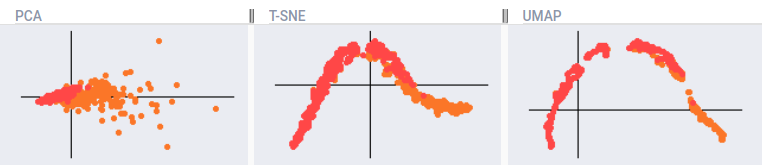
The history of "Visualizations of Embeddings" in "Archaeology of AI"
#MachineLearning #ArtificialIntelligence #Visualizations #history
 arXiv Robotics🦾
📝 Distributional Instance Segmentation: Modeling Uncertainty and High Confidence Predictions with Latent-MaskRCNN 🔭👾🦾
"Latent code models can model uncertainty over plausible object masks by learning a distribution of latent codes and mapping them to object masks in a decoder network, where the latent codes are sampled from the distribution." [gal30b+] 🤖 #CV #AI #RO

Distributional Instance Segmentation: Modeling Uncertainty and High Confidence Predictions with Latent-MaskRCNN
Object recognition and instance segmentation are fundamental skills in any robotic or autonomous system. Existing state-of-the-art methods are often unable to capture meaningful uncertainty in challenging or ambiguous scenes, and as such can cause critical errors in high-performance applications. In this paper, we explore a class of distributional instance segmentation models using latent codes that can model uncertainty over plausible hypotheses of object masks. For robotic picking applications, we propose a confidence mask method to achieve the high precision necessary in industrial use cases. We show that our method can significantly reduce critical errors in robotic systems, including our newly released dataset of ambiguous scenes in a robotic application. On a real-world apparel-picking robot, our method significantly reduces double pick errors while maintaining high performance.
Compare and contrast #MachineLearning visualizations of multiple models' "attention" using Kangas and its new metric mask.
See the live demo: https://kangas.comet.com/?datagrid=/data/attention.datagrid&select=ID,Image,Model+Name
Try "Group by" ID to compare images; try "Group by" Model Name to compare models.
Open source from the folks at https://comet.com/
A new paper just came out from Microsoft on the topic of GPT-4 titled: "Sparks of Artificial General Intelligence: Early experiments with GPT-4".
Now, sit down, remember this day, and begin reading (or watch this video).
Here is the paper:
https://arxiv.org/abs/2303.12712
Here is a video on the paper:
https://www.youtube.com/watch?v=Mqg3aTGNxZ0&ab_channel=AIExplained

Sparks of Artificial General Intelligence: Early experiments with GPT-4
Artificial intelligence (AI) researchers have been developing and refining large language models (LLMs) that exhibit remarkable capabilities across a variety of domains and tasks, challenging our understanding of learning and cognition. The latest model developed by OpenAI, GPT-4, was trained using an unprecedented scale of compute and data. In this paper, we report on our investigation of an early version of GPT-4, when it was still in active development by OpenAI. We contend that (this early version of) GPT-4 is part of a new cohort of LLMs (along with ChatGPT and Google's PaLM for example) that exhibit more general intelligence than previous AI models. We discuss the rising capabilities and implications of these models. We demonstrate that, beyond its mastery of language, GPT-4 can solve novel and difficult tasks that span mathematics, coding, vision, medicine, law, psychology and more, without needing any special prompting. Moreover, in all of these tasks, GPT-4's performance is strikingly close to human-level performance, and often vastly surpasses prior models such as ChatGPT. Given the breadth and depth of GPT-4's capabilities, we believe that it could reasonably be viewed as an early (yet still incomplete) version of an artificial general intelligence (AGI) system. In our exploration of GPT-4, we put special emphasis on discovering its limitations, and we discuss the challenges ahead for advancing towards deeper and more comprehensive versions of AGI, including the possible need for pursuing a new paradigm that moves beyond next-word prediction. We conclude with reflections on societal influences of the recent technological leap and future research directions.
 Howard Rheingold
Non-members can tune into the WELL conversation with John Markoff about "Whole Earth," his biography of Stewart Brand. Post questions and comments to me and I will relay them.
 Carlos E. Perez @IntuitMachine
Oh damn! This is becoming mainstream much faster than we can possibly imagine!
You knew it was just a matter of time until we did this (extend the @[email protected] savings with @[email protected], that is).
🐦🔗: https://twitter.com/VancityReynolds/status/1612816761585369090

 Alex R
Unsplash seem to be using AI to caption their images, and it’s going great! #AltText #a11y #accessibility