Daniel Vaulot ๐Ÿ‡ช๐Ÿ‡บ๐Ÿ‡บ๐Ÿ‡ฆ

257 Followers
384 Following
425 Posts
Biological oceanographer - Emeritus Research Director @CNRS - Station Biologique de Roscoff - focusing on marine (pico) #phytoplankton.
#metabarcoding #Rstats #18Srrna #shiny
Personnalhttps://daniel-vaulot.fr
PR2 databasehttps://pr2-database.org
ORCIDhttps://orcid.org/0000-0002-0717-5685

Applications to ECODIM XII 2025 are open until September 15th.


ECODIM (https://ecodim.imo-chile.cl/) is a 3-weeks international postgraduate (masters, PhD and early career researchers) school in microbial ecology,  coordinated by the University  of Concepciรณn (Chile). It combines classes and lab work.  

The International Course Ecology and Diversity of Marine Microorganisms (ECODIM XI) will be held at the Marine Biological Station of the Department of Oceanography of the University of Concepcion, Dichato, Chile, on 6-25 January 2020.

New preprint lead by Elianne Egge and Bente Edvardsen on the distribution of parasite alveolates in the Arctic Ocean around Svalbard during the Micropolar cruises

https://www.biorxiv.org/content/10.1101/2024.03.01.582906v1

Post doc position at Univ of Oslo on Plankton

Through EU Horizon Marie Skล‚odowska-Curie Action 18 post-doctoral positions (3 years) are available at the University of Oslo (UiO).

Looking for potential candidates interested in building an application within "ONEPlankton - interconnecting methods for high-throughput phytoplankton diversity" research area.

Deadline: 4th April 2024
Starting date: Oct 1, 2024

ONEplankton: https://www.uio.no/dscience/english/dstrain/research-areas/biosciences/oneplankton---interconnecting-methods-for-high-thr/
Applications: https://www.jobbnorge.no/en/available-jobs/job/255679/dstrain-msca-postdoctoral-fellowships-in-computational-and-natural-sciences-18-positions

ONEPlankton - interconnecting methods for high-throughput phytoplankton diversity and abundance - dScience โ€“ Centre for Computational and Data Science

Read this story on the University of Oslo's website.

๐Ÿ‡จ๐Ÿ‡ต ๐ŸŒŠ Open position
Director of the Biological Marine Station in #Roscoff, France
๐Ÿค“ ๐Ÿ–ฅ๏ธ ๐Ÿงช ๐Ÿฆ  ๐Ÿš ๐Ÿ”ฌ ๐Ÿงฌ ๐Ÿ“
deadline: 29 February 2024
@roscoff @cnrs
โ€œWhy blue carbon cannot truly offset fossil fuel emissionsโ€
#BlueCarbon #CarbonCredit
https://www.nature.com/articles/s43247-023-01068-x
Why blue carbon cannot truly offset fossil fuel emissions - Communications Earth & Environment

Blue carbon will not solve climate change. The effect is too small; existing sediment carbon stock is a liability; and there is a timescale mismatch between ancient fossil fuel emissions and uptake by vegetation. Clearer communication would support informed decision-making.

Nature

The strain on scientific publishing ๐Ÿ“„:

The publishing sector has a problem. Scientists are overwhelmed, editors are overworked, special issue invitations are constant, research paper mills, article retractions, journal delistingsโ€ฆ JUST WHAT IS GOING ON!?

Myself, pablo, @paolocrosetto and Dan have spent the last few months investigating just that.
https://arxiv.org/abs/2309.15884

A thread๐Ÿงต1/n

#AcademicChatter #PublishOrPerish #Elsevier #Springer #MDPI #Wiley #Frontiers #PhDAdvice #PhDChat #SciComm

The strain on scientific publishing

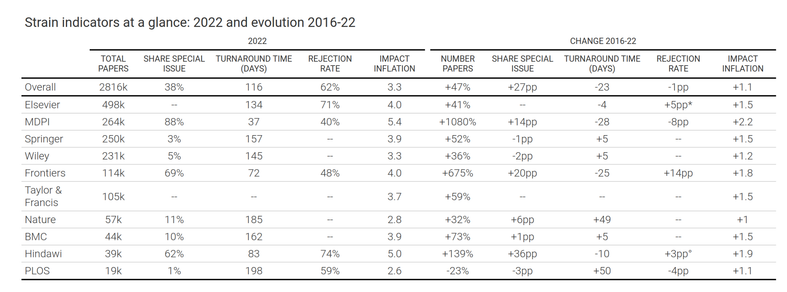
Scientists are increasingly overwhelmed by the volume of articles being published. Total articles indexed in Scopus and Web of Science have grown exponentially in recent years; in 2022 the article total was approximately ~47% higher than in 2016, which has outpaced the limited growth - if any - in the number of practising scientists. Thus, publication workload per scientist (writing, reviewing, editing) has increased dramatically. We define this problem as the strain on scientific publishing. To analyse this strain, we present five data-driven metrics showing publisher growth, processing times, and citation behaviours. We draw these data from web scrapes, requests for data from publishers, and material that is freely available through publisher websites. Our findings are based on millions of papers produced by leading academic publishers. We find specific groups have disproportionately grown in their articles published per year, contributing to this strain. Some publishers enabled this growth by adopting a strategy of hosting special issues, which publish articles with reduced turnaround times. Given pressures on researchers to publish or perish to be competitive for funding applications, this strain was likely amplified by these offers to publish more articles. We also observed widespread year-over-year inflation of journal impact factors coinciding with this strain, which risks confusing quality signals. Such exponential growth cannot be sustained. The metrics we define here should enable this evolving conversation to reach actionable solutions to address the strain on scientific publishing.
arXiv.org
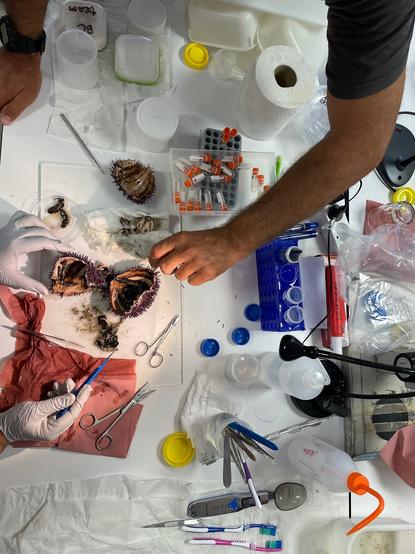
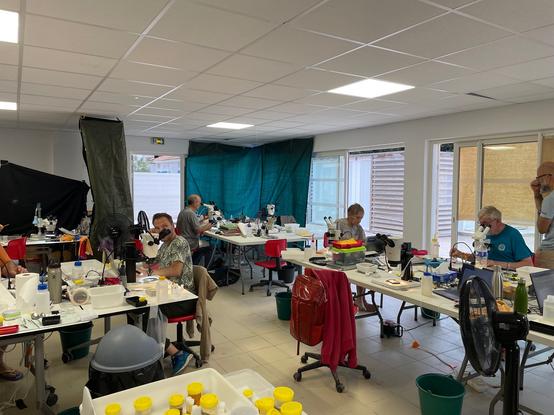
@atlasea #sampling_expedition_Leucate (Mediterranean Sea) organised by #MNHN: first organisms coming out from the sea, sorting, taxonomic identification and freezing before shipping to Sequencing Laboratory at #Genoscope @cea_officiel for #genome_sequencing
#JobOpportunity ATLASea #Hiring
3 open positions are part of the BYTE-Sea project, which will develop @atlasea infrastructure and the tools for processing and analyzing the data made available to the international community
๐Ÿ‘‰https://www.atlasea.fr/en/contact-2/careers/
Deadline: 25 October 2023
Careers โ€“ ATLASea

#JobOpportunity ATLASea #Hiring
Another position is now open as part of DIVE-Sea, which will be responsible for taking samples on the coast and during expeditions to the open sea and at depth:
๐Ÿ‘‰https://atlasea.fr/en/contact-2/careers/
โณApplication deadline: 30 october
Careers โ€“ ATLASea

Presenting the Roscoff Culture Collection at the European Phycology Meeting in Brest.

https://roscoff-culture-collection.org/sites/default/files/basic-page-files/Presentation%20RCC%20EPC%20Brest%202023-08-24.pdf