
Cecilia Noecker

76 Followers
251 Following
14 Posts
New Assistant Professor at Minnesota State U Mankato (she/her). Interested in microbial ecology, genomics, computational biology, equitable education, & more. Also on bluesky.
Websitehttps://cnoecker.github.io/

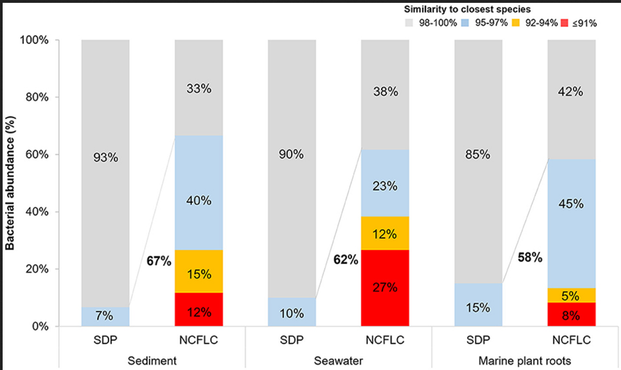
Here they do a dilution to extinction experiment where they purposefully screen for wells that do *not* grow on solid media. What do they find? A huge enrichment in undercultivated microbes: Acidobacteria, Verrucomicrobia, Armatimondaetes!

Really simple, but seems really effective!

https://www.frontiersin.org/articles/10.3389/fmicb.2023.1194466/full
A targeted liquid cultivation method for previously uncultured non-colony forming microbes

A large number of microbes are not able to form colonies using agar-plating methods, which is one of the reasons that cultivation based on solid media leaves the majority of microbial diversity in the environment inaccessible. We developed a new Non-Colony-Forming Liquid Cultivation method (NCFLC) that can selectively isolate non-colony-forming microbes that exclusively grow in liquid culture. The NCFLC method involves physically separating cells using dilution-to-extinction (DTE) cultivation and then selecting those that could not grow on a solid medium. The NCFLC was applied to marine samples from a coastal intertidal zone and soil samples from a forest area, and the results were compared with those from the standard direct plating method (SDP). The NCFLC yielded fastidious bacteria from marine samples such as Acidobacteriota, Epsilonproteobacteria, Oligoflexia, and Verrucomicrobiota. Furthermore, 62% of the isolated strains were potential new species, whereas only 10% were novel species from SDP. From soil samples, isolates belonging to Acidobacteriota and Armatimonadota (which are known as rare species among identified isolates) were exclusively isolated by NCFLC. Colony formation capabilities of isolates cultivated by NCFLC were tested using solid agar plates, among which approximately one-third of the isolates were non-colony-forming, approximately half-formed micro-colonies, and only a minority could form ordinary size colonies. This indicates that the majority of t...

Frontiers
@melissaekline Sounds somewhat similar to this course/textbook? https://bookdown.org/roback/bookdown-BeyondMLR/
Beyond Multiple Linear Regression

An applied textbook on generalized linear models and multilevel models for advanced undergraduates, featuring many real, unique data sets. It is intended to be accessible to undergraduate students who have successfully completed a regression course. Even though there is no mathematical prerequisite, we still introduce fairly sophisticated topics such as likelihood theory, zero-inflated Poisson, and parametric bootstrapping in an intuitive and applied manner. We believe strongly in case studies featuring real data and real research questions; thus, most of the data in the textbook arises from collaborative research conducted by the authors and their students, or from student projects. Our goal is that, after working through this material, students will develop an expanded toolkit and a greater appreciation for the wider world of data and statistical modeling.

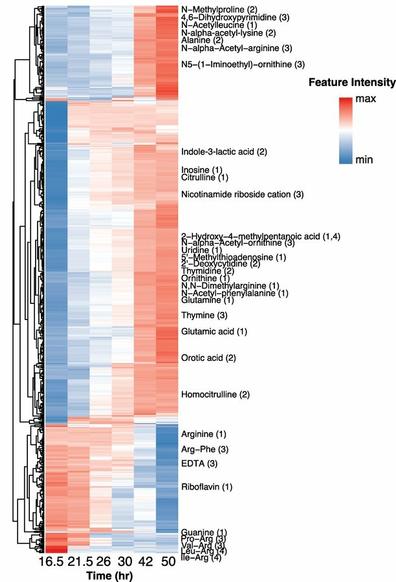
My paper is now out in PLOS Biology! Check it out if you are interested in nutrient niches in the gut, multi-omics, anaerobic metabolism, and/or modeling of gut microbes: https://journals.plos.org/plosbiology/article?id=10.1371/journal.pbio.3002125 #microbiology
Systems biology elucidates the distinctive metabolic niche filled by the human gut microbe Eggerthella lenta

Bacterial metabolism is important for human health, but most mechanistic insight relies on a few model organisms. This study uses a systems biology approach to explore the unusual metabolism of the prevalent and disease-linked gut actinobacterium Eggerthella lenta.

Bacterial #metabolism is important for human health, but most research relies on a few model organisms.
A new study in #PLOSBiology used a systems biology approach to explore the unusual metabolism of the disease-linked gut bacterium Eggerthella lenta. #microbiology
https://plos.io/45nrdCH
Systems biology elucidates the distinctive metabolic niche filled by the human gut microbe Eggerthella lenta

Bacterial metabolism is important for human health, but most mechanistic insight relies on a few model organisms. This study uses a systems biology approach to explore the unusual metabolism of the prevalent and disease-linked gut actinobacterium Eggerthella lenta.

RT @KevinDKohl
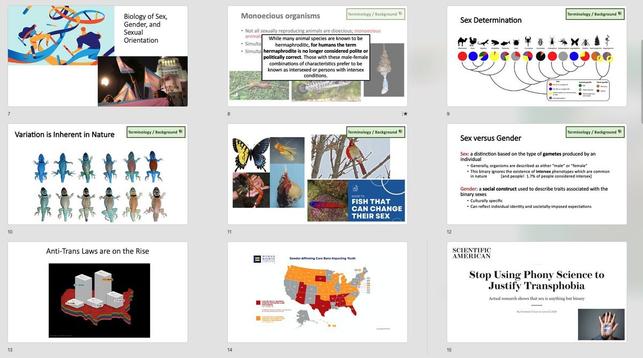
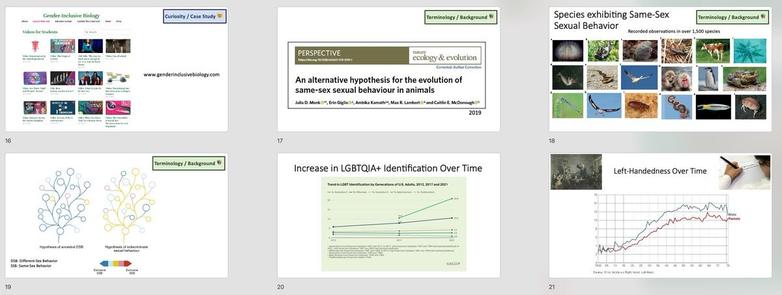
'Biology' is often used to defend anti-LGBTQIA+ ideologies. But, what is the biology, and do we teach this information?

Here are (far from perfect) slides from my Comparative Physiology class. Students are always grateful to hear these topics covered in a bio class. ๐Ÿณ๏ธโ€โšง๏ธ๐Ÿณ๏ธโ€๐ŸŒˆ๐Ÿงฌโœจ

To continue our recent preprint whirlwind ๐ŸŒช๏ธ, we just posted a revision of @jpjl57's manuscript on in vivo bacterial population growth phase estimation from metagenomic time series.

Here's what's new ๐Ÿงต

@isbsci

https://www.biorxiv.org/content/10.1101/2022.04.23.489288v2

RT @VictoriaPascal_
After a lot of work, it's finally out: https://rdcu.be/c5xgq ๐Ÿฅณ. Profiling the gut microbiome with gutSMASH shows mechanistic differences at the taxa level among other findings. Great team effort: @marnixmedema , @jingyuan_fu, @mfgrp , @LianminChen, @HannahAugustijn ๐Ÿ‘

MSE speaker series starts next week, features talks on diet and gut microbes, early life and breastfeeding, soil health, equitable research, how microbes are part of us, and more!

These talks are presented virtually, and registration is free. They are open to all so please feel free to join us and learn about microbes.

https://sueishaqlab.org/2023/01/11/mse-speaker-series-starts-next-week-features-talks-on-diet-and-gut-microbes-early-life-and-breastfeeding-soil-health-equitable-research-how-microbes-are-part-of-us-and-more/

MSE speaker series starts next week, features talks on diet and gut microbes, early life and breastfeeding, soil health, equitable research, how microbes are part of us, and more!

The Microbes and Social Equity Speaker Series starts next week! Join us for talks on microbiomes and health, equity in research, and more! Spring 2023; January 18 โ€“ May, Wednesdays from 11:00โ€ฆ

The Ishaq Lab

RT @[email protected]

Have you ever worked with samples containing DNA from prokaryotes and eukaryotes (e.g. host and microbe)?

If so, I recently wrote a software program that can separate out bacterial/archaeal sequences from eukaryotic ones: https://bmcgenomics.biomedcentral.com/articles/10.1186/s12864-022-08382-2

๐Ÿฆ๐Ÿ”—: https://twitter.com/theironark/status/1608336734890360832

SprayNPray: user-friendly taxonomic profiling of genome and metagenome contigs - BMC Genomics

Background Shotgun sequencing of cultured microbial isolates/individual eukaryotes (whole-genome sequencing) and microbial communities (metagenomics) has become commonplace in biology. Very often, sequenced samples encompass organisms spanning multiple domains of life, necessitating increasingly elaborate software for accurate taxonomic classification of assembled sequences. Results While many software tools for taxonomic classification exist, SprayNPray offers a quick and user-friendly, semi-automated approach, allowing users to separate contigs by taxonomy (and other metrics) of interest. Easy installation, usage, and intuitive output, which is amenable to visual inspection and/or further computational parsing, will reduce barriers for biologists beginning to analyze genomes and metagenomes. This approach can be used for broad-level overviews, preliminary analyses, or as a supplement to other taxonomic classification or binning software. SprayNPray profiles contigs using multiple metrics, including closest homologs from a user-specified reference database, gene density, read coverage, GC content, tetranucleotide frequency, and codon-usage bias. Conclusions The output from this software is designed to allow users to spot-check metagenome-assembled genomes, identify, and remove contigs from putative contaminants in isolate assemblies, identify bacteria in eukaryotic assemblies (and vice-versa), and identify possible horizontal gene transfer events.

BioMed Central
@amydwillis Hi Amy, for a stats journal, seems reasonable to call it X in general but link it to Y terminology multiple times in the intro, keywords, wherever you can fit it in?? Microbiome scientists can learn new words ๐Ÿ˜