Carlos Brody

302 Followers
91 Following
43 Posts
Neuroscientist at Princeton University and Howard Hughes Medical Institute

Excited to share work from postdoc @thomaszluo and grad student Tim Kim! Just posted on bioRxiv. https://t.co/vvaAAIXK6m

New unsupervised method for learning latent dynamics (Kim et al., in prep) reveals that decision-making activity in frontal regions of rats is composed of two phases.

A simplified model of these two phases accounts for a variety of phenomena (including stepping vs ramping neural profiles), and precisely predicts internal decision commitment times.
Excited to share work from postdoc @thomaszluo and grad student Tim Kim! Just posted on bioRxiv. https://t.co/vvaAAIXK6m

New unsupervised method for learning latent dynamics (Kim et al., in prep) reveals that decision-making activity in frontal regions of rats is composed of two phases.

A simplified model of these two phases accounts for a variety of phenomena (including stepping vs ramping neural profiles), and precisely predicts internal decision commitment times.

Deeply saddened to hear of Krishna Shenoy's passing.

He was brilliant and gentle, a giant of science, of kindness, and generosity. He embodied the fact that world-class research could, and should, be built by leading a lab fundamentally made of kindness and care for his trainees, and for everyone he met.

A big loss.

Proud to share this work connecting population-level factors to spiking activity, in @cellpress!

https://www.cell.com/neuron/fulltext/S0896-6273(22)01080-7

Latent factors are a powerful framework for understanding computation but what are factors? Just an analysis trick? Where are they in a neural circuit? (1/9) #neuroscience #tootprint #neuralnetworks

Sad doesn't begin to describe the the passing of my long-time friend, colleague, and mentor, Krishna Shenoy.

Who was Krishna?

The change in conversation from neuron to population,
the development of dynamics in neuroscience,
the advance of BMI to help humans with profound illness.

But mentorship and care for his neuroscience family, as he would say, that was deepest Krishna.

For the holiday, a thread on how to befriend crows.

--

Befriending crows is a wonderful thing.

I have many crow friends at home and at work. They bring joy at unexpected moments and can rescue a miserable day even without shaking down the dust of snow that Robert Frost described.

This thread is an updated version of one I posted at the bird site in July 2019.

#birding #birdwatching #birds #urbanbirding #crows #corvids #crow #corvid #crowfriends

If you write, academically or otherwise, and haven't read this piece by Gopen and Swan, then here's a Xmas gift for you: https://www.americanscientist.org/blog/the-long-view/the-science-of-scientific-writing

Writing has been a huge part of my job for like twenty years - yet apparently I have never really thought deeply about *how* I construct sentences, and how I string them together.🤯

Shows really neatly why text may be hard to understand not because of the subject matter, but instead simply because of poor sentence structure.

The Science of Scientific Writing

American Scientist
Thinking about making a little mastodon bot that summarizes and links the day's most popular posts across neuro and AI. A completely optional algorithmic feed, if you will. WDYT? CC @kordinglab

New paper! Full text is now available.

Working Memory Is Complex and Dynamic, Like Your Thoughts
https://direct.mit.edu/jocn/article/35/1/17/113628/Working-Memory-Is-Complex-and-Dynamic-Like-Your
#neuroscience

Working Memory Is Complex and Dynamic, Like Your Thoughts

Abstract. Working memory is where thoughts are held and manipulated. For many years, the dominant model was that working memory relied on steady-state neural dynamics. A neural representation was activated and then held in that state. However, as often happens, the more we examine working memory (especially with new technology), the more complex it looks. Recent discoveries show that working memory involves multiple mechanisms, including discontinuous bouts of spiking. Memories are also dynamic, evolving in a task-dependent manner. Cortical rhythms may control those dynamics, thereby endowing top–down “executive” control over our thoughts.

MIT Press

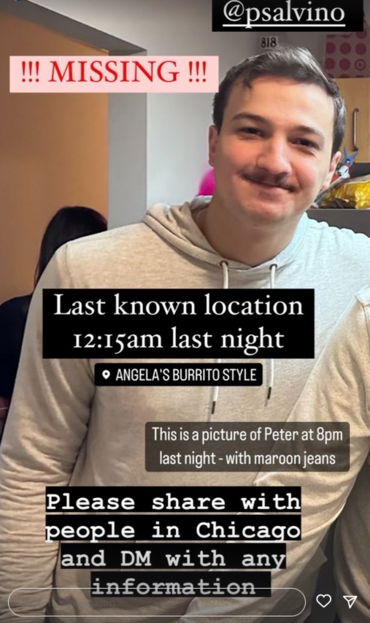
Please share if you are in Chicago! 👇

RT @[email protected]

Please RT. My graduate student Peter Salvino @[email protected] has been missing since last night. Last seen in Lincoln Park, Chicago. See below. Please get in touch if you have any info

🐦🔗: https://twitter.com/lucasmpinto/status/1604629202124300289

Lucas Pinto on Twitter

“Please RT. My graduate student Peter Salvino @petersalvino has been missing since last night. Last seen in Lincoln Park, Chicago. See below. Please get in touch if you have any info”

Twitter