Ben Blaiszik

@blaiszik
219 Followers
230 Following
86 Posts
Group Leader - AI and data infrastructure for science at @uchicago/@argonne/@globus. @DataFacility, funcx, @ml_garden chemistry, drug discovery, physics.🤖🔬
LinkedInhttps://www.linkedin.com/in/benblaiszik

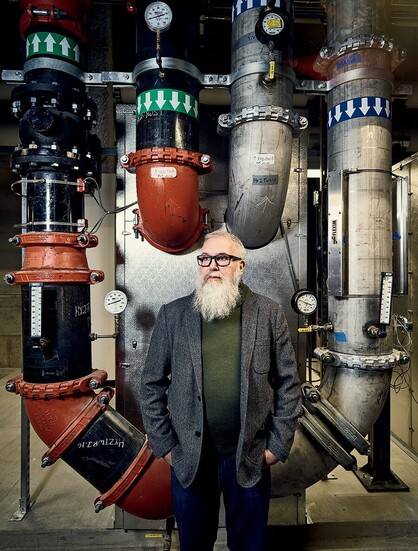
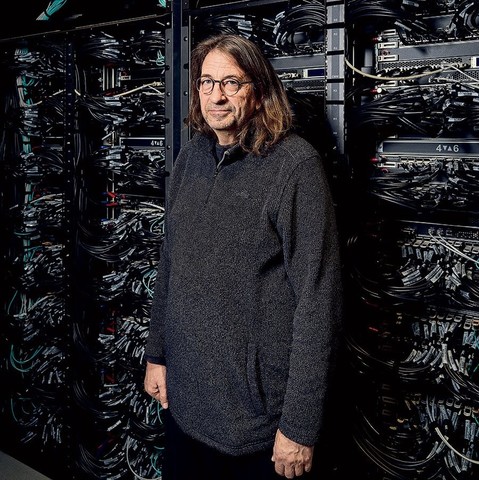
🛫 A new generation of scientific understanding and #AI is on the horizon with the Exascale Aurora system. Very nice article profiling the efforts of Rick Stevens, Michael Papka, and the Argonne Leadership Computing Facility team.

“You’ve got a community of people that have been working on advancing high-performance computing for decades. And it powers the whole economy.” - Rick Stevens

Article: https://lnkd.in/g2s3w-U5
#HPC #ML #science #research #computing #team

January 2023 #ML and #AI for Science developments including: 🔹 ML for polymeric drug formulation; 🔸A new Recursion RXRX dataset; 🔹The Year of #OpenScience @WHOSTP; 🔸AI to understand reaction mechanisms; 🔹10 yrs of battery testing data.

Let's go 🚀

LinkedIn Thread: https://www.linkedin.com/posts/benblaiszik_ml-ai-openscience-activity-7026259777672421376-XHPN?utm_source=share&utm_medium=member_desktop

Ben Blaiszik on LinkedIn: #ml #ai #openscience #ml #openscience #research #energy #ai #ml…

January 2023 #ML and #AI for Science developments including: 🔹 ML for polymeric drug formulation; 🔸A new Recursion RXRX dataset; 🔹The Year of #OpenScience…

Forgot to attach the screenshot. :)

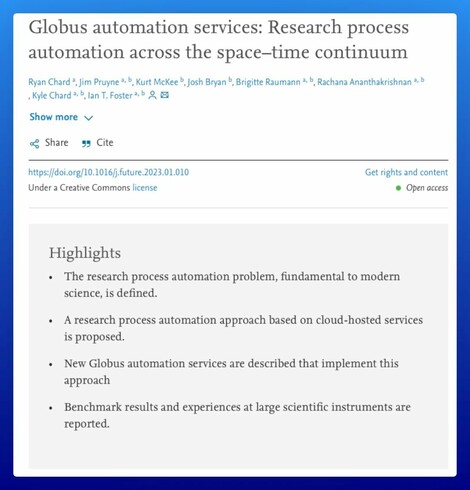
Research automation is an emerging way to connect #ExaScale computing, #ML in the loop, and large experimental user facilities while enabling sharing of data in ways that support #OpenScience.

These automation services handle auth, enable the specification of reusable and shareable research processes, modular actions (e.g., transfer, email, compute, metadata index), and the execution/orchestration of automation flows.

Paper: https://lnkd.in/gw-FcfX2

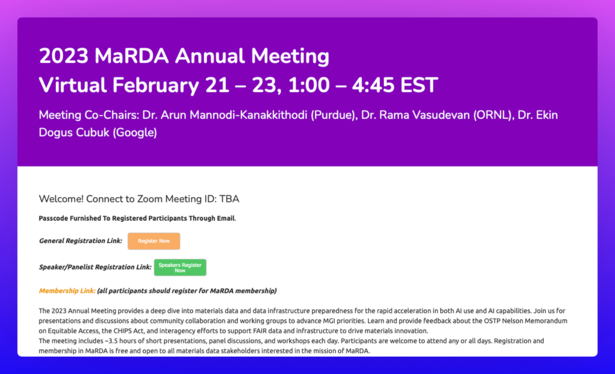
Registration is now open for the Materials Research Data Alliance (MaRDA) annual conference! The conference will be held fully virtual with free registration (Feb 21-23). List of speakers forthcoming soon, but I can guarantee there are exciting people involved and the discussions will be great.

Registration: https://lnkd.in/g5gyZuUy

#ai #ml #openscience #data #materialsscience #acceleratedscience

Marda – members working together to change the data landscape

Yes!

US National Science Foundation looks to shake up funding with ‘Golden Ticket’ pilot

The agency wants to give individual reviewers the power to fund proposals they think are promising, even if other panelists disagree. The aim is to avoid only backing the least controversial applications

https://sciencebusiness.net/news/us-national-science-foundation-looks-shake-funding-golden-ticket-pilot

US National Science Foundation looks to shake up funding with ‘Golden Ticket’ pilot

The US National Science Foundation (NSF) is looking to give its review panel members a ‘Golden Ticket’ to fund proposals they think have great potential, even if this goes over the heads of other panellists and programme officers. NSF hopes the pilot could help shake up how it distributes its $8.8 billion annual budget, preventing a “regression to the mean” in consensus-based funding decisions that risk rewarding only the least divisive proposals, not those with most potential.

Science|Business

What's the easiest way to find everyone interested in lab automation, #AI4Science for #materials, #chemistry, etc. from the old site? Should I just follow everyone that follows @aspuru?

If you're interested in these topics, give me a follow and I'll follow back!

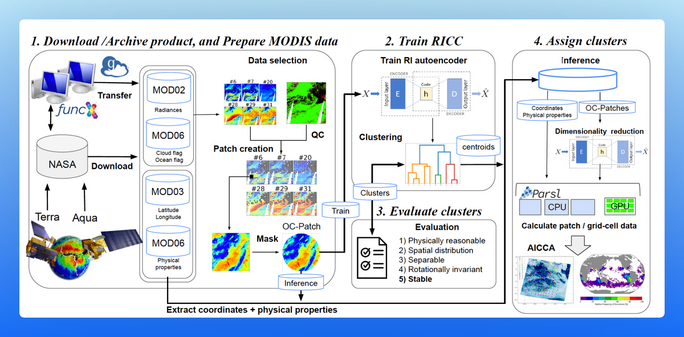
New study from Globus Labs uses #ML to classify clouds in satellite images to better understand environmental dynamics. 🌪️🌤️🌩️ #science #environment

Link: https://doi.org/10.3390/rs14225690
Globus Labs Research Group: https://labs.globus.org

Authors: Takuya Kurihana, Ian Foster, Liz Moyer
University of Chicago, Argonne National Laboratory, Argonne Leadership Computing Facility

AICCA: AI-Driven Cloud Classification Atlas

Clouds play an important role in the Earth’s energy budget, and their behavior is one of the largest uncertainties in future climate projections. Satellite observations should help in understanding cloud responses, but decades and petabytes of multispectral cloud imagery have to date received only limited use. This study describes a new analysis approach that reduces the dimensionality of satellite cloud observations by grouping them via a novel automated, unsupervised cloud classification technique based on a convolutional autoencoder, an artificial intelligence (AI) method good at identifying patterns in spatial data. Our technique combines a rotation-invariant autoencoder and hierarchical agglomerative clustering to generate cloud clusters that capture meaningful distinctions among cloud textures, using only raw multispectral imagery as input. Cloud classes are therefore defined based on spectral properties and spatial textures without reliance on location, time/season, derived physical properties, or pre-designated class definitions. We use this approach to generate a unique new cloud dataset, the AI-driven cloud classification atlas (AICCA), which clusters 22 years of ocean images from the Moderate Resolution Imaging Spectroradiometer (MODIS) on NASA’s Aqua and Terra instruments—198 million patches, each roughly 100 km × 100 km (128 × 128 pixels)—into 42 AI-generated cloud classes, a number determined via a newly-developed stability protocol that we use to maximize richness of information while ensuring stable groupings of patches. AICCA thereby translates 801 TB of satellite images into 54.2 GB of class labels and cloud top and optical properties, a reduction by a factor of 15,000. The 42 AICCA classes produce meaningful spatio-temporal and physical distinctions and capture a greater variety of cloud types than do the nine International Satellite Cloud Climatology Project (ISCCP) categories—for example, multiple textures in the stratocumulus decks along the West coasts of North and South America. We conclude that our methodology has explanatory power, capturing regionally unique cloud classes and providing rich but tractable information for global analysis. AICCA delivers the information from multi-spectral images in a compact form, enables data-driven diagnosis of patterns of cloud organization, provides insight into cloud evolution on timescales of hours to decades, and helps democratize climate research by facilitating access to core data.

MDPI
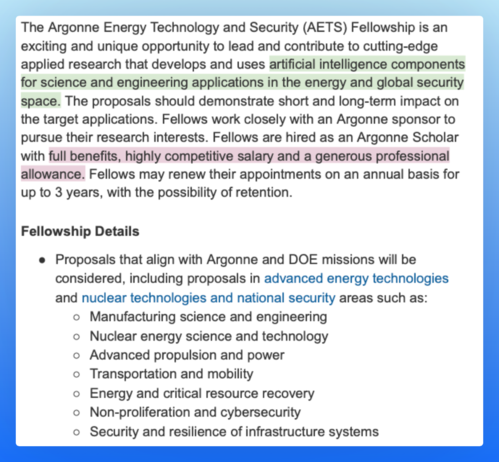
Link to more information and location to apply. https://www.anl.gov/aet/argonne-energy-technology-security-fellowship
Argonne Energy Technology & Security Fellowship | Argonne National Laboratory

@Argonne Energy Technology and Security Fellowship is open for applications! Excellent opportunity for those interested in #AI4Science applied to energy, manufacturing, transportation, infrastructure resilience, security, and more!

#postdoc #fellowship
(emphasis txt shade mine)