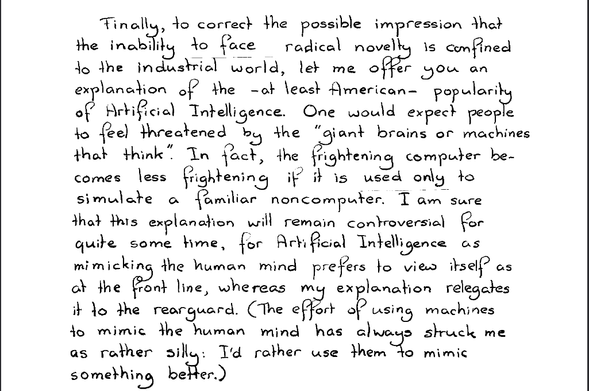
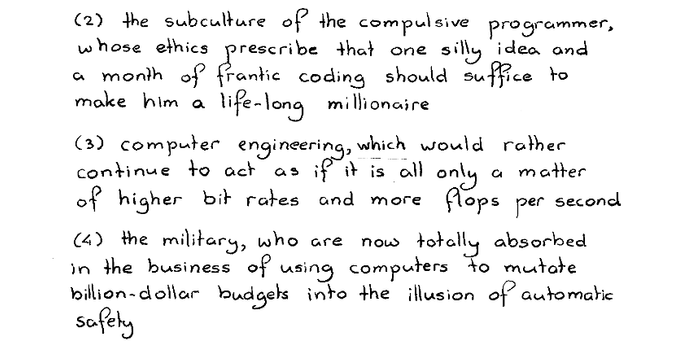
TIL Dijkstra was against AI before it was cool (1988).

| Codeberg | https://codeberg.org/janAkali |
| Itch.io | https://janAkali.itch.io |
| TIC-80 | https://tic80.com/dev?id=6856 |
| Fantasy Console Discord | https://discord.gg/jcT9CXDgHB |
almost 40 years later and the world is still the same.
The idea of liking an operating system is kinda bizarre to me.
So far explaining why I like one has just been a case of whether or not it frustrate me. Fedora just failed me on that one. I don't love anything particular about Arch - it just never make me want to pull my hair out, and in the rare cases something fails, it is always possible to fix and I often learn something in the process. It is also hard for me to put my finger on why I dislike a distro - other than the process of using it causing me frustration.
Also I'd like to give a shout out to SparkyLinux - a small Debian distro that just works.
edit: ea. an operating system shouldn't be there for me to have opinions on it, it should sort of just melt away in the background without needing me to think about its existance.
#music #french #pop
> you finally find time to sit and listen to that random french group you've found on Spotify
> you love every single song and one of them is a banger cover
> their last and only album is from 2006 🥹
Go give Radiomatic a listen - https://www.youtube.com/watch?v=jZTuNVPO__Q&list=OLAK5uy_kRAaFkvT6GR85oZkNGVfwFi0EEdAY4G8I&index=13

#noai #programming #depression #nim
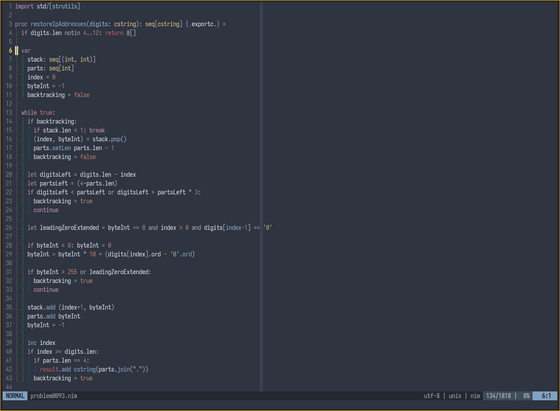
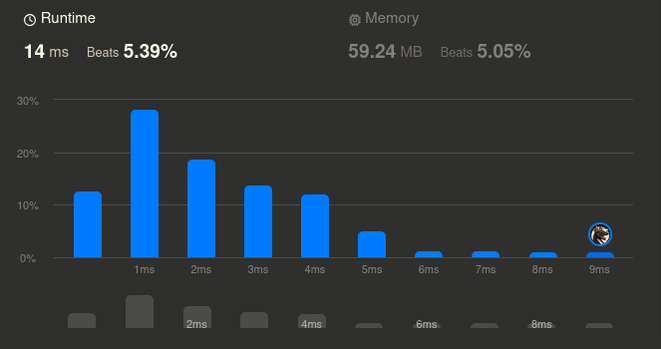
Today I spent embarassingly long time getting this stupid thing to work. It's an iterative manual stack solution that minimizes stack space for leetcode problem 93 in Nim (compiled to js).
Why? I dunno, just felt like it.
Using “AI” to manage your #Fedora system seems like a really bad idea
https://www.osnews.com/story/144006/using-ai-to-manage-your-fedora-system-seems-like-a-really-bad-idea/
🤣
My definition of a Christmas spirit:
writing a mod manager for #Skyrim ...
on a #NintendoSwitch ...
in #Nim

Got an okay looking visualization for part 2!
 hell \ Rebekah Hellberg
 🍁voilà-DCKIM🍁
 Karl Voit

 Ryan Harp
 Decivex