 Paul Cantrell
 Nico Blüthgen
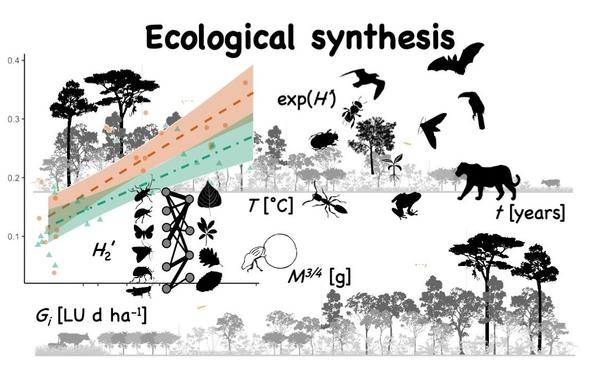
Three exciting #PostDoc 🧑🔬👩🔬🧕 positions on #Ecological #Synthesis at TU Darmstadt for Reassembly #rainforest 🇪🇨 🌱🌴🦜 & #Biodiversity Exploratories 🌲🐄🚜🪲🐝
Please spread widely ✉️♥️▶️ & apply quickly 🙃
| personal website | https://amynang.github.io/ |
Here’s the lightning sketch of Paul’s Treatise Against Efficiency that I’ve never written:
1. Efficiency is asymptotically inefficient: as costs approach zero, the cost of further reducing them approaches infinity.
2. Efficiency prioritizes the measurable over the difficult-to-measure.
3. Efficiency prioritizes what those in power see (or imagine) over on-the-ground reality.
4. Following from 2 and 3, efficiency reduces the amount and quality of information flowing into a human system.
5. Efficiency foments institutional inflexibility.
6. By removing slack, efficiency causes small failures to cascade more readily and increases the risk of catastrophic failure.
7. Following rom 4, 5, and 6, efficiency trades small costs for massive risks: from failures, from missed opportunities, and from inability to adjust.
8. Efficiency, when pushed, strangles the emergent phenomena that in the long term create all new things of value.
9. Thus, although it can be a by-product of evolution, efficiency as a goal in itself strangles evolution.
10. Efficiency as a goal strangles joy.
Three exciting #PostDoc 🧑🔬👩🔬🧕 positions on #Ecological #Synthesis at TU Darmstadt for Reassembly #rainforest 🇪🇨 🌱🌴🦜 & #Biodiversity Exploratories 🌲🐄🚜🪲🐝
Please spread widely ✉️♥️▶️ & apply quickly 🙃
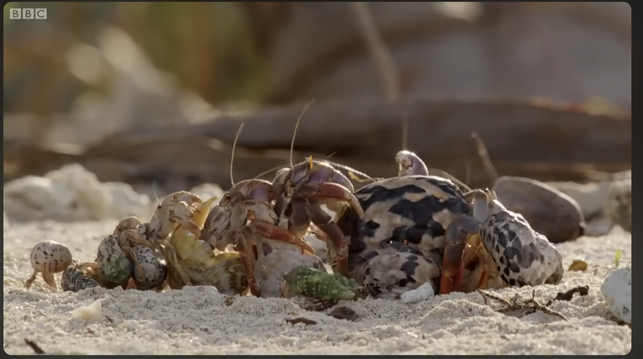
My favourite discovery in The Golden Mole: a whole new meaning to a house-moving chain. Hermit crabs that find a potential new shell that's too big wait next to it, & as others arrive they line up in size order until there's one who can take the big new shell. Then everyone upgrades.
Video here: https://www.youtube.com/watch?v=zpjklLt1qWk

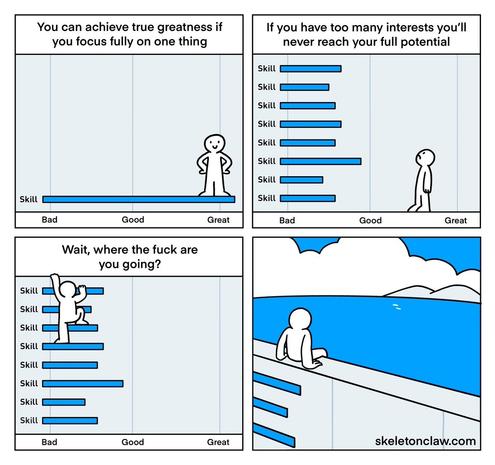
Oh, as a topic wanderer myself (I don’t like the word “generalist”), I love and endorse this comic.
(via @simondlr’s newsletter).
@TheBreadmonkey This reminded me of this study: https://www.nature.com/articles/s41586-021-03380-y
"...we show that people systematically default to searching for additive transformations, and consequently overlook subtractive transformations."

Observational and experimental studies of people seeking to improve objects, ideas or situations demonstrate that people default to searching for solutions that add new components rather than for solutions that remove existing components.
Our emojis show our bias with respect to the natural world.
 Barry Rowlingson
 Helen Czerski
 Rian van der Merwe
 notplants
 Peer Community In
 David Ho