24 Followers
73 Following
16 Posts
PhD student at #CBDR, University of Zurich
https://cbdr-lab.net
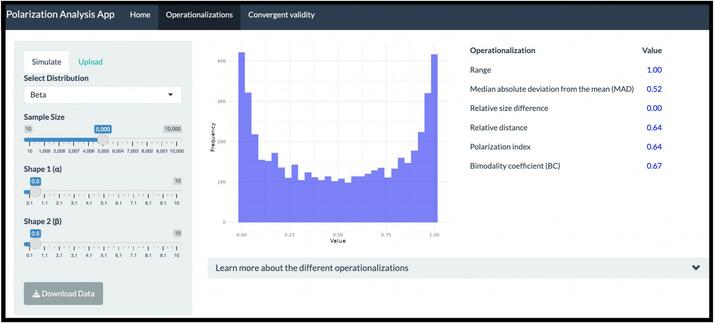
These days, everyone is talking about #polarization. But how best to measure it? Olivia Fischer and I have a new paper that empirically compares various operationalizations of polarization (e.g., on people's risk perceptions), including a shiny app to simulate and analyze different kinds of polarization. https://dx.doi.org/10.1002/bdm.70041 #CBDR_lab @oliviafischer
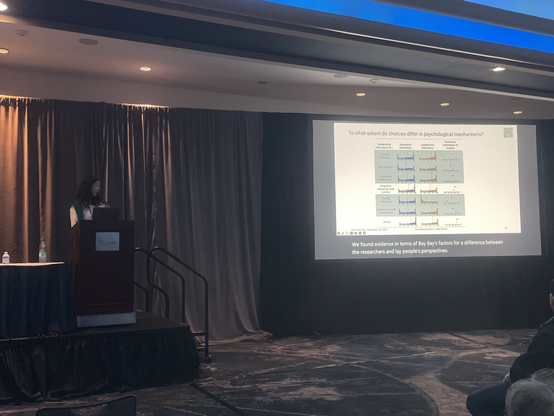
Exciting news from #CBDR_lab: @oliviafischer presented her most recent project aimed at better understanding to what extent the risky choices behavioral scientists study reflect the choices people actually make in real life - and if not, to what extent it matters. Make sure to check out the preprint to learn more: https://doi.org/10.31234/osf.io/h43cj
#SJDM #psynom24 #CBDR_lab
Read the paper here: https://arxiv.org/abs/2310.04153
Watch the Ig Nobel prize ceremony here: https://improbable.com/ig/archive/2024-ceremony/
Fair coins tend to land on the same side they started: Evidence from 350,757 flips

Many people have flipped coins but few have stopped to ponder the statistical and physical intricacies of the process. We collected $350{,}757$ coin flips to test the counterintuitive prediction from a physics model of human coin tossing developed by Diaconis, Holmes, and Montgomery (DHM; 2007). The model asserts that when people flip an ordinary coin, it tends to land on the same side it started -- DHM estimated the probability of a same-side outcome to be about 51\%. Our data lend strong support to this precise prediction: the coins landed on the same side more often than not, $\text{Pr}(\text{same side}) = 0.508$, 95\% credible interval (CI) [$0.506$, $0.509$], $\text{BF}_{\text{same-side bias}} = 2359$. Furthermore, the data revealed considerable between-people variation in the degree of this same-side bias. Our data also confirmed the generic prediction that when people flip an ordinary coin -- with the initial side-up randomly determined -- it is equally likely to land heads or tails: $\text{Pr}(\text{heads}) = 0.500$, 95\% CI [$0.498$, $0.502$], $\text{BF}_{\text{heads-tails bias}} = 0.182$. Furthermore, this lack of heads-tails bias does not appear to vary across coins. Additional analyses revealed that the within-people same-side bias decreased as more coins were flipped, an effect that is consistent with the possibility that practice makes people flip coins in a less wobbly fashion. Our data therefore provide strong evidence that when some (but not all) people flip a fair coin, it tends to land on the same side it started.

arXiv.org

What do we (a group of 50 scientists) and B. F. Skinner have in common? Of course winning an Ig Nobel prize! 🎉

In a study led by František Bartoš where we performed 350,757 coin flips, we showed that when flipping a fair coin, it tends to land on the same side it started on (probability = 50.8%). Last week, we received the Ig Nobel prize for probability for this breath-taking finding. 🙂

Links to paper and prize ceremony below👇🏼

#CBDR_lab flips coins

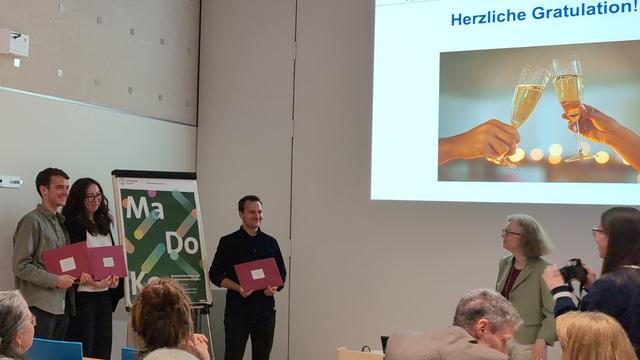
Congratulations to @oliviafischer and @aaronlob who won the 1st an 2nd prizes at our institute's local student conference yesterday 🍾 💪 😀 #CBDR_lab
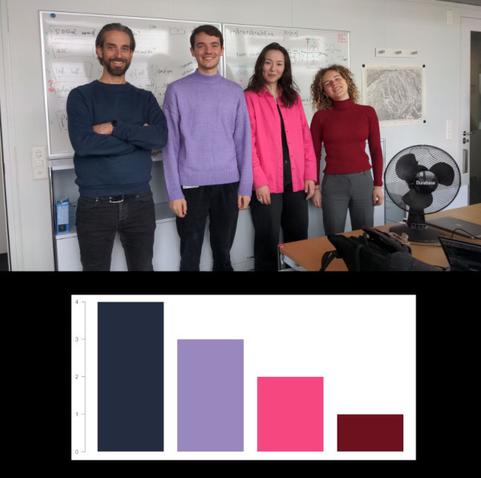
Do you already know the #CBDR_lab color palette for R? Particularly well-suited for barplots up to four bars.
Does loss aversion increase with age? This brief Current Opinion in Psych. article provides a review of recent findings and theoretical ideas. Open access here: https://sciencedirect.com/science/article/pii/S2352250X23002105
#aging #decisions #gains and #losses
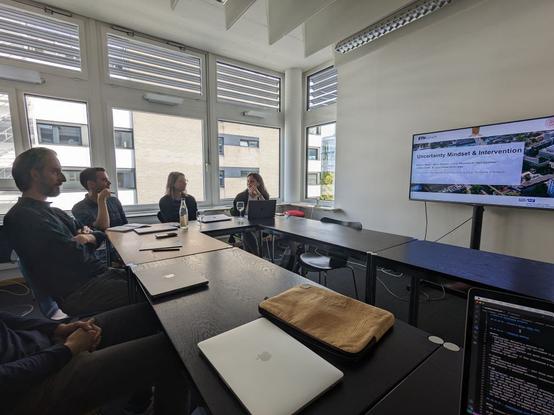
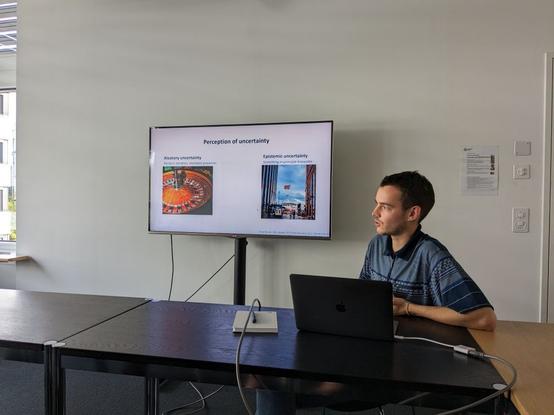
Since decades, scientist are debating the nature and structure of uncertainty. We are currently working on a project to improve our understanding of what people perceive when faced with uncertainty, and how they react to different types of it. Hopefully more to share soon!
Taking on the long journey from ETH, Alina Gerlach and Elaine Strittmatter visited us at #CBDR_lab, @oliviafischer, @renatofrey to talk about how people perceive and react to uncertainty.
You can find their work here: https://wop.ethz.ch/

We also found considerable variance in the same-side bias between our 48 tossers. The bias varied with a standard deviation of 1.6%, CI [1.2%, 2.0%], in our sample. The variation could be explained by a different degree of "wobbliness" between our tossers.

The manuscript is at arXiv: https://arxiv.org/abs/2310.04153
And the open data, code, and video recordings at OSF: https://osf.io/pxu6r/.

Fair coins tend to land on the same side they started: Evidence from 350,757 flips

Many people have flipped coins but few have stopped to ponder the statistical and physical intricacies of the process. We collected $350{,}757$ coin flips to test the counterintuitive prediction from a physics model of human coin tossing developed by Diaconis, Holmes, and Montgomery (DHM; 2007). The model asserts that when people flip an ordinary coin, it tends to land on the same side it started -- DHM estimated the probability of a same-side outcome to be about 51\%. Our data lend strong support to this precise prediction: the coins landed on the same side more often than not, $\text{Pr}(\text{same side}) = 0.508$, 95\% credible interval (CI) [$0.506$, $0.509$], $\text{BF}_{\text{same-side bias}} = 2359$. Furthermore, the data revealed considerable between-people variation in the degree of this same-side bias. Our data also confirmed the generic prediction that when people flip an ordinary coin -- with the initial side-up randomly determined -- it is equally likely to land heads or tails: $\text{Pr}(\text{heads}) = 0.500$, 95\% CI [$0.498$, $0.502$], $\text{BF}_{\text{heads-tails bias}} = 0.182$. Furthermore, this lack of heads-tails bias does not appear to vary across coins. Additional analyses revealed that the within-people same-side bias decreased as more coins were flipped, an effect that is consistent with the possibility that practice makes people flip coins in a less wobbly fashion. Our data therefore provide strong evidence that when some (but not all) people flip a fair coin, it tends to land on the same side it started.

arXiv.org