František Bartoš

@fbartos
396 Followers
205 Following
16 Posts
PhD Candidate | Psychological Methods at University of Amsterdam | interested in statistics, meta-analysis, and publication bias
Webhttps://www.frantisek-bartos.info/
GitHubhttps://github.com/FBartos
Scholarhttps://scholar.google.com/citations?user=vAo-APsAAAAJ&hl=en

Our "ADEMP-PreReg" preregistration template for simulation studies is now available on OSF Registries!

We also gave an interview about the template and our reasons for creating it, read more here <https://www.cos.io/blog/introducing-the-simulation-studies-preregistration-template>

We welcome any feedback or suggestions at <https://github.com/bsiepe/ADEMP-PreReg>

Introducing the Simulation Studies Preregistration Template: Q&A with Björn S. Siepe, František Bartoš, and Samuel Pawel

Initially submitted through COS’s open call for community-designed preregistration templates, the Simulation Studies Template is now part of the expanding collection of preregistration resources available on the OSF.

I am sure many have heard about the landmark study by Bartos (@fbartos) et al. (2023) where 48 people flipped a coin 350,757 times to examine same-side bias (the slightly larger than 50% chance that a coin will land on the same side as where it started): https://arxiv.org/abs/2310.04153

Given that this is such a neat dataset, I have now added this to the metadat package: https://wviechtb.github.io/metadat/reference/dat.bartos2023.html

#RStats #MetaAnalysis #FlippingCoinsForScience

Fair coins tend to land on the same side they started: Evidence from 350,757 flips

Many people have flipped coins but few have stopped to ponder the statistical and physical intricacies of the process. We collected $350{,}757$ coin flips to test the counterintuitive prediction from a physics model of human coin tossing developed by Diaconis, Holmes, and Montgomery (DHM; 2007). The model asserts that when people flip an ordinary coin, it tends to land on the same side it started -- DHM estimated the probability of a same-side outcome to be about 51\%. Our data lend strong support to this precise prediction: the coins landed on the same side more often than not, $\text{Pr}(\text{same side}) = 0.508$, 95\% credible interval (CI) [$0.506$, $0.509$], $\text{BF}_{\text{same-side bias}} = 2359$. Furthermore, the data revealed considerable between-people variation in the degree of this same-side bias. Our data also confirmed the generic prediction that when people flip an ordinary coin -- with the initial side-up randomly determined -- it is equally likely to land heads or tails: $\text{Pr}(\text{heads}) = 0.500$, 95\% CI [$0.498$, $0.502$], $\text{BF}_{\text{heads-tails bias}} = 0.182$. Furthermore, this lack of heads-tails bias does not appear to vary across coins. Additional analyses revealed that the within-people same-side bias decreased as more coins were flipped, an effect that is consistent with the possibility that practice makes people flip coins in a less wobbly fashion. Our data therefore provide strong evidence that when some (but not all) people flip a fair coin, it tends to land on the same side it started.

arXiv.org

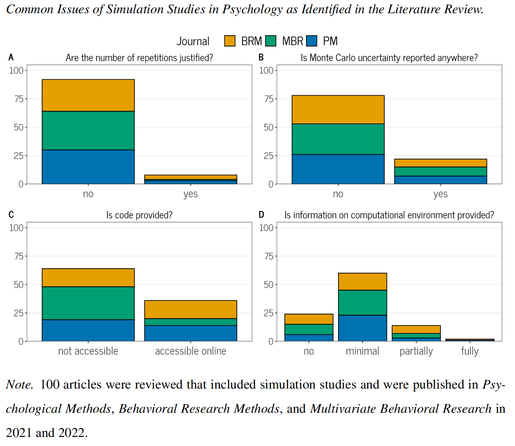
New preprint "Simulation Studies for Methodological Research in Psychology: A Standardized Template for Planning, Preregistration, and Reporting"

In our review of 100 simulation studies published in prominent methodological journals in psychology, we find that most articles do not justify the number of simulation repetitions, do not report Monte Carlo uncertainty, and do not provide code or computational details.

https://doi.org/10.31234/osf.io/ufgy6

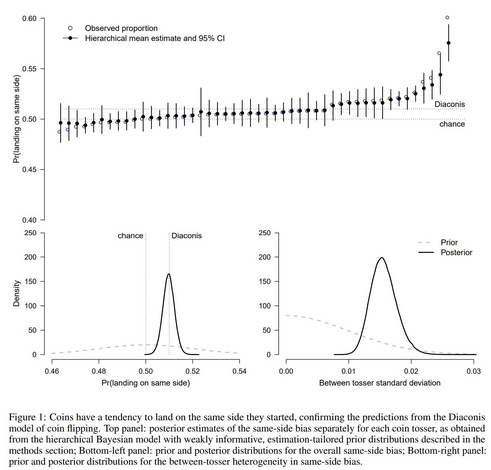
We also found considerable variance in the same-side bias between our 48 tossers. The bias varied with a standard deviation of 1.6%, CI [1.2%, 2.0%], in our sample. The variation could be explained by a different degree of "wobbliness" between our tossers.

The manuscript is at arXiv: https://arxiv.org/abs/2310.04153
And the open data, code, and video recordings at OSF: https://osf.io/pxu6r/.

Fair coins tend to land on the same side they started: Evidence from 350,757 flips

Many people have flipped coins but few have stopped to ponder the statistical and physical intricacies of the process. We collected $350{,}757$ coin flips to test the counterintuitive prediction from a physics model of human coin tossing developed by Diaconis, Holmes, and Montgomery (DHM; 2007). The model asserts that when people flip an ordinary coin, it tends to land on the same side it started -- DHM estimated the probability of a same-side outcome to be about 51\%. Our data lend strong support to this precise prediction: the coins landed on the same side more often than not, $\text{Pr}(\text{same side}) = 0.508$, 95\% credible interval (CI) [$0.506$, $0.509$], $\text{BF}_{\text{same-side bias}} = 2359$. Furthermore, the data revealed considerable between-people variation in the degree of this same-side bias. Our data also confirmed the generic prediction that when people flip an ordinary coin -- with the initial side-up randomly determined -- it is equally likely to land heads or tails: $\text{Pr}(\text{heads}) = 0.500$, 95\% CI [$0.498$, $0.502$], $\text{BF}_{\text{heads-tails bias}} = 0.182$. Furthermore, this lack of heads-tails bias does not appear to vary across coins. Additional analyses revealed that the within-people same-side bias decreased as more coins were flipped, an effect that is consistent with the possibility that practice makes people flip coins in a less wobbly fashion. Our data therefore provide strong evidence that when some (but not all) people flip a fair coin, it tends to land on the same side it started.

arXiv.org
If you bet a dollar on the outcome of a coin toss 1000 times, knowing the starting position of the coin toss would earn you 19$ on average. This is more than the casino advantage for 6deck blackjack against an optimal player (5$) but less than that for single-zero roulette (27$).
We found overwhelming evidence for a "same-side" bias predicted by Diaconis and colleagues in 2007: If you start heads-up, the coin is more likely to land heads-up and vice versa. How large is the bias? In our sample, the mean estimate is 50.8%, CI [50.6%, 50.9%].

About a year ago, we embarked on a quest to answer one of the most intriguing questions:

If you flip a fair coin and catch it in hand, what's the probability it lands on the same side it started?

Today, we are finally ready to share the results. Thanks to my friends, collaborators, and even strangers from the internet, we collected flippin 350,757 coin flips. We ran several "Coin Tossing Marathons" (e.g., https://youtu.be/3xNg51mv-fk?si=o2E3hKa-ReXodOmc) and spent countless hours flipping coins.

Coin Tossing Marathon (4th of December 2022)

YouTube
New preprint "Exploring Open Science Practices in Behavioural Public Policy" with
@fbartos, Nichola Raihani, David Shanks, T.D. Stanley, @EJWagenmakers & Adam Harris.
https://psyarxiv.com/msv8y
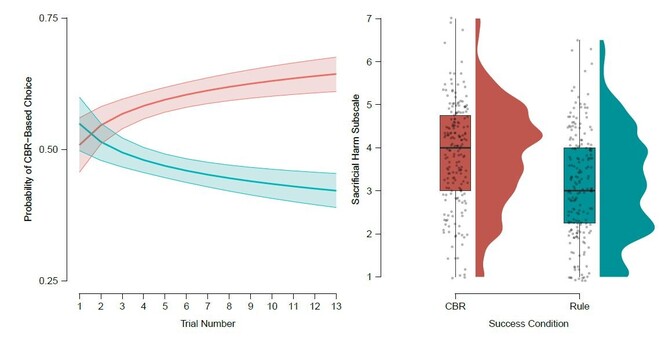
New preprint with Vanessa Cheung, @fbartos , & Falk Lieder "Learning from Consequences Shapes Reliance on Moral Rules vs. Cost-Benefit Reasoning". Using realistic moral dilemmas with outcomes, we show that moral decision-making is shaped by experience (https://doi.org/10.31234/osf.io/gjf3h).
Now Coin Tossing with Research Master Students at UvA!
https://www.twitch.tv/cointossingteam
CoinTossingTeam - Twitch

The Coin-Tossing Marathon

Twitch