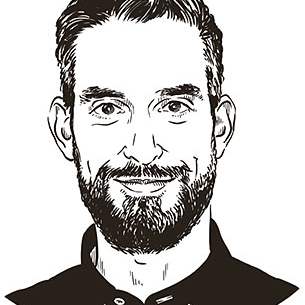
Renato Frey

187 Followers
94 Following
44 Posts
Professor of psychology @ University of Zurich, #CBDR_lab. Data science. R. Python. Decision making. Cognition. Behavior. Risk and uncertainty. Meta science.
Webhttps://renatofrey.net
Webhttps://cbdr-lab.net
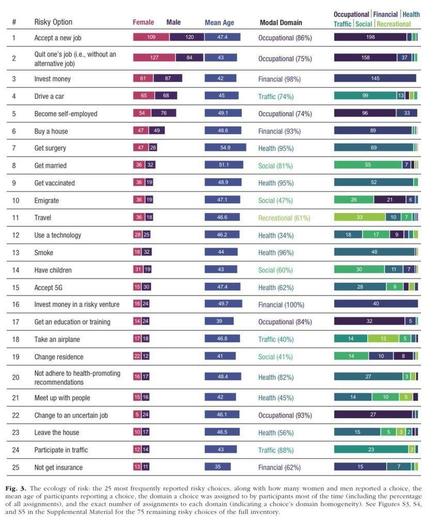
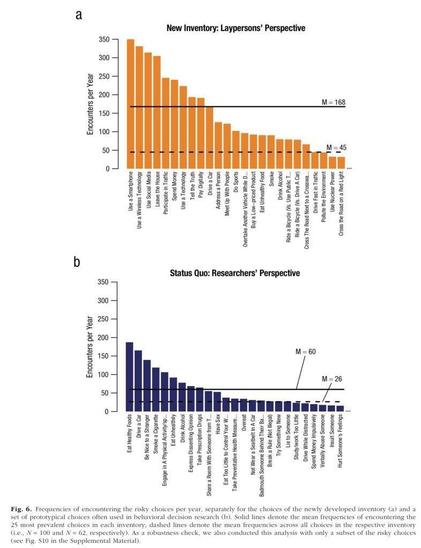
Which risky choices should (and do) we study as behavioral scientists? In two related articles, we recently examined the current "ecology of risk" (i.e., laypersons' reports on what risky choices they face in real life) and how these choices differ from those typically studied in the lab. See https://journals.sagepub.com/doi/10.1177/09567976251384975 and https://psycnet.apa.org/record/2027-13320-001 With @oliviafischer and @aaronlob #risk #decisions #cbdr_lab

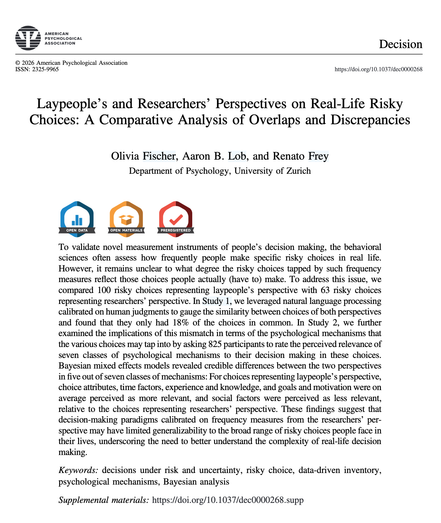
Modern life confronts us with a uniquely large and diverse set of risks.

@renatofrey & Fischer mapped 100 of them using a large Swiss survey, collectively a rich, comprehensive inventory across life domains, superior to conventional selections:

https://journals.sagepub.com/doi/full/10.1177/09567976251384975

People sometimes say they do not have time to do open science. But they can use the time they would have needed 40 years ago to send and request paper copies of articles to read the literature.

Somehow we never acknowledge where we gained time that we can invest in open science.

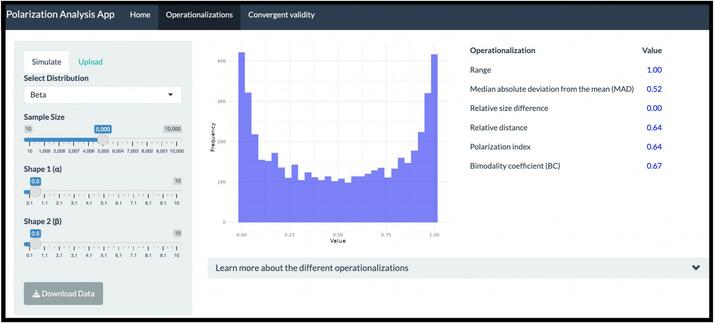
These days, everyone is talking about #polarization. But how best to measure it? Olivia Fischer and I have a new paper that empirically compares various operationalizations of polarization (e.g., on people's risk perceptions), including a shiny app to simulate and analyze different kinds of polarization. https://dx.doi.org/10.1002/bdm.70041 #CBDR_lab @oliviafischer
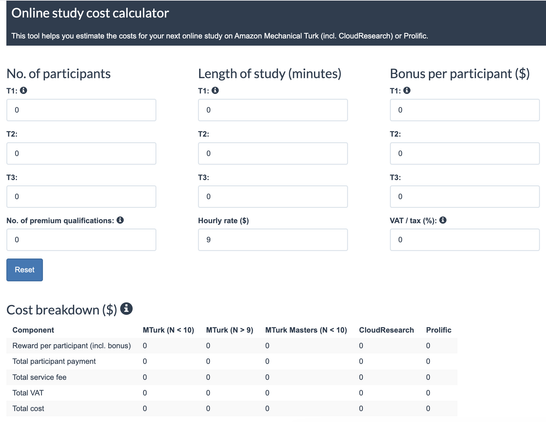
Planning an online study and wondering how much it will cost? I designed a Shiny app to help with this tedious task. Just input the number of participants, study duration, and hourly pay for up to three studies, and get a cost breakdown for each platform.This and other apps are available here: https://www.psychology.uzh.ch/en/areas/nec/cogres/services.html
#CBDR_lab
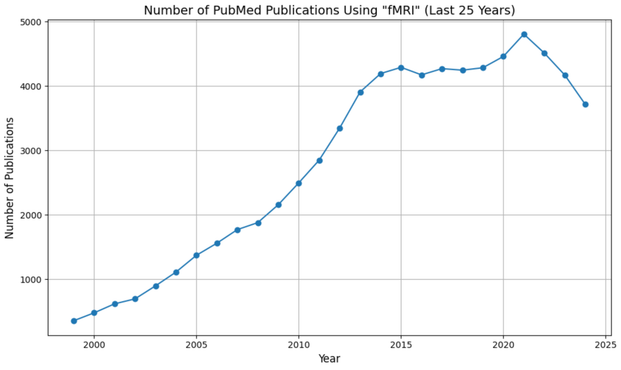
Has fMRI peaked?

the outcry on Bluesky over the 1 million Bluesky post Huggingface data set for ML training seems like a perfect illustration of how people’s desires regarding privacy and consent are not just at odds with what platforms give them, but also with *their own actions* (e.g., the consent to terms/conditions they regularly give).

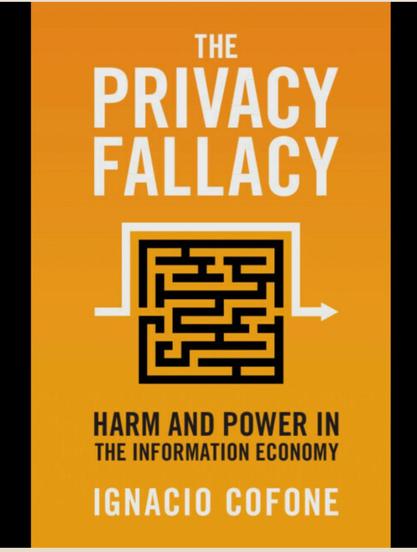
This book makes a strong case for why the current consent-based approach to privacy and data harms is fundamentally inadequate, and we need very different legal tools

last comment on the Bluesky post Hugginface ML training set issue. For those querying whether this has “the consent of the Bluesky team and Jay Garber”, the Bluesky preprint from the beginning of the year explicitly mentioned network wide *sentiment analysis by companies* as a use for Bluesky data…

sentiment analysis *is* machine learning/AI.

…Bluesky is designed for this

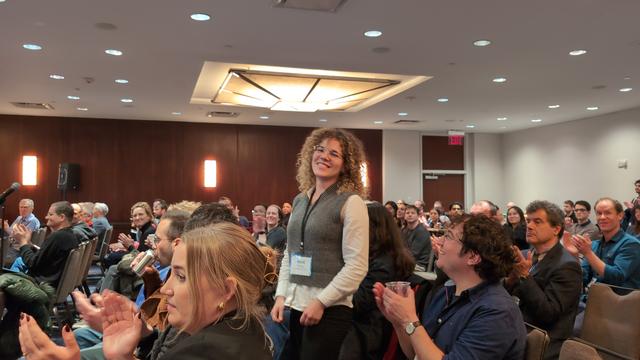
Congratulations to Maué Pantoja (https://cbdr-lab.net/pantoja/) for the 2nd place of the student poster award (Society for Judgment & Decision Making #SJDM / New York) 🚀🚀 🚀 #CBDR_lab
Read the paper here: https://arxiv.org/abs/2310.04153
Watch the Ig Nobel prize ceremony here: https://improbable.com/ig/archive/2024-ceremony/
Fair coins tend to land on the same side they started: Evidence from 350,757 flips

Many people have flipped coins but few have stopped to ponder the statistical and physical intricacies of the process. We collected $350{,}757$ coin flips to test the counterintuitive prediction from a physics model of human coin tossing developed by Diaconis, Holmes, and Montgomery (DHM; 2007). The model asserts that when people flip an ordinary coin, it tends to land on the same side it started -- DHM estimated the probability of a same-side outcome to be about 51\%. Our data lend strong support to this precise prediction: the coins landed on the same side more often than not, $\text{Pr}(\text{same side}) = 0.508$, 95\% credible interval (CI) [$0.506$, $0.509$], $\text{BF}_{\text{same-side bias}} = 2359$. Furthermore, the data revealed considerable between-people variation in the degree of this same-side bias. Our data also confirmed the generic prediction that when people flip an ordinary coin -- with the initial side-up randomly determined -- it is equally likely to land heads or tails: $\text{Pr}(\text{heads}) = 0.500$, 95\% CI [$0.498$, $0.502$], $\text{BF}_{\text{heads-tails bias}} = 0.182$. Furthermore, this lack of heads-tails bias does not appear to vary across coins. Additional analyses revealed that the within-people same-side bias decreased as more coins were flipped, an effect that is consistent with the possibility that practice makes people flip coins in a less wobbly fashion. Our data therefore provide strong evidence that when some (but not all) people flip a fair coin, it tends to land on the same side it started.

arXiv.org