21 Followers
43 Following
39 Posts

Observations, thoughts and facts about selected things in museums.

(Photo attributions in ALT tags.)

What adventurous setting inspired many children's toys? Outer space!

Toys from the 2 decades in which human spaceflight went from science fiction to reality—the 1950s and 1960s—added lights and sound, while Japan's toy manufacturers perfected the small motors that gave their toys much-prized movement.

Colourful examples from 1965 are: (clockwise) Astro 8 flying saucer by Marubishi-Yamazaki, Dan Dare Space Control Radio Station by JL Randall (1961), Moon Explorer by Masudaya, and Moon Rocket rocketship by Matsuya.

Such toys were usually battery powered, though Astro 8 was friction powered via its wheels. Space Control Radio Station had sound—handsets plugged in to the console, which had a Morse-code lever and scroll for decoding. Moon Rocket could simulate a landing; it mechanically set itself upright, opened a door, and then lowered a ramp.

Details are in the image descriptive ALT text.

#Art #Design #child #toy #Japan #UK #space #SpaceRace #moon #rocket #VictoriaAndAlbert #Museum

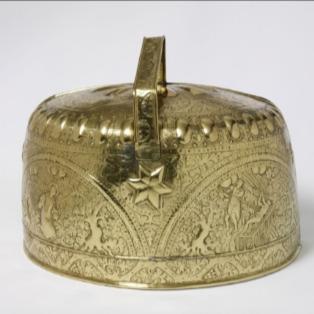
How did 1600s Dutch households keep their fire embers from going out at night? With a curfew.

Yes, it's a pun. Curfews were metal covers that kept fire embers smouldering overnight, to be revived for the next day's cooking and heating. The word curfew comes from the French for fire cover (couvre feu).

The brass one pictured here is among the earliest to survive, made in Holland but now in London's V&A. It's embossed with an image of Saint Lawrence.

This is dark humour, since Lawrence was roasted alive in the third century—punishment for perhaps the first Christian protest. The early church's refusal to worship Roman gods led to persecution. Lawrence was ordered to surrender the church's treasures to authorities. He turned up with the sick, marginalized, poor, elderly, and widows, boldly proclaiming: “These are the true treasures of the church.” For this insolence, he was martyred (killed).

#art #design #brass #heating #fire #religion #saint #martyr #VictoriaAndAlbert #museum #UK

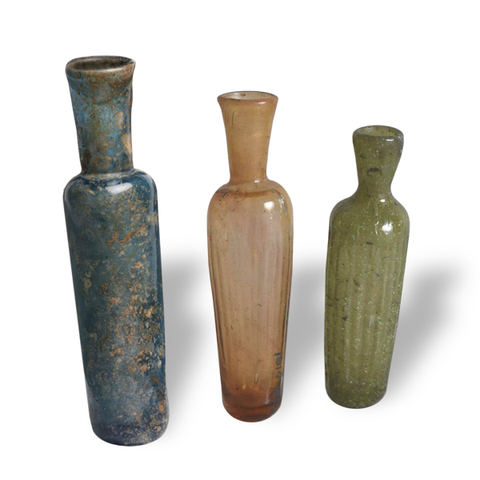
Would you carry plant oil and perfume in tiny bottles around your neck? Romans did.

Perfume was used for its sensual pleasure, but also burned with offerings to appease the gods, and to ward off disease.

Rather than alcohol, the base of Roman perfume was oil and fat—olive, bitter almond oil—or the juice of unripe grapes.

The scented materials were mainly imported from Greek city states or other Mediterranean ports like Alexandria in Egypt. Roses, pomegranates, lavender, quinces, grapes, rosemary, basil and, if you could afford it, cinnamon myrrh, classic incense, resins, or roots.

Perfume was priced for its ingredients and bottle. Bottles could be highly decorated with gems, made of alabaster, bronze, lead, silver, or gold. Around their necks, Roman women would tie on a bottle shaped like a sphere, pear, dove, woman’s head, or cup. The ones pictured are tubes, from Rome and Alexandria.

See the ALT text.

#art #design #glass #bottle #perfume #AncientRome #VictoriaAnAlbert #museum

What does it take to design artistic mass-market goods? Producibility.

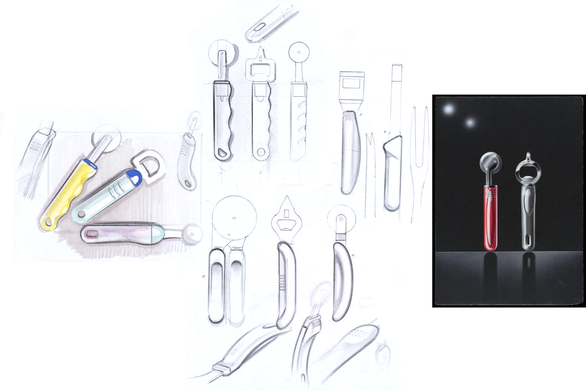
For his designs of household appliances and kitchen gadgets, Italian Pino Spagnolo looked beyond aesthetic and emotional factors to the cost of materials, which affects the final price of the item.

From the late 1980s, Spagnolo's design studio specialised in transposing day-to-day dreariness into the world of art. He did this not only with kitchenware—coffee pots, corkscrews, cutlery, vases, and bar sets—but also in transportation (motorcycles, trains, yachts) and interior architecture.

Producibility was key to the Turin-based design studio's success: understanding the production technologies of the company commissioning a design. To bring art into day-to-day household work, a manufacturer must be able to profitably make and sell an object at the right price.

V&A has 40 Spagnolo objects: https://collections.vam.ac.uk/context/organisation/A16695/pino-spagnolo-design-snc

#art #design #household #VictoriaAndAlbert #museum #tool #utensil #appliance

What could a bow shoot, besides arrows? Stones or pellets.

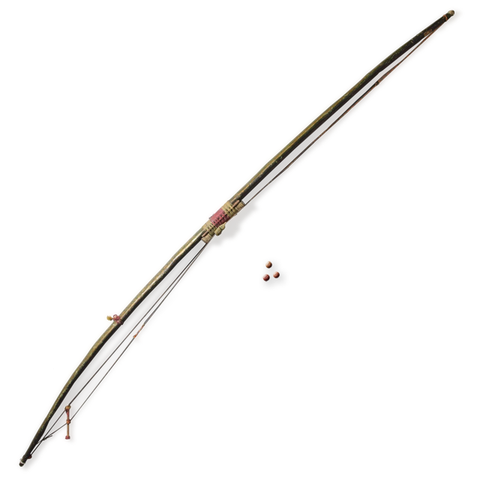
Pellet bows propel a pebble or clay pellet from a silk pouch on a double string.

The artistry is both in making the bow and string and in the shooting technique, or khatra. On releasing the string and pellet, archers must immediately move the bow—and the hand holding it—out of the path of the projectile, to avoid painful injury.

Pellet bows were used to hunt small game, on the ground or in flight.

Pictured is a bamboo galalee, goolal, or gulal, from mid-1800s Lahore, India. This bow has double strings of thin bamboo strips and blackened thread, joined in the centre by a sling attachment, for hurling clay pellets or stones. It's painted in green and gold, with ivory mountings.

This weapon was displayed in the India Museum from 1879, then transferred down the road in 1955 to the South Kensington, later the Victoria & Albert, then to the V&A's East Storehouse.

#design #art #weapon #bow #archery #VictoriaAndAlbert #museum #UK

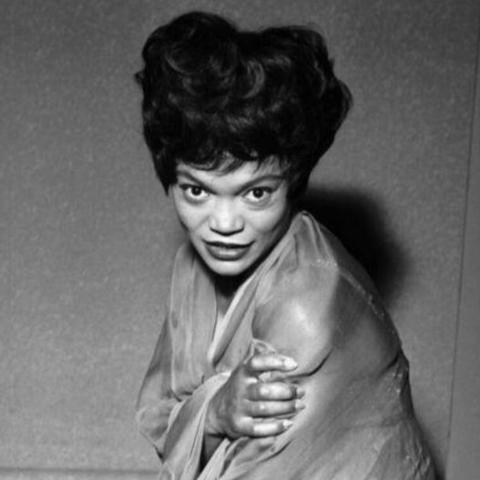
What was singer Eartha Kitt known for, besides the definitive rendition of Santa Baby? Acting and activism.

There's her growling purr, a half-dozen songs on the 1950s pop charts, roles on stage and screen—famously as Catwoman to TV's Batman—and as a voice actor in later years. Her collaborator Orson Welles called her "The most exciting woman in the world." Kitt won a Tony and 3 Emmy awards. She died Christmas day, 2008.

In 1950s London, Tin Pan Alley and pop-scene photographer Harry Hammond took a series of black-and-white photos of Kitt. The #VictoriaAndAlbert #Museum now houses the negatives.

Eartha Kitt was also a peace and LGBT+ activist. During the 1960s Vietnam war, she berated her White-House luncheon hosts, saying: "You send the best of this country off to be shot and maimed. No wonder kids rebel and take pot." The fallout meant an unflattering CIA dossier and a career shift to Europe and Asia.

#art #design #photography #performance #EarthaKitt #BlackAndWhitePhotography

Can a cookie tin be a work of decorative art? Yes.

When the UK's Licensed Grocer's Act of 1861 first allowed the sale of individually packaged groceries, decorative cookie tins ("biscuit tins" in the UK) got their start. These simple metal boxes were soon embossed with 3D detail, and decorated with colourful lithographic prints.

They sold as Christmas gifts for children. (UK grocer Marks & Spencer continues the tradition.) Later tins appealed to adults, and decorated middle-class homes across Britain's empire.

By 1890, the mass-produced tins mimicked other objects in shape—first baskets, then collectable art like Chinese vases.

The 1912 "Bell" biscuit tin below has a faux copper finish. It's in the Victoria and Albert Museum's collection, and was made for Reading, UK, biscuit makers Huntley & Palmers. See the image description (ALT text) for details.

Today's biscuit tins are sometimes sold in UK fundraisers.

#art #design #VictoriaAndAlbert #museum #cookie #biscuit #tin #container

Which rock guitarist only took up playing at age 20? Jimi Hendrix.

Hendrix grew up poor and Black in the USA's Pacific northwest. At 19, he found himself in court facing a choice of 3 years in prison or 2 years in the Army—during the Vietnam war. He chose Army, quickly managed to get thrown out, and took up guitar. By 1966 he'd moved to England, where he rocketed to fame. Hendrix was the era's most influential instrumental guitarist.

This 1967 photo of Hendrix in his prime is by Linda Eastman, photographer of such 1960s music luminaries as Aretha Franklin, Bob Dylan, Janis Joplin, the Doors, the Who, and Neil Young. She was the first female photographer to make a Rolling Stone magazine cover. She was known for publicity shots of bands on tour, and intimate, behind-the-scenes photos.

Hendrix died at 27, in 1970 in London. Eastman died in 1998. Her husband, former Beatles singer Paul McCartney, donated her work to V&A about a decade ago.

#art #design #photograph #music #rock #guitar

Which relative did Napoleon execute? A brother-in-law.

Carolina, said to resemble her brother in political astuteness, lost her husband due to her own ambitious miscalculation. Carolina's rise began at 17 with her marriage to Napoleon's officer, Joachim Murat. She soon became Grand Duchess of Berg, and Queen of Napoli.

Carolina's affluent life is reflected in the parure, or set of jewellery, shown below. This five-piece parure showcases the fine and detailed hardstone mosaic work of Laboratorio delle Pietre Dure. This workshop was established in Naples in 1737 by Charles VII, then King of Naples.

Carolina meddled in Napoleon's marriage to Josephine, and in a 1815 persuaded her husband to fight Napoleon. Murat was defeated and executed. Carolina fled to Trieste, renamed herself Countess of Lipona (an anagram of Napoli), and married another military man. In 1839 she died of the Bonaparte weakness, stomach cancer.

#art #design #jewellery #jewelry #hardstone #VictoriaAndAlbert #museum

A beer jug promoted anti-slavery? Yes.

John Turner made this jug around the 1800s in what's now Stoke-on-Trent. Then, its coal-fired potteries caused heavy air-pollution and hazardous working conditions typical of England's industrial revolution and continuing until the UK's 1968 Clean Air Act.

Interestingly, out of one oppression came political support to end another: Turner's jug has an abolitionist theme.

Such jugs were fashionable around 1800 when decorated with an allegorical message. Turner's was more political—apparently unique—as the symbolic Britannia helps a slave. (See the image description in its ALT text for details). At the time, the anti-slavery campaign was unpopular in ports like Bristol and Liverpool, which served trade that used enslaved people.

However, the message on this jug didn't harm Turner. He was appointed Potter to the Prince of Wales in 1784 and had a retail outlet in London.

#art #design #pottery #VictoriaAndAlbert #museum #slavery #abolition #race