This is the only time, in our lifetime, that we have any chance of fighting back. Soon things will be so oppressive all efforts will be crushed immediately in devastating ways. This is the only chance we get in our lifetime and not enough people are grasping that.
This is the only time, in our lifetime, that we have any chance of fighting back. Soon things will be so oppressive all efforts will be crushed immediately in devastating ways. This is the only chance we get in our lifetime and not enough people are grasping that.
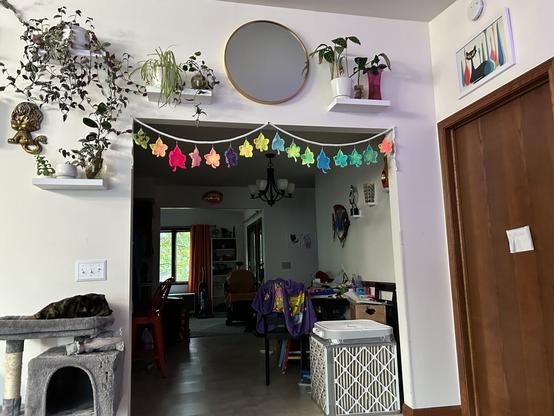
I made some leaves… 🩷🧡💛💚🩵💜
Image description: crochet leaves in many bright, bold colors of pinks, oranges, yellows, blues, and greens across between rooms, beneath a gold mirror with white shelves on either side, with a variety of plants on each shelf. There is a corsi-rosenthal box on the lower right hand side. Beneath the mirror, shelves and leaves, it’s dark, so not much is visible aside from a window in the distance on the left.
From: A Cherokee Feast of Days - Daily Meditations - Joyce Sequichie Hilfer
“October 14
It is peculiar how important something can be at one time and how totally unimportant at another. As we grow, our interests grow. We lose sight of situations we thought to be footed in concrete.
Lovely or unlovely, nothing stays the same. It cannot.
It grows into something newer and better, or it gives way where it is. Life is a living, moving force at every moment. We would not have that change-but to live happily, we must change. We cannot allow ourselves to crystallize until we are inflexible. There is too much to shatter us if we cannot bend. To enjoy the present moment is to have the innate knowledge that the next one and the next can be even better.
My forefathers were warriors. Their son is a warrior.
From them I take my existence, from my tribe I take nothing. I am the maker of my own fortune.
TECUMSEH”
Covid Safety Isn't an Anxiety Disorder:
Why Health Care Professionals should avoid pathologizing Covid precautions
MENTA
FIFTH EDITION
TEXT REVISION
DSM-5 TR
What we know about fear & anxiety
• In the DSM-5 TR, Criteria D for a diagnosis of "Specific Phobia" states
"the fear or anxiety.is.out of.proportion to the actual danger.posed by the specific object or situation and to the sociocultural context."
• We know that "anxiety.and fear responses are necessary components of adaptive behavior" (Ahmari et al., 2009).
• So what about those who have fears about Covid?
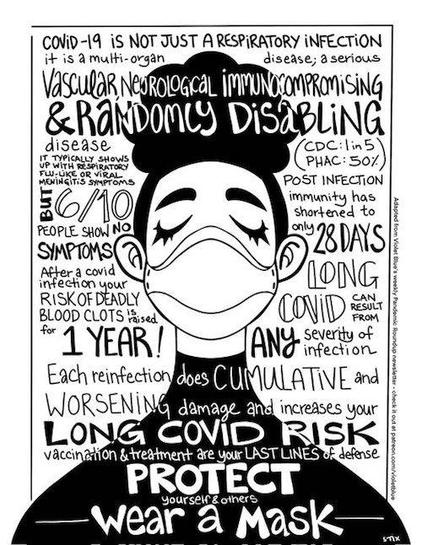
What we know about Covid & Long Covid
• 75.4% of U.S. adults had at least one increased-risk condition, 40.3% had at least two, and 18.5% had three or more conditions (Ajufo et al.. 2021).
• CDC defines high-risk populations: "racial and ethnic minority groups," pregnant people, infants, age 65+, developmental disabilities, mood disorders, diabetes, asthma, autoimmune diseases, & more
• CDC says: symptoms can last weeks, months, years or be lifelong
• American Medical Association: 20-30% of patients will develop Long Covid
• 200+ potential symptoms, across all organ systems
COVID-19 • Risk increases with each infection (Bowe et al. 2022).
* * 70% of individuals with long COVID exhibited evidence of damage to at least one organ (Li et al. 2023).
• Covid is still a novel virus, and while we know a lot about the harm it can cause, there are likely many health problems that may take years to come to light, much like HIV and AIDS.
Putting it all together
• With all that we know about Covid, the harm it can cause, and the potential for many negative long term health outcomes, it is very reasonable to take steps to avoid infection. The best way to prevent long Covid is to prevent infection in the first place.
• Taking safety precautions like wearings masks, avoiding large gatherings, and limiting time in indoor spaces are all rational choices that are proportional to the dangers of a Covid infection.
• We would

COVID-19
MYTHS VS. FACTS
* MYTH
Everyone will get COVID-19 at some point, so there's no point in trying to prevent it.
FACT
Every new COVID-19 infection increases your risk of serious illness, Long COVID, and permanent organ damage, even if you are young and healthy, so it's important to avoid illness as much as you can.
* MYTH
I won't get COVID-19 as long as I wash my hands well.
A FACT
It's always a good idea to wash your hands, but COVID-19 spreads primarily through the air and respiratory droplets, so handwashing is much less likely to prevent COVID-19 than wearing masks.
X MYTH
If l've already had COVID-19 once, I'm immune from getting it again.
A FACT
There is no limit on how many times you can get
COVID-19. Reinfection is common, and each new infection raises your risk of serious illness, organ damage, Long COVID, and more.
* MYTH
I don't have access to the highest quality masks, so there's no reason to wear one at all.
FACT
High-quality masks like N95s and KN95s (these are also called respirators) provide the best protection against COVID-19, but any mask is better than nothing. Wear the best available to you.





 Dinah 🕊🇺🇦