
Hugh Lewis
- 418 Followers
- 111 Following
- 242 Posts
Member of the Astronautics Research Group at the University of Southampton with interests in space debris, NEOs, modelling and AI. Also a #pwME
 Dr. John Barentine FRAS
Thanks to T.S. Kelso for support with the SOCRATES/SOCRATES PLUS data (here: https://celestrak.org/SOCRATES/) and @planet4589 for support with the Starlink statistics (here: https://planet4589.org/space/con/star/log.dat) [6/6; fin]
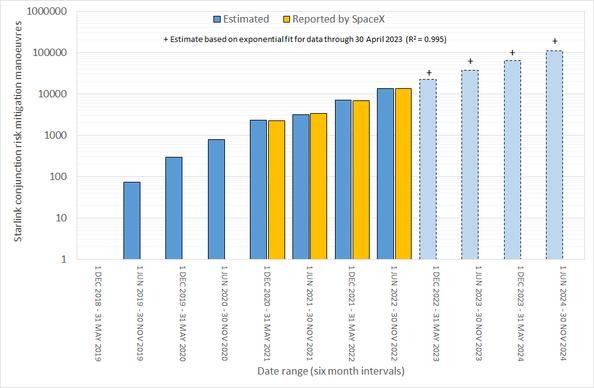
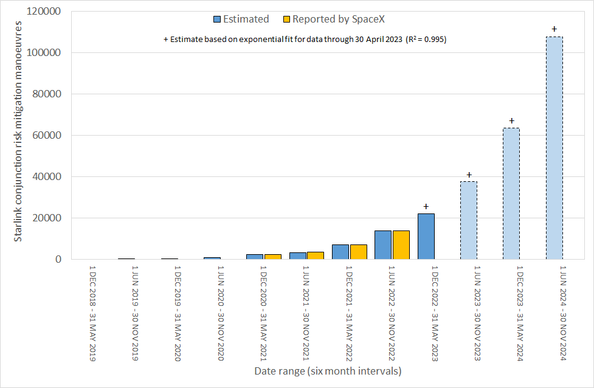
Based on the predictions, I think SpaceX could be reporting > 100,000 new manoeuvres in the 12 months from 1 June 2023 (if the trends continue; note the caveat about correlation/causation in the image description above) [4/n]
Here, I looked at the manoeuvre estimates/reports in 6-monthly intervals, corresponding to the reporting periods used by SpaceX. Additionally, I added a prediction to the end of 2024 based on an exponential fit through 30 April 2023. [3/n]
A better relationship to consider is the one between the (cumulative) number of manoeuvres and the (cumulative) number of Starlink satellites launched. The growth is a non-linear function of the number of Starlink satellites [2/n]
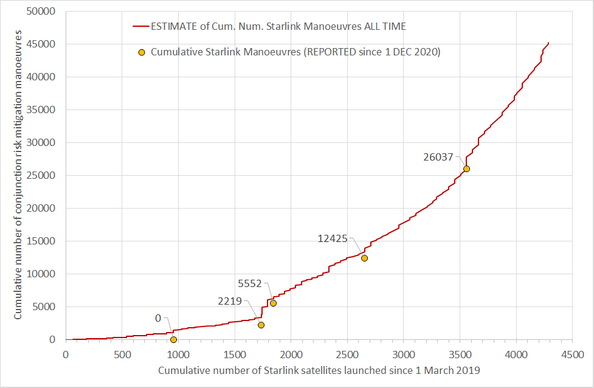
Welcome to this month's look at #Starlink conjunction risk mitigation manoeuvres. Through 30 April 2023, I estimate that Starlink satellites have made a total of > 45,000 manoeuvres to mitigate the risk of colliding with other space objects. The number of manoeuvres is growing exponentially (see later in the thread) because the number of Starlink satellites in orbit is increasing and the number of other objects in orbit is increasing [1/n]

@alysondecker the number of manoeuvres is (now) driven primarily by the number of Starlink satellites. As the constellation has grown in size there has been a disproportionate increase in the number of conjunction risk mitigation manoeuvres by satellites in the constellation.
@jknodlseder I have the data but I haven't plotted it.
In March 2023 alone, Starlink satellites likely performed more conjunction risk mitigation manoeuvres ('collision avoidance manoeuvres') than they did in the entire first 2.5 years of Starlink deployment.