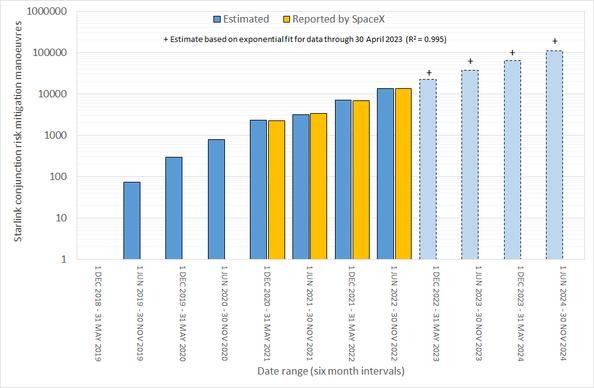
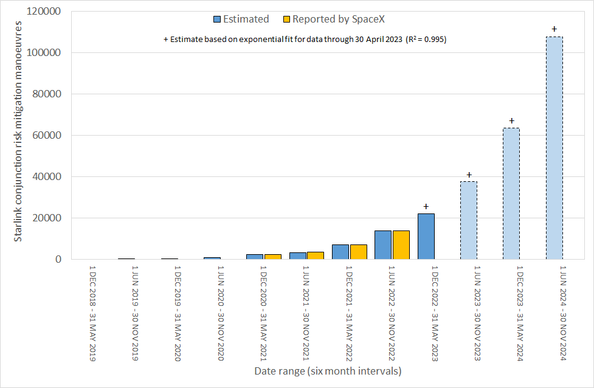
Here's the same chart but with a logarithmic y-axis [5/n]
Here, I looked at the manoeuvre estimates/reports in 6-monthly intervals, corresponding to the reporting periods used by SpaceX. Additionally, I added a prediction to the end of 2024 based on an exponential fit through 30 April 2023. [3/n]
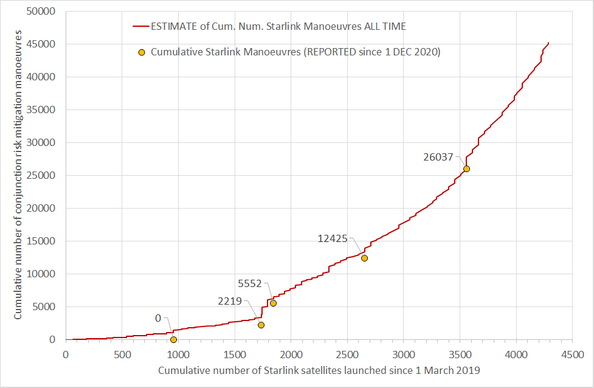
A better relationship to consider is the one between the (cumulative) number of manoeuvres and the (cumulative) number of Starlink satellites launched. The growth is a non-linear function of the number of Starlink satellites [2/n]
Welcome to this month's look at
#Starlink conjunction risk mitigation manoeuvres. Through 30 April 2023, I estimate that Starlink satellites have made a total of > 45,000 manoeuvres to mitigate the risk of colliding with other space objects. The number of manoeuvres is growing exponentially (see later in the thread) because the number of Starlink satellites in orbit is increasing and the number of other objects in orbit is increasing [1/n]
In March 2023 alone, Starlink satellites likely performed more conjunction risk mitigation manoeuvres ('collision avoidance manoeuvres') than they did in the entire first 2.5 years of Starlink deployment.
Finally, here is the historical evolution of all conjunctions predicted by SOCRATES (within 5 km) from March 2019 through February 2023. At the end of February, Starlink & OneWeb combined accounted for 63% of all conjunctions reported [9/n]
This insight is (perhaps partially) supported by the altitude distribution for the conjunctions (the ones in this chart are from a SOCRATES report generated on 4 March 2023 btw) [7/n]
If we look at these numbers as proportions of the total, for each constellation, the different distributions become more apparent. Current thinking is that the difference is a result of the orbit-raising by OneWeb satellites through the most highly-used region of LEO [6/n]
Categorising the predicted conjunctions (not just manoeuvres now) into those involving debris, other payloads, payloads from the same constellation, and rocket bodies reveals quite different distributions for the two constellations [5/n]
Here are the manoeuvre estimates shown as a function of the cumulative number of Starlink satellites launched. The gradient estimated for the last 500 Starlink satellites launched is ~24/satellite (compared with ~14/satellite for the previous 500 satellites launched) [3/n]