
Malin Wiese

328 Followers
799 Following
38 Posts
Kann man Nutzen und Wert von #Ökosystem|en angemessen bewerten? Ein Team um @MoritzDrupp @unihh und @_MartinHaensel #UniLeipzig hat neuen Berechnungsansatz vorgeschlagen, um Konsequenzen von #Naturzerstörung sichtbarer zu machen. #Klimawandel
https://nachrichten.idw-online.de/2024/03/08/wie-lassen-sich-dienstleistungen-der-natur-fuer-politische-entscheidungsprozesse-angemessen-bewerten
Wie lassen sich „Dienstleistungen“ der Natur für politische Entscheidungsprozesse angemessen bewerten?

For thousands of years…
---
RT @IPCC_CH
#IPCC's Synthesis Report 👉 https://bit.ly/SRYRpt23

With every increment of warming:

The risks, impacts & related losses & damages escalate.

Adaptation options are becoming more constrained & less effective.

What our future will look like depends on the choices we make today.
https://twitter.com/IPCC_CH/status/1640739067720527872

AR6 Synthesis Report: Climate Change 2023

Intergovernmental Panel on Climate Change

RT @ipbes
.@hdavidcooper, the new acting Executive Secretary for the UN Convention on Biological Diversity (CBD), said countries & corporations must act immediately on December’s historic agreement in Montreal.🌎

@UNBiodiversity

🗞️@pgreenfielduk for @Guardian⬇️
https://www.theguardian.com/environment/2023/mar/02/overconsumption-by-rich-must-be-tackled-says-acting-un-biodiversity-chief-aoe

Overconsumption by the rich must be tackled, says acting UN biodiversity chief

Wealthy countries and businesses should act now to ensure success of historic nature agreement signed at Cop15 in Montreal

The Guardian
Great explainer of the current weird weather extremes in North America by Susan and Mike! @ClimateComms @MichaelEMann https://thehill.com/opinion/energy-environment/3871118-enjoy-the-weather-worry-about-the-climate/
Enjoy the weather. Worry about the climate.

People tend to normalize extreme weather over just two to eight years, gradually coming to accept a more hostile environment as just the way things are now.

The Hill

Nature has just put out correspondence that calls for scholarly institutes to join the #fediverse, and start their own #mastodon instances.

Together with that, the writers put out a longer article, 'Mastodon over Mammon', that explains the argument in greater detail, and is worth reading.

Great work by @brembs et al, which points to the core issue: the private ownership of public commons.

Full version:
https://zenodo.org/record/7652771
Nature Correspondence:
https://www.nature.com/articles/d41586-023-00486-3

Mastodon over Mammon - Towards publicly owned scholarly knowledge

Twitter is in turmoil and the scholarly community on the platform is once again starting to migrate. As with the early internet, scholarly organizations are at the forefront of developing and implementing a decentralized alternative to Twitter, Mastodon. Both historically and conceptually, this is not a new situation for the scholarly community. Historically, scholars were forced to leave social media platform FriendFeed after it was bought by Facebook in 2006. Conceptually, the problems associated with public scholarly discourse subjected to the whims of corporate owners are not unlike those of scholarly journals owned by monopolistic corporations: in both cases the perils associated with a public good in private hands are palpable. For both short form (Twitter/Mastodon) and longer form (journals) scholarly discourse, decentralized solutions exist, some of which are already enjoying some institutional support. Here we argue that scholarly organizations, in particular learned societies, are now facing a golden opportunity to rethink their hesitations towards such alternatives and support the migration of the scholarly community from Twitter to Mastodon by hosting Mastodon instances. Demonstrating that the scholarly community is capable of creating a truly public square for scholarly discourse, impervious to private takeover, might renew confidence and inspire the community to focus on analogous solutions for the remaining scholarly record – encompassing text, data and code – to safeguard all publicly owned scholarly knowledge.

Zenodo

Tree planting is widely popular with programs from the Sahel to South Korea – but can it lead to *local* climate change?

Anna Papp, Charles Taylor, and I study this in a new WP "Rain Follows the forest: Land use policy, climate change, and adaptation" http://bit.ly/3xoqQrL

A short thread 1/8

Good piece, and another datapoint on relative inelasticity of ag land use at least in the short run

How Climate Change Is Making Tampons (and Lots of Other Stuff) More Expensive https://nyti.ms/3Z3daxY

How Climate Change Is Making Tampons (and Lots of Other Stuff) More Expensive

Cotton farmers in Texas suffered record losses amid heat and drought last year, new data shows. It’s an example of how global warming is a “secret driver of inflation.”

Get ready for a daily tweets highlighting the work of Black Economists to celebrate #blackhistorymonth2023

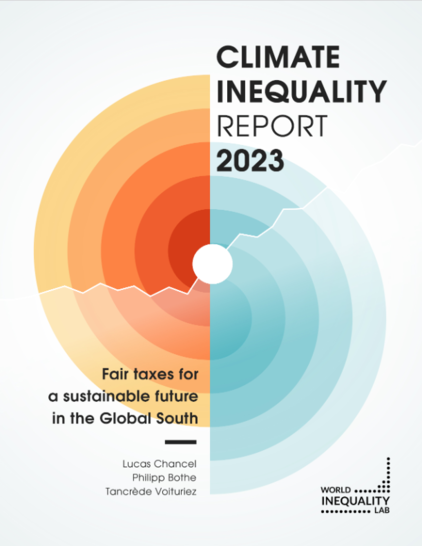
The Climate Inequality Report 2023 is out:
Fair taxes for a sustainable future in the global South

https://wid.world/wp-content/uploads/2023/01/CBV2023-ClimateInequalityReport1.pdf

"What is the link between winter storms and global warming?" by Lucie Aubourg for @afpfr / @RawStory: https://www.rawstory.com/what-is-the-link-between-winter-storms-and-global-warming-2659036599/
What is the link between winter storms and global warming?

The world is getting warmer, winters included. The United States, however, has experienced severe winter storms in recent years, and experts are taking a closer look at the link between these extreme cold events and climate change.While the link between global warming and heat waves is very direct, ...

Raw Story - Celebrating 18 Years of Independent Journalism