133 Followers
18 Following
22 Posts

Max Planck Institute for Neurobiology of Behavior – caesar

How does the collective activity of the vast numbers of interconnected neurons in the brain give rise to the plethora of animal behaviors? Our research departments and groups address neuroethology questions in a range of animals species from worms to fish to mammals to birds using a variety of unique techniques.

Websitewww.mpinb.mpg.de
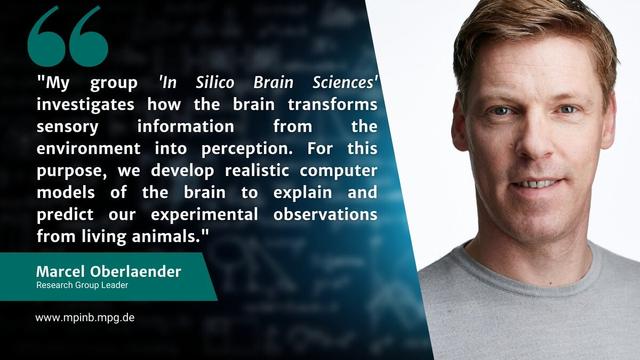
MPINB people 🥳 Discover the incredible work of Dr. Marcel Oberlaender, leading the group 'In Silico Brain Sciences' 🧠🔬 Their research aims to simulate the mammalian brain, unveiling new insights into sensory-guided behaviors.
Can pigeons dream? A new study suggests that pigeons might be flying in their dreams: Researchers studied sleeping pigeons and found brain activity in areas that process visual signals and information from the wings during REM sleep. Read more: https://www.bi.mpg.de/news/2023-06-rattenborg


#science #sciencemastodon #scicomm #wisskomm #sciencenews #research #researchnews #pigeons #birds #sleep #dreams #maxplanck #ornithology

When pigeons dream

Dreams have been considered a hallmark of human sleep for a long time. Latest findings, however, suggest that when pigeons sleep, they might experience visions of flight. Researchers at Ruhr University Bochum and at the Max Planck Institute for Biological Intelligence studied brain activation patterns in sleeping pigeons, using functional magnetic resonance imaging. The study revealed that similar to mammals, most of the brain is highly active during REM sleep. However, this wake-like state might come at a cost of reduced waste removal from the brain. The researchers published their findings in the journal Nature Communications on 5 June 2023.


Impressions from our scientific retreat last week. We had a wonderful time!
🧠 Our team at the Department of Computational Neuroethology is passionate about uncovering how the brain processes sensory information to produce behavior and identifying sources of variability during goal-directed actions.
Just take a look 🧠 Using optical microscopy and machine learning, we study how neural networks in D.melanogaster relate to adaptive behaviors.
Meet Jun, the postdoctoral researcher in Monika Scholz's research group who is exploring the neural circuit controlling feeding behavior in the small nematode C.elegans. With only 20 neurons controlling food intake and feeding rate, Jun is creating a toolbox to better understand how these neurons work together. This research is part of a larger effort to use foraging behavior of C. elegans as a model for ecologically relevant behavior.
Did you know some animals have a magnetic sense? 🧲🐀 Our Malkemper Lab is exploring the African mole-rat's ability to navigate using Earth's magnetic field. Follow our research institute for updates on this fascinating neuroethology research! 🧠🔬 https://mpinb.mpg.de/en/research-groups/groups/neurobiology-of-magnetoreception/research-focus.html
Research Focus - MAX PLANCK INSTITUTE FOR NEUROBIOLOGY OF BEHAVIOR — CAESAR

Proud to support exceptional researchers like Aneta through the Lise Meitner Excellence Programme. She and her team focus on developing a theory of computations&learning in biochemical networks.
https://mpinb.mpg.de/en/research-groups/groups/cellular-computations-and-learning/research-focus-ccl-eng.html
Research Focus - MAX PLANCK INSTITUTE FOR NEUROBIOLOGY OF BEHAVIOR — CAESAR

Meet the talented PhD students of IMPRS for Brain&Behavior - a fully-funded program offering world-class training and research in neuroethology and neuroscience. A joint program of the DZNE @dzne, the University of Bonn, and us. We are proud to support the next generation of scientists!
Talk about a spark! 💥 Check out this amazing fluorescence image of two cortical neurons seemingly sharing a kiss. The brain never ceases to amaze us. 🧠🔬