 nixCraft 🐧
enterprise grade security vs. human the weakest link in the chain 😂

Moderately burnt-out software fry.
I do some open source stuff and cat volunteering on the side. I have a cat, myself!
I enjoy anime and manga, and enjoy good literary analysis. Writing #MHA "fix-it" fic, slowly but surely, because the in-universe discrimination and hypercapitalism convergence towards the end of the manga bothers me a bunch.
I enjoy games! Last played: #Balatro, #PathOfExile, #LastEpoch, #Warframe
| Website | https://nixalted.com |
| Pronouns | they/them |
You're paying AI companies a monthly subscription fee to be fingerprinted like a parolee.
I got bored and ran uBlock across Claude, ChatGPT, and Gemini simultaneously.
Claude:
ChatGPT:
Gemini:
When uBlock blocks Gemini's requests, the JS exceptions bubble up and Gemini dutifully tries to POST the error details back to Google. uBlock blocks that too. The error messages contain the internal codenames for every upsell popup that failed to load.
KETCHUP_DISCOVERY_CARD.
MUSTARD_DISCOVERY_CARD.
MAYO_DISCOVERY_CARD.
Google named their subscription upsell popups after condiments and I found out because their error handler snitched on them.
All three of these products cost money.
One of them is also running ad infrastructure.
Touch grass. Install @ublockorigin
so hrtcafe.net went down due to a coordinated terf/far-right action.
and so this is as good a time as it gets to make even more mirrors of https://git.gay/hrt/pages/ (or the github repo this is a mirror of already, if you want to touch github).
clone it, set a cronjob to do a pull every week. set up a web view like https://hrt.soap.systems if you have the means to do so and the willingness to deal with potential terf interference.
trying to shut down online resources hosted by annoyed transfems, that’s totally going to work and have the intended effect, right?
edit: people are asking if I know what actually happened, what kind of attack it was and such.
I didn’t see a lot of confirmed info about it (and didn’t really look too hard either), but judging by what I’ve read so far, I’m assuming a combination of doxxing, pestering the hosting and threatening legal harassment.
supposedly the person who hosted it took it down themselves to get the heat off of them - and I can’t blame them, that’s reasonable, no one doing this should ever feel expected to stand up to being personally targeted. that’s what we have a community for. they can back off to ensure their own safety, while we deploy a hundred more mirrors.
/erin
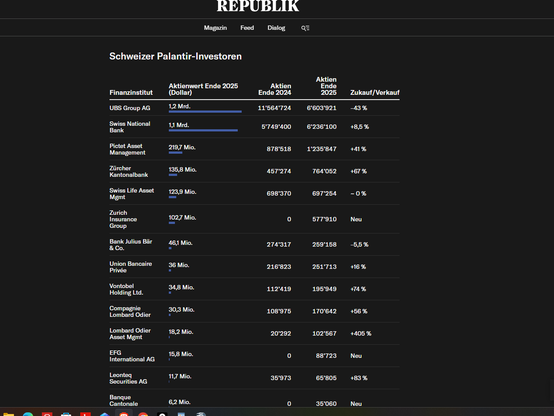
We present: the Swiss Banks and Insurances holding shares of Palantir...and bought thousand of new shares in 2025 despite of many many controversial headlines.
Die Schweizer Nationalbank nach wie vor weit vorne...
Und wie wird das mit all den ethischen und nachhaltigen Investment-Strategien der Finanzinstitute und Versicherungen gerechtfertigt?
Die ZKB verweist auf den Schweizer Verein für verantwortungsbewusste Kapitalanlagen und den UN Global Compact, dem sich Firmen anschliessen können. Derzeit sei Palantir bei keiner der beiden Initiativen aufgelistet, so die ZKB, weshalb man weiter investiere.
Allerdings ist die Global-Compact-Liste keine schwarze Liste: Aufgeführt sind vielmehr Firmen, die sich an minimale Standards halten. Palantir ist dort gar nicht gelistet. Damit konfrontiert, antwortet die ZKB widersprüchlich, wonach es keine Rolle spiele, ob eine Firma gelistet ist. Wichtig sei, ob sie sich an die Regeln halte.
Wie die ZKB wissen will, dass sich Palantir an die Minimalregeln hält, wenn sie nicht auf der Liste ist, sagt die Bank nicht.
Swiss Life beteuert, dass sie sich unter anderem zu den OECD-Richtlinien verpflichte. Zu ihren Palantir-Investitionen will sie jedoch genauso wenig sagen wie die Zurich-Versicherung.
Und die Nationalbank, von deren Investition am Ende auch Bund und Kantone profitieren, die einen Teil der Nationalbank-Gewinne erhalten?
Man investiere nicht in Unternehmen, «deren Produkte oder Produktionsprozesse in grober Weise gegen gesellschaftlich breit anerkannte Werte verstossen», schreibt die Nationalbank auf Anfrage. Konkret sind damit Unternehmen gemeint, «die grundlegende Menschenrechte massiv verletzen». Eine Begründung, wie die Investition in Palantir mit diesen Grundsätzen vereinbar sein soll, will auch die Nationalbank nicht liefern. Ihre Sprachregelung: Einzelne Anlagen kommentiere man nicht.
Eine europaweite Recherche, initiiert und koordiniert von Follow the Money EU! Weitere Kooperationspartner neben der Republik sind «De Tijd» (Belgien), «Børsen» (Dänemark), «Der Standard» (Österreich), «Morgenbladet» (Norwegen), «El País» (Spanien) und «The Nerve» (UK).
Der Artikel von Yves Wegelin, Lorenz Naegeli und mir:
https://www.republik.ch/2026/03/19/schweizer-konzerne-finanzieren-palantirs-ueberwachungs-software
I don’t object to ‘if you don’t like it, fork it’ as a response as long as you have structured the project to make it easy for people to maintain downstream forks. Indeed, I consider the existence of downstream forks to be a sign of health in an open-source ecosystem. This means:
This leads to small projects with loose coupling that can be done (or, at least, ‘maintenance mode’, where they get occasional bug fixes but meet their requirements and don’t need to change).
A lot of projects were like that 20-30 years ago. Reaching the ‘maintenance mode’ state was a badge of honour: you had achieved your goals and no one else needed to reinvent the wheel. New things could be built as external projects. The last few decades have seen a push towards massive too-big-to-fork projects that have external interfaces that the rest of the ecosystem needs to integrate with, which are complex and lead to tight coupling.
 Housey


 things as a treat
 k3ym𖺀
k3ym𖺀 erin // Eileen
 Rabbit Cohen
 Anya
Anya 
 Adfichter
 David Chisnall (*Now with 50% more sarcasm!*)