Die NOZ hat über die Einführungswoche unseres neuen Masterstudiengangs Geographie: Gesellschaft - Umwelt Zukunft berichtet. In der Einführungswoche wurde 4 Tage zum Weiterbau der A33 geforscht. "Für die Studenten war das Projekt eine Herausforderung, auf die sie gerne zurückschauen. „Es war spannend, in ein Forschungsprojekt geworfen zu werden“, sagt Eric Husemann" schreibt dazu die NOZ.
https://www.noz.de/lokales/belm/artikel/geografie-studenten-geben-a33-nord-in-belm-schlechtes-zeugnis-45690549
#geographieuos #erdkunde #guz #uniosnabrück #geographie #A33

Geografie-Studenten: Schlechtes Zeugnis für A33-Nord in Belm
Die Studenten des neuen Masters „Geografie: Gesellschaft, Umwelt, Zukunft“ starteten ihr Studium mit einem Projekt zur A33-Nord in Belm.
Die Ausbreitung digitaler Plattformen in der #Logistik wirkt sich negativ auf die #Arbeitsbedingungen in der Branche aus. #Betriebsräte & #Gewerkschaften finden darauf kaum passende Antworten.
Neues Working-Paper von Philip Verfürth, Veronique Helwing und mir: Digitale Business-to-Business-Plattformen im Logistiksektor. Auswirkungen auf Arbeit und Reaktionen von Betriebsräten und Gewerkschaften, Working Paper Forschungsförderung 272, Düsseldorf: Hans-Böckler-Stiftung. https://www.boeckler.de/de/faust-detail.htm?sync_id=HBS-008542


Digitale Business-to-Business-Plattformen im Logistiksektor
In diesem Working Paper werden die Auswirkungen digitaler Business-to-Business Plattformen auf die Arbeitsbedingungen in der Logistikbranche in Deutschland untersucht. Zudem werden die resultierenden Reaktionen von Betriebsräten und Gewerkschaften auf die insbesondere im Straßengütertransport weit verbreiteten Plattformmodelle aufgezeigt. Es wird deutlich, dass gängige Plattformen negative Folgen für die Arbeitsbedingungen in Logistikunternehmen haben, Betriebsräte und Gewerkschaften bisher jedoch kaum passende Antworten auf diese Entwicklungen finden.
Du willst die Zukunft aktiv gestalten? Der Studiengang „#Geographie: Gesellschaft – Umwelt – Zukunft“ (GUZ) an der #UniversitätOsnabrück stellt die Zukunftsorientierung in den Mittelpunkt. Viele der großen gesellschaftlichen Herausforderungen – z.B. #Umweltverschmutzung, #Globalisierung & #Klimawandel – kann nur begegnet werden, wenn die klassischen Grenzen zwischen naturwissenschaftlichem & sozialwissenschaftlichem Denken überwunden werden. In #GUZ lernst du genau das!
#Erdkunde #Geographie
Die aktuelle Ausgabe der Zeitschrift
#Wirtschaft #Münsterland beschäftigt sich u.a. mit dem Thema
#Transport und
#Logistik. Auch unser Projekt
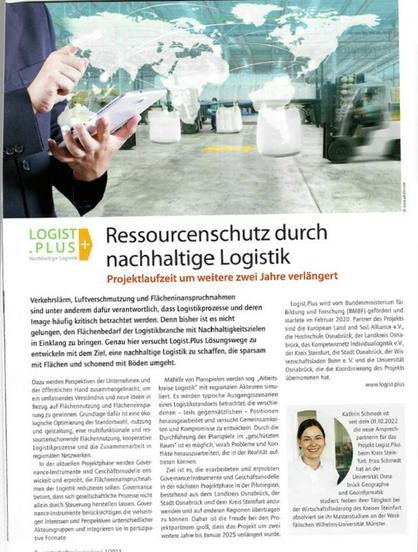
#LogistPlus wird darin vorgestellt.
War COVID-19 ein Treiber für die #Digitalisierung des Einzelhandels?
Neuer Artikel von Christopher Herb, Carla Friedrich & Cordula Neiberger im #Standort - Zeitschrift für angewandte #Geographie untersucht die Fallbeispiele #Düren, #Eschweiler, #Heinsberg & #Baesweiler
https://doi.org/10.1007/s00548-022-00824-z
#DVAG #Einzelhandel #Onlinehandel


COVID-19 – Treiber für die Digitalisierung des Einzelhandels? - Standort
The COVID-19 pandemic has posed major challenges not only to society but also to business, including the retail sector in particular. Although online retailers benefited from lockdowns and the closure of local stores, brick-and-mortar retailers were cut off from their main source of income overnight. The latter has been undergoing structural change for decades and has recently had to face new challenges as a result of extensive social and economic digitalization. Our article deals with the question of the extent to which retailers felt compelled to undertake increased digitization as a consequence of the COVID-19 lockdowns. We consider different online strategies, ranging from complete inactivity to a comprehensive online strategy (online shops, supported by social media activity). In order to visualize the development over the last years as well as over three COVID-19 lockdowns, the study presents a comparison of two survey dates (2017/2018 and 2021) based on four medium-sized towns in North Rhine-Westphalia (Baesweiler, Düren, Eschweiler, Heinsberg). It can be seen that the digitalization process is progressing in general, although the extent of digital activities is strongly dependent on the respective form of organization. In addition, differences can also be seen with regard to the size of the medium-sized towns.
Bedarf für die #Paketzustellung durch #Drohnen – eine Alternative für die Versorgung schwer erreichbarer Gebiete?
Neuer Artikel im #Standort - Zeitschrift für angewandte #Geographie von A. Path, K. Schaefer, A. Straubinger & A. Habersetzer
https://doi.org/10.1007/s00548-022-00825-y
#Paketdrohne #Drohne #Logistik

Bedarf für die Paketzustellung durch Drohnen – eine Alternative für die Versorgung schwer erreichbarer Gebiete? - Standort
The supply of the North Frisian Islands and Halligen is strongly characterized by their dependency on tides, weather, and seasons. This study examines whether supplying these difficult-to-reach areas with transport drones would have the potential to fill possible supply gaps to contribute to the alignment of living conditions with those of the mainland. Qualitative interviews with stakeholders in the region indicate that the seasonality of ferries leads to supply constraints, especially for time-critical goods. Although local residents have developed adaptation strategies such as stockpiling, there are always short-term unmet needs for specialty goods. A drone concept developed using existing regional supply routes shows that the use of drones has the potential to improve the supply situation by supplementing existing shipping. However, the majority of respondents are skeptical about the use of drones. The concerns expressed are mainly related to environmental protection, sustainability, tourist appeal, and the ability of drones to operate in adverse weather conditions. Thus, it can be seen that the acceptance of new technologies by the population is a core challenge for the successful solution of supply bottlenecks by transport drones and must receive central attention in addition to the investigation of the technical and economic feasibility of such concepts.
Kann das Konzept der
#Symbiose auch in bestehenden Gewerbegebieten noch eingeführt werden?
Neu im
#Standort - Zeitschrift für angewandte
#Geographie: Symbiotisches Wirtschaften als Ansatz zur Weiterentwicklung von Bestandsgewerbegebieten von
Marius Angstmann, Roman Wolf, Veronika Wolf und Thiemo Wolf
https://doi.org/10.1007/s00548-022-00826-x#Gewerbegebiet #Industriegebiet #Kreislaufwirtschaft #Nachhaltigkeit #Stadtentwicklung
Symbiotisches Wirtschaften als Ansatz zur Weiterentwicklung von Bestandsgewerbegebieten - Standort
In recent decades, the further development of existing commercial areas has played a subordinate role in planning and commercial development. In the context of the transformation towards a more sustainable economic system, it is important to pay new attention to these spaces and to try out new approaches . The concept of industrial symbiosis is aimed at creating energy and material flows in the form of a complementary use of by-products by neighbouring industries. Collaborations between neighbouring companies aimed at increasing energy and resource efficiency across companies also exist in Germany. Although these do not necessarily include networks, the existing interconnections between companies nevertheless show opportunities to exploit new potentials by the networking of representatives of industrial and commercial areas. The article looks at the extent to which the concept of symbiosis is suitable for implementation in heterogeneous existing commercial areas. For this purpose, guideline-based interviews were conducted with representatives from economic development, area management and planning.
Um der Circular Economy bessere Möglichkeiten zur Integration in stadtregionale Strategien zu verschaffen, bietet sich die Verknüpfung mit weiter gefassten Zielen der Resilienz an.
#CircularEconomy trifft urban-regionale #Resilienz – Synergien für eine nachhaltig-anpassungsfähige #Stadtentwicklung.
Neuer Artikel von Martina Fromhold-Eisebith im #Standort - Zeitschrift für angewandte #Geographie
https://doi.org/10.1007/s00548-022-00815-0 #DVAG

Circular Economy trifft urban-regionale Resilienz – Synergien für eine nachhaltig-anpassungsfähige Stadtentwicklung - Standort
To provide the Circular Economy with better opportunities for integration into city-regional strategies, linkages with broader objectives of resilience are solicited. The concepts of Urban and Regional Resilience are also increasingly discussed in Germany, as an approach to future viability. They are expected to bolster the robustness, adaptability, and recovery capabilities of cities and regions in the face of multiple crises, connected to objectives of sustainable development. This article, on the one hand, shows in which respects a combined view of urban-regional resilience establishes a suitable framework for effectively embedding systemic approaches of the Circular Economy into city-regional contexts. On the other hand, it explains how, in turn, the resilient cushioning against environment- and economy-related risks can be more successful if elements of the Circular Economy are integrated. After conceptual considerations of the synergistic interdependencies of these process fields, the example of the City of Aachen serves to illustrate the appropriate combination of ‘Circular City’ and resilience-related objectives. It elucidates how important a focus on innovation is for such strategic approaches. Finally, recommendations are made for designing a resilient-circular urban economy.
#Nachtökonomie wird als Themenfeld der #Wirtschaftsförderung vernachlässigt – trotz ihrer Bedeutung für die lokale Wirtschafts- & #Stadtentwicklung. Neuer Beitrag im #Standort - Zeitschrift für angewandte #Geographie von Jens Konermann
https://doi.org/10.1007/s00548-022-00816-z #DVAG


Nachtökonomie als Themenfeld der kommunalen Wirtschaftsförderung – Status quo, Herausforderungen und Förderansätze - Standort
As a municipal player, the municipal economic development agency is entrusted with a variety of tasks to shape the parameters for successful business. For this, the advantages of the location are communicated and the factors important for the development of the location are shaped. One of these location factors is the local nightlife. With its many facets, it appeals to a broad target group and reflects the liveliness and quality of life of a city. Clubs, venues, and the music industry make an important contribution to this.This article examines the importance that municipal economic development agencies attach to the Night-Time Economy and the extent to which they are already addressing the issue. In addition, the challenges and opportunities for promoting nightlife in the context of municipal economic development are discussed. For this purpose, the article draws on the results of an online survey of municipal economic development agencies in Germany.
229 FB 1 Assistant Professor in in Social Geography and Reflexive Migration Studies (W1 with tenure track to W2) - Universität Osnabrück