💧🌏 Greg Cocks
Impact Of Floods On Surface Water Quality - A Systematic Review And Comprehensive Assessment
--
https://doi.org/10.1016/j.jhydrol.2026.135916 <-- shared paper
--
https://www.epa.gov/system/files/documents/2024-12/2024-12.pdf <-- shared paper
--
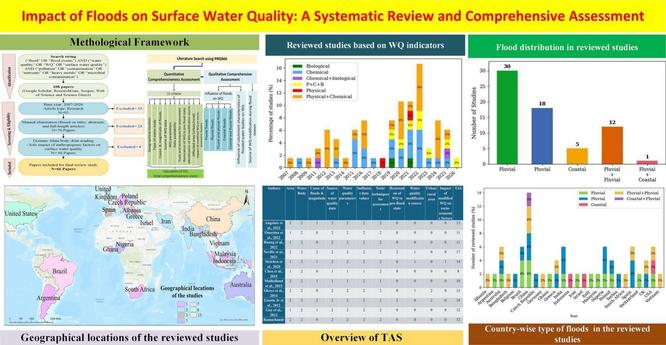
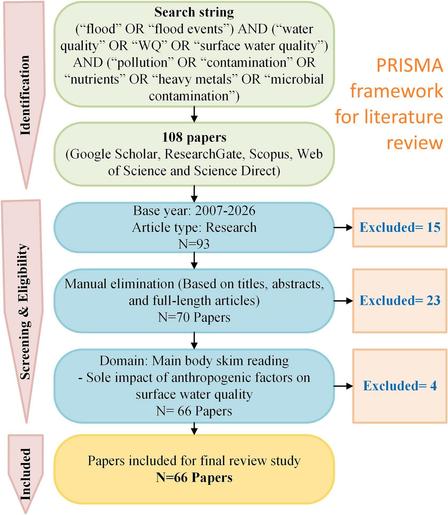
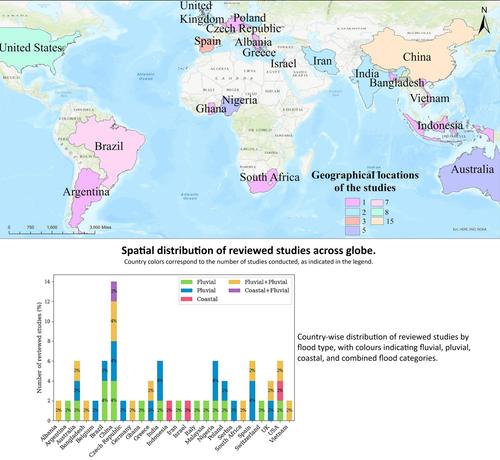
“Floods, as extreme flow events, are among the costliest and devastating natural hazards. Among the various domains impacted by flooding, environmental degradation, particularly the deterioration of water quality (WQ), is one of the most impacted yet often overlooked. Therefore, it is essential to understand the nature and source of water pollution associated with flooding. This study aims to evaluate and assess multiple studies conducted globally to determine the impact of floods on WQ. A literature review and assessment of 66 studies published between 2007 and 2026 was conducted using the total comprehensiveness score (TCS). To support the scoring process, studies that scored more than 70% of the maximum achievable TCS (15.4) are considered the most detailed and comprehensive in addressing the objectives of this review. 16 studies achieved a TCS above 15.4, indicating that a limited number of studies incorporate a broader set of factors in this domain. A higher number of studies were conducted post the year 2021, highlighting both scientific progress and a growing focus on WQ impacts from disasters such as floods, beyond the traditionally emphasized socio-economic loss. Among the shortlisted studies, fluvial floods are the most frequently examined, followed by pluvial floods and coastal floods. During fluvial floods, turbidity increased by up to two orders of magnitude, while nutrient concentrations (TN, TP) typically rose by ∼ 10–30%. In contrast, pluvial floods were characterised by dilution-driven decreases in EC and TDS, with DOX, BOD and COD showing variable responses across flood types. This review evaluates flood impacts on WQ, catchment characteristics, and sources of WQ modification. The findings of the research reveal that not all WQ parameters are responsible for WQ degradation during every flood event. Rather, it is a combination of certain parameters that leads to deteriorated WQ. WQ degradation depends on interacting factors such as flood duration, extent, depth, and flow dynamics. In overall, this study provides an overview of the multiple cascading impacts of floods on WQ, along with a detailed perspective on the set of criteria that should be considered in future research…”
#water #hydrology #hydrography #flood #flooding #criteriaassessment #waterpollution #waterquality #parameters #extremeflow #waterresources #extremeweather #waterresources #watermanagement #global #literaturereview #morphology #source #type #watersecurity #research #papers #compilation #humanimpacts #PRISMA #spatiotemporal #fluvial #pluvial #coast #coastal #risk #hazard #riverine #climatechange #EnvironmentalScience #Research #ClimateResilience #floodtype #pollution #naturalhazard
--
https://doi.org/10.1016/j.jhydrol.2026.135916 <-- shared paper
--
https://www.epa.gov/system/files/documents/2024-12/2024-12.pdf <-- shared paper
--
“Floods, as extreme flow events, are among the costliest and devastating natural hazards. Among the various domains impacted by flooding, environmental degradation, particularly the deterioration of water quality (WQ), is one of the most impacted yet often overlooked. Therefore, it is essential to understand the nature and source of water pollution associated with flooding. This study aims to evaluate and assess multiple studies conducted globally to determine the impact of floods on WQ. A literature review and assessment of 66 studies published between 2007 and 2026 was conducted using the total comprehensiveness score (TCS). To support the scoring process, studies that scored more than 70% of the maximum achievable TCS (15.4) are considered the most detailed and comprehensive in addressing the objectives of this review. 16 studies achieved a TCS above 15.4, indicating that a limited number of studies incorporate a broader set of factors in this domain. A higher number of studies were conducted post the year 2021, highlighting both scientific progress and a growing focus on WQ impacts from disasters such as floods, beyond the traditionally emphasized socio-economic loss. Among the shortlisted studies, fluvial floods are the most frequently examined, followed by pluvial floods and coastal floods. During fluvial floods, turbidity increased by up to two orders of magnitude, while nutrient concentrations (TN, TP) typically rose by ∼ 10–30%. In contrast, pluvial floods were characterised by dilution-driven decreases in EC and TDS, with DOX, BOD and COD showing variable responses across flood types. This review evaluates flood impacts on WQ, catchment characteristics, and sources of WQ modification. The findings of the research reveal that not all WQ parameters are responsible for WQ degradation during every flood event. Rather, it is a combination of certain parameters that leads to deteriorated WQ. WQ degradation depends on interacting factors such as flood duration, extent, depth, and flow dynamics. In overall, this study provides an overview of the multiple cascading impacts of floods on WQ, along with a detailed perspective on the set of criteria that should be considered in future research…”
#water #hydrology #hydrography #flood #flooding #criteriaassessment #waterpollution #waterquality #parameters #extremeflow #waterresources #extremeweather #waterresources #watermanagement #global #literaturereview #morphology #source #type #watersecurity #research #papers #compilation #humanimpacts #PRISMA #spatiotemporal #fluvial #pluvial #coast #coastal #risk #hazard #riverine #climatechange #EnvironmentalScience #Research #ClimateResilience #floodtype #pollution #naturalhazard