https://sfconservancy.org/llm-gen-ai/llm-backed-generative-ai-recommendations.html

@conservancy nope. Fail.
The aim of gen AI is to move the means of production from devs to model owners. This undermines FOSS more thoroughly than any Embrace Extend Extinguish attempt to date.
✅ Points 1 and 2
❌ The libertarian bullshit that follows
As usual, the SFC have made it all about maximizing personal freedoms and individual rights.
I'd quite like to know what planet SFC folks are living on, as it's clearly not this one or they'd be more concerned about setting it on fire. There's a bigger fucking issue here than copyright. Keep up.
Point three does irk me in particular.
The problems with Software Freedom in our communities is that we're all about Free Speech and Copyright.
We're ignoring Freedom of Association. So if a Software Project had already made it very clear they don't want LLM contributions, then yes, they can show that potential contributor the door.
Our projects are collections of people. LLMs are not.
So yes, I will shun, especially if they don't respect our boundaries.
@abucci @onepict @dentangle I dunno.
Look, it seems clear that FOSS has failed. Or is LOSS. Snark aside, whatever it is today isn't what's needed.
While I love the idea of each of us growing MOSS in our gardens, I'd like for that idea to catch on. I know for a fact that there are plenty who think along similar lines, but a lot of them are busy in their gardens.
I don't begrudge that. In fact, I think it's fundamentally better than trying to set up a big movement. I have spent much of the...
@abucci @onepict @dentangle ... last year trying to figure out how to tend to my own garden. I think I have a way forward, but it doesn't include movement building.
I would still love for MOSS gardening to catch on. Because threads like this show well enough the disconnect between LOSS and MOSS.
I have no answer to that, though 🤷
The recommendations do say you can show them the door & affirms freedom of association.
Specifically, we recommend projects do that in a nice way, that (in particular) lets them know they would be welcome if they'd like to not submit slop and actually become a real FOSS developer instead.
I have BTW actually seen screeds made against a contributor suspected of submitting #AI slop that violate most #FOSS Codes of Conduct.
That sort of thing *should* stop, IMO.
Cc: @dentangle @jens
@dentangle @jens @conservancy
> As usual, the SFC have made it all about maximizing personal freedoms and individual rights.
I mean, isn't that the whole point of copyleft, to prevent groups of people from controlling software and information?
@jens said:
> “The aim of gen #AI is to move…means of production from devs to model owners”
…same idea as “The aim of copyright, work-for-hire,& proprietary software is to move the means of production from devs to for-profit company owners.”
Yet, we used the tools of theses oppressors & yielded a strong stalemate against them.
& *of course* they wanna undermine #FOSS! #Microsoft, #GitHub, #Apple, etc. have worked to undermine #FOSS for *decades*.
Pragmatic idealism FTW then & (we hope) again!
@bkuhn Stalemate?
It's an arms race, and one side has the funding for it. Hint: it's not us.
So forgive me if I judge success differently. Much of what I see are compromises that set up the next battle in a weaker position.
I understand that back in the day when free software and open source started, the libertarian positions it holds were adopted.
We had privileged white boys complaining about having their privilege reduced. Yes, with enough vision to see liberation for everyone on the...
@bkuhn ... horizon. But not enough self-awareness to factor privilege into things.
Which is why the freedoms value individual choices much more highly than the common good. The logic is, quite literally, "I need liberties so I can help others", not "the rights of the unprivileged need to be strengthened".
It's missing the equivalent zero'th law of robotics. And fuck, it shows.
@bkuhn This isn't capitalism's fault. There is a lot of fault in capitalism, sure.
But this is the FLOSS movement's own failure. It's my failure as well. I used to believe that shit. Feels good to picture oneself as a Robin Hood character.
So quelle surprise, but there are libertarians out there who do not value the commons, and we've let them dominate the conversation. Thinking they were some of us. But they're robber barons, arguing for their liberties in order to rob.
So any position...
@bkuhn ... in 2026 that says, essentially, "we should let the robber barons retain their rights" has missed the train leaving the station.
Oh, thanks for also allowing in the recommendations that we can show them the door, so long as we don't hurt their feelings.
Well, I don't think that permission is required. Thank Cthulhu for that.
@bkuhn I swear, every time I see another old guard FOSS person take that position is another nail in the movement's coffin.
I'm already more than ready for the next thing. But it'd hurt some libertarians' feelings.
> It's an arms race, and one side has the funding for it. Hint: it's not us
Wasn't the flaw here? Shouldn't the FLOSS movement have been seeking sustainability for its 'peasants' from the very start?
I've been fondly quoting that Harvard study finding that (F(L))OSS contributes 9 trillion to the global economy. Yet its an unsustainable burnout zone for anyone who seeks to eek out a living in it. In the past I've said that dabbling in this movement feels like "burning ones privilege at the altar of sacrifice". Another way to look at it is that 99.9% of FOSS is really 'hobby projects' for those who can afford it.
Then the notion of "working in public" is imho flawed. After my years in the space it left me with uncomfortable questions.
https://social.coop/@smallcircles/116316524763055082
Just throwing new tech out into society is no different than what the opponent does, but does it more smartly and unscrupulously.
It's a pity, perhaps too late for me, but I'd love to explore "working in commons".
Note, and I must state this explicitly, that I'm not blaming any individual participant in the FOSS movement, where most people are doing their stinking best with noble - varying between the more mythical, or less mythical kinds - Robin Hood motives being their intrinsic motivational drivers. To do good for society.
The issues arise by Emergence i.e. in-the-large where the net impact on society may not be so positive. Where the individualism in FOSS where everyone goes it alone, or in tiny groups does not contribute to a sustainable economy, where the indivuals' ethics, morals, and values can be held high. Value is directly inserted in larger society, which works on the basis of hypercapitalism. The emergent FOSS movement can't escape Conway's Law that way.
A Big Industry analogy intrigues me, which can uphold hypercomplex global supply chains, whereas the typical FOSS project has trouble scaling beyond a handful of people. We must be able to organize our supply chains.
The TLDR is that imho the movement should be much more about people, than about the product that rolls off the production pipeline, i.e. the software. Coding is social.
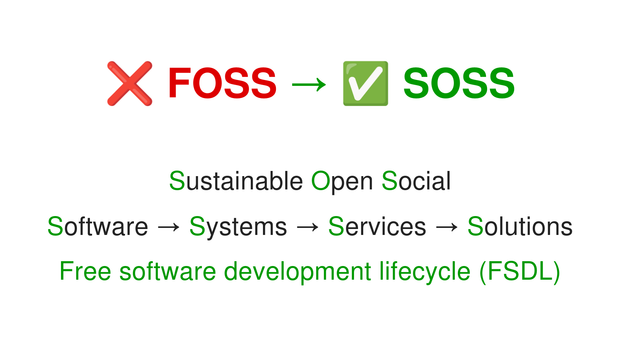
Let FOSS be code + a protective license. SOSS then is the sustainable production facility, where many SOSS initiatives participate in the formation of a larger and growing commons based value economy. Doing service development, delivery, and exchange with other parties based on trust and proven track records. Creating a fitness formula that is better able to hold the bad actors at bay. Ideally this formula is such that bad actors push themselves out of collaborative arrangements, and become intrinsically motivated to adopt better and more sustainable practices, in order to reap most benefit from their commons participation.
@smallcircles Well, that's a difficult one.
I have some aims and thoughts, but no clear path yet. And I think that's actually good, because if there's anyone here that points in one direction and everybody else follows, we're failing from the start.
It's funny how these topics come up.once in a while, and then they bundle up weirdly.
So for one thing, a few days ago we stumbled upon new terminology, which I kind of like. From coding guidelines to mystics around the world, we get...
@smallcircles... told that names have power. I think it's because names are essentially pointers at arbitrarily complex mental models, and the power comes from succinctly transporting a complex idea.
So we, that is @onepict and @abucci and myself, were sort of half shitposting about FOSS and/or FLOSS. Anthony brought up LOSS as "Libertarian Open Source Software" as a much better name for showing the particular failure mode of the movement, which starts from individual liberties...
@smallcircles... and essentially hopes for the best in how that might translate into wider society. Not individuals - I agree that they often try very hard. But core tenets along which to orient oneself.
LOSS perfectly references the parts that work, but also clearly states that an important part is lost along the way.
So we were spitballing about what to call the other thing, the thing that we should have. I suggested MOSS, which is an awkward acronym for...
@smallcircles... "Mutual(ly supportive) Open Source Software". Mostly it's because I wanted something green, soft, small, yet beautiful and full of life. The meaning.is.shoehorned into the word.
But it's pretty much what I want, too. I want to grow stuff, in its own time. I don't want to emulate startups based on extraction from the commons. I want people to feel good about it. I want to feel good about making it.
So it kinda caught on, for me at least, for a bit.
@smallcircles I want to focus on MOSS gardening.
I think this is also something where we've sort of lost our way. "We" definitely includes myself, and looking at various others out there, I'm not alone. I look at "small tech" folk, indie game.devs, etc. We want the joy of creation just as much as we want other folks to have joy. Happy little b+-trees, under skies dotted by fluffy home clouds.
Bob Ross channeling aside...
Another thread by @bagder was about what...
@smallcircles... to tell folk with some political authority about sustainability, and I felt obliged to point out that we have two faces to the problem "coin":
1. Maintainers require that "no warranty of any kind" is required, because - and here I cross streams - MOSS gardening is incompatible with pressure to do things in a certain way.
2. Projects which build on the commons need supply chain safety in the same way they'd get from commercial offerings.
@smallcircles The two are incompatible, until you have mechanisms in place by which the activities that users demand of suppliers are sustainably funded.
But those activities don't have to all be performed by a project maintainer. Some, like support, can be done elsewhere.
They key issues here revolve around how easy or hard it is to pick and choose between activities and rewards. As a MOSS gardener, I want to pick up issues when I can, and a coffee in...
@smallcircles recompense is fine. If I'm supposed to review an onslaught of dodgy LLM "security issues", it's a full time job, and not what I signed up for.
Politics is great at creating regulatory frameworks that favour the stronger lobby. Here we have industry on the consumer side, and individuals on the supply side. It's pretty clear that regulatory efforts focus on "how can industry get what they need?"
So, putting a realistic cost to that is one of the...
@bagder @onepict @abucci @bkuhn
@smallcircles... more effective arguments.
Meanwhile, if this means I cannot grow my MOSS garden any longer, well, we're all going to run out of commons pretty soon. So the flip side to this is to give gardeners all the incentives to turn their hobby into a job, with none of the downsides - until they decide they can take on some additional responsibility for additional incentive.
That is hard, because it requires trusting the gardeners instead of forcing...
The recommendations don't say you shouldn't hurt the feelings of LLM-gen-AI proprietary companies. Pls do, if you can find a way: those running them are likely sociopaths & probably have no feelings to hurt.
What the recommendations say is to treat people who may not know what their doing and used a terrible tool for a terrible thing with kindness, and assistance rather than condemnation.
It's what we should have done to Microsoft fans in the 1990s. A lot more would use Linux today.
@bkuhn The central issue here is *capacity erosion*, and that is entirely unaddressed.
In the short term, this is about the capacity to handle incoming changes, to review them meaningfully, and so forth.
In the longer term, it's the capacity to build software unassisted.
The recommendations on "careful use" mirror those of pretty much every other balanced recommendation on the subject I've seen.
Speaking as a manager of a software team, my issue is not throughput or efficiency of the...
@bkuhn ... team members. They have good and bad moments, but at a fundamental level, their throughput is fine.
The issue is capacity maintenance. Knowledge transfer. Training and maintaining the ability to reason through complex problems.
I can already see how much this got reduced by a few more experienced people leaving, and younger folk joining. So now they use LLMs to help them reason. They will not have an equivalent learning curve in understanding what they build to become the seniors...
@bkuhn ... that have left.
They're smart. They will figure other things out. I trust in *them*, as people.
But when they ask their LLM something, they shrug and say "the reply sounds reasonable, we can try it out?" Without a senior to tell them why it is or isn't a good idea, there's great uncertainty.
And the tools aren't reliable enough to make up for that.
So on the one hand, we're *losing* capacity. And on the other hand, we're becoming reliable on a rented tool.
When you translate...
@bkuhn ... this back to the commons, it's enclosure from within. We don't let landowners build fences around the commons, oh no!
Instead we say: there's this cool plant, let's put it in our community garden! Yes, the landowners told us about it. And yes, we pay the landowners rent for it. But it's so cool, because it grows almost without effort! And it's evergreen! The name? Oh, it's ivy... even sounds nice!
Accepting gen AI contributions is not a viable position.
@bkuhn Lest one think this is just "my" team, I spent many of my years consulting with software companies all around the world.
There's a widespread issue thinking that code generation is tedious and should be automated. The tedious part is thinking. But you can't automate that, you can at best shift it somewhere else.
I wrote a 20 page thesis paper as an undergraduate Medieval Legends 400-level seminar under Professor Kelly DeVries on how the Robin Hood myth is widely misunderstood in the 20ᵗʰ century.
I am well-versed enough on the subject to say that @jens got the Robin Hood analogy all wrong.
#RobinHood #Medieval #MedievalLegends #MedievalLegend #KellyDeVries #DeVries #AI
@bkuhn Yeah. So much the point here. And so insightful, considering how widespread this misunderstanding is, as you point out.
In a different moment, I might even be interested. @jensimmons
Understood.
TL;DR: the real Robin Hood was likely a deposed noble who manipulate the oral tradition narrative expertly to make himself a man of the people to get revenge on other nobles who were enemies.
Recent retellings have made Robin Hood pure as the driven snow which is a huge oversimplification.
Anyway , youre right it's OT but given I have a weird unexpected expertise on that mythology , I couldn't let it go. 😝
@bkuhn That is very understandable!
And your TL;DR is "sort of obvious", in the sense that the cynical side of me suspects this in all hero figures.
But I had no idea that were was actual evidence for this being collected and evaluated for the actual Robin Hood character. So thank you for this!
@conservancy if a prospective contributor's employer requires them to use LLMs to create their patch, it should be rejected just like any other patch which is not released under a compatible license, fails code review, or is otherwise deemed not suitable for merging.
This is not complicated.
In a policy statement¹, @conservancy said:
> “#FOSS projects should not shun contributors who choose to use LLM-gen-AI systems.”
@dalias' reply:
>> “LOL WTF NOPE. 🤡”
While it was surely unintentional, your reply is quite similar to the cruelty of traditional #FreeSoftware rhetoric — wherein we shunned people for *using* #Apple & #Microsoft. Such users deserve sympathy and help toward more software freedom.
Same goes for #LLM-backed generative #AI users.
¹ https://sfconservancy.org/llm-gen-ai/llm-backed-generative-ai-recommendations.html
I think perhaps you wrote your reply before you finished reading the recommendations?
For example, https://sfc.ngo/llm-gen-ai-recs#input-licensing (and items following therefrom) are directly on point to what you're concerned about.
Also, note that this is a first statement, not a last one. There is much more to come to address the problems that concern you (and many more!) in the weeks and months to come from @conservancy.
#copyleft #LLM #AI #SFC #FOSS #OpenSource #FreeSoftware
Cc: @next
@bkuhn @conservancy @dalias I think the problem is that the document seems very random in its use of "FOSS community", "FOSS contributor", "FOSS project", "contributor", "submitter", "community", "FOSS project leader", "FOSS maintainer", "LLM-gen-AI user", and more variants with or without "FOSS" or "LLM-gen-AI" added. It isn't clear to me who is who, whether the addition of the word FOSS (or leaving it out) is relevant or not.
Same in your comparison, you use the word user. Is that the same as the word contributor that is quoted? It feels different to me personally. But given the two words seem to be used somewhat interchangeably in other places I cannot tell.
Also to this non-English speaker the use of the word shun isn't clear. I interpret it as ignoring or avoiding someone, you seem to read something more into it.
(a) people using proprietary software systems effect all those around them (consider Facebook, document formats that are hard to edit without a proprietary program, etc.)
(b) "people enthusiastically adopting a new fascist project where use of it impacts everyone they interact with as well" is a straw-person argument because we did not say that.
Pretending these recommendations were hyperbolic when they weren't may win at FediDrama, but it just doesn't advance the policy discussion.
Making an analogy to war here, particularly at a time when real war is being waged in many places around the world in places where people are being murdered every day is a very inappropriate analogy.
I suspect like all of us, you feel threatened by what these capitalist 🤬s are doing to all of us. I agree it's completely evil. We have to resist, *and* have non-hyperbolic policy debate about how to succeed against what they're doing.
But saying they're tantamount to murders isn't that.
@bkuhn And I think it's rather disingenuous to criticize the use of the word "war" here as inappropriate when the fascist program doing this to FOSS is the exact same fascist program laundering responsibility for very tangible real-world war crimes (for example, letting "AI" take the blame for the decision to murder schoolgirls in Iran).
It's all the same people behind this, and it's absolutely not just within our right but within our moral duty to exclude people who are like "no actually, AI is cool! and you're being an intolerant asshole for discriminating against my opinion on it!"
As to “all the same people behind this”, the situation is much more nuanced than that. I agree completely that the billionaires are feeding the VCs who are feeding the LLM-gen-AI companies who feed all proprietary software companies, some of whom are feeding the Beyond Evil™ companies like Palantir, who are feeding the Department of War, who are bombing people indiscriminately. That chain is disturbing, but I don't think it useful to make false equivalences of every link in the chain.
@amd's comment makes little sense. Esp b/c it provides no evidence and/or quote where I “stand on the…side [of companies]” . If you look at my record in #FOSS, you'll instead find anti-captialist statements & rhetoric for *20 years* about “using the tools of the oppressor against the oppressor” to advance software freedom.
It *feels* easier to boycott anything proprietary until the bitter end. But I'm glad RMS didn't do that, otherwise GCC & GNU Emacs wouldn't exist.
Cf: https://sfc.ngo/ethical-use-proprietary-for-foss

In this philosophical essay, I explore the question: “When (if at all) is it ethically and morally acceptable to use proprietary software in the production and/or improvement of urgently needed copylefted FOSS?”The question presents a complex conundrum. I attempt herein to rigoriously examine it through both a priori ethical analysis and a posteriori (and folksy) consideration of my personal experience and the shared experiences of the early software freedom movement.
@bkuhn @amd The "using the tools of the oppressor against the oppressor" thing is tired and thoroughly debunked.
Using the same language to talk about "AI" as you did to talk about copyright doesn't mean they have anything in common.
"AI" is not something you can leverage to get us anything. It's destructive to anyone who uses it.
I don't have a general position about the entire field of AI expressed here, nor does SFC, so I think we're talking past each other at this point.