 Molly White
very cool illustration of ranked choice voting and how it worked in Maine’s gubernatorial Democratic primary
via Reddit (https://www.reddit.com/r/Maine/comments/1ua4e7n/sankey_diagram_of_the_democratic_gubernatorial/)

very cool illustration of ranked choice voting and how it worked in Maine’s gubernatorial Democratic primary
via Reddit (https://www.reddit.com/r/Maine/comments/1ua4e7n/sankey_diagram_of_the_democratic_gubernatorial/)
So true!
Add ranked choice voting, get rid of gerrymandering, and stop all the other voter suppression tactics such as trying to manipulate or get rid of voting by mail.
I'm disabled (chronic illness) so I'd have a *really* hard time voting in person. Thankfully, Oregon automatically sends all registered voters a ballot via email. And I usually return the completed ballot at one of the many dropboxes.
@DekOfTheYautja
Reformed elections aren't going to do anything to get us there.
The system is not reformable. Not on anything but an absolutely cosmetic level. Getting rid of the oligarchs and capitalism will take a complete revolution. And that means a general strike.
How? So far all I've seen is magical thinking which never works.
The oligarchs and the Party elders run the system. Have you noticed that so-called "reformist" candidates either lose, or immediately give up their principles upon gaining office?
The oligarchs own both parties, the mass media, and most of social media. And you believe that they are going to allow candidates who oppose their interests to win?
If Bernie couldn't win and sold us out instead, what makes you think that anyone else can win?
@Quasit You're right, oligarchs own both parties, which is where RCV comes in. Because in RCV there are no "parties". No "teams". No "tribes". It's just "may the best person win".
Bernie could not win because the Dems cheated him from the party nomination. Again, in RCV there are no parties, and Bernie does not need their blessing and does not need to be primaried.
But what makes you think that the oligarchs and party leaders who won't allow genuine reform or sincere progressives to run will allow ranked choice voting?
They wouldn't allow it. The difference is that reform happens within the system, and revolution/general strikes come from OUTSIDE the system.
The system is under the control of the oligarchs. The people are not. That's why the oligarchs fear us.
They control inside. The DNC is a private corporation which has proclaimed proudly in court that they are not required to follow even their own rules, and that no one can make them. The court agreed.
So there's literally no way to force the DNC to accept something that they are not willing to accept. And the oligarchs are certainly not going to accept a challenge to their ownership of the DNC, nor the RNC.
By definition, outside is the only way to go. Even a brief general strike in Minnesota got action. A sustained one would bring them down.
@DekOfTheYautja
You may be, but I'm not. The system is corrupt and rigged. You want to use the system to fundamentally reform the system, which has been tried many times and always failed.
I'm talking about working OUTSIDE the system to overthrow it. History shows us that that's possible. They've made general strikes illegal BECAUSE they work.
So we break the law, have a sustained general strike, and break the power of the oligarchs.
Or we can do it your way. Voting harder, keep donating to corrupt Democratic politicians who inevitably sell us out, and wonder why nothing ever seems to change.
That's what brought us fascism, and that's what brought us Trump. Not magic. The Democrats were a key part of that.
No, that's just the implication of everything you've said in this thread so far. So you AREN'T urging everyone to support Democratic candidates, then? If so, why not say so?
@Koochulainn @DekOfTheYautja
But you can't get ranked choice voting without the permission of the two parties at this point. They have locked out third parties quite effectively, and the DNC in particular is extremely aggressive in the courts to shut down any third-party challenge.
What's a PR system in this case? Public relations?
@Quasit @DekOfTheYautja and that is exactly why it needs to be changed. I do appreciate that changing your electoral systems (aren't they decided on a state by state basis?) is easier said than done though.
Proportional Representation system.
https://youtu.be/l8XOZJkozfI?is=H7yZyvaZNRUH5olz
@acm_redfox @molly0xfff Don't use ranked-choice voting. To see why, read up on Arrow's impossibility theorem. We almost had a failure in California where there was a chance that all the Democrats would be eliminated in the election for Governor because there were two Republicans and a lot more Democrats in the race. Democrats far outnumber Republicans in California.
https://en.wikipedia.org/wiki/Arrow%27s_impossibility_theorem
@bzdev @acm_redfox @molly0xfff
One thing you did not do is recommend something better than Ranked Choice Voting. We know that First-Past-the-Post is bad, and mathematically leads to only 2 parties winning. RCV seems to be less bad.
Also, I don't think California's system is RCV. If I'm not mistaken, it's simply the top two candidates go to the main election - which as you've demonstrated - can be problematic.
@traecer @ScottStarkey @acm_redfox @molly0xfff I provided a link to a description of a well-known theorem. From that article: "The result is often cited in discussions of voting rules,[5] where it shows no ranked voting rule can eliminate the spoiler effect."
Whether the election is partisan or non-partisan doesn't matter: you fundamentally have the same problem.
Instead of arguing, read the article.
@bzdev @traecer @ScottStarkey @acm_redfox @molly0xfff I think "spoiler" needs to be better defined. What often happens in RCV is that the second-most popular candidate gets elected, as is shown in the diagram. I'd posit that this is a good thing, as it will most times lead to an elected official that is palatable to an overall greater percentage of the population, thus reducing partisan, radical behaviors we see so often in #USpol.
However, as has been said elsewhere in the thread, this doesn't really impact the "danger" you're pointing out in California's gubernatorial race. Rather, the nonpartisan primary is the real culprit for almost having two Republicans square off in the fall.
@bzdev @acm_redfox @molly0xfff Californiaca primaries don't use RCV. It's "top two go to a runoff". With RCV the outcome you fear can't happen because to win one of the Republicans would have to end up with an outright majority.
RCV does have a flaw but it's one that can affect the outcome only in exceptionally weird and rare circumstances
@tknarr @jtwcornell91 @acm_redfox @molly0xfff Frankly, you guys don't understand what was proven decades ago. It was that there are cases where any procedure for this type of election fails. Those cases vary depending on the procedure being used. Sometimes it works, but there are *always* cases where it doesn't.
Citing a case where it works merely shows that either you didn't bother to read up on the theorem or that you didn't understand it.
@bzdev @jtwcornell91 @acm_redfox @molly0xfff Icm familiar with the theory. The problem is that we aren't dealing with a theory. We're dealing with practical reality where simply not having elections because we can't find a perfect solution isn't feasible.
As I said, the failure case requires a very small number of ballots and deliberate calculation to force it to happen. With any significant number of ballots and independent voters you never come anywhere near it.
@tknarr @jtwcornell91 @acm_redfox @molly0xfff Recently, we had a three-way race in a primary after our congress person retired. The system nearly failed - a tie between 2nd and 3rd place occurred, which was resolved in a recount. The tie involved 30,249 votes each for two of the candidates. During the recount, they found a 12-vote error in which those votes were tallied but not counted due to an operator error.
So don't tell me it works!
.https://www.latimes.com/california/story/2024-05-01/ca-16-results-recount-tk-tk
@bzdev @jtwcornell91 @acm_redfox @molly0xfff Sounds like it worked as designed. The recount would've happened even if it weren't a tie due to the slim margin. The recount found the error, it was corrected and the correct outcome resulted.
Checks like recounts are part of the system and can't be ignored.
@tknarr @jtwcornell91 @acm_redfox @molly0xfff Is Todd serious? I suggested an alternative that is (a) understandable, (b) easy to implement, and (c) is one for which there is no spoiler effect. The winning candidate apparently funded the recount, apparently because the rules for a tie meant that all three would be in the general election & the guy with the most votes preferred to have one opponent. That is not good for public confidence in the fairness of an election.
 DekOfTheYautja
 GhostOnTheHalfShell
 Ahimsa
 Quasit
 Kookulainn
 Jacques Chester
 Dave Freedman
 Jeremy
 Michael Westergaard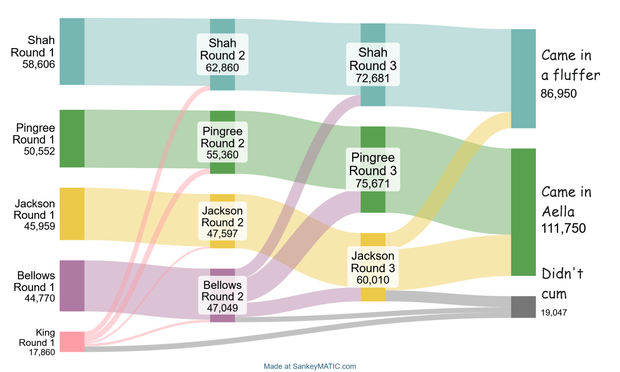
 DNA schedule
 Roger Ap Gwillian
 acm
acm Bill Zaumen
 Scott Starkey
 traecer
 Kevin Neely
 Todd Knarr
 JTW
JTW