 nixCraft 🐧
DuckDuckGo's AI-free search saw nearly 28% more visits in the week following Google's insistence that people love AI mode. Is anyone surprised by this result?
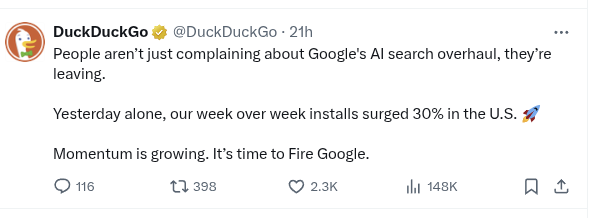
DuckDuckGo's AI-free search saw nearly 28% more visits in the week following Google's insistence that people love AI mode. Is anyone surprised by this result?
@Mustardfacial @nixCraft thats a great question and I have no answer.
I believe the existing aosp still works, i have lineage with fdroid and there is no google in it at all.
@Mustardfacial @nixCraft the general public does not care. facebook and tiktok come preinstalled on most phones so they have little interest for apps except banks and shit. They have no idea what a browser is so they will only use the preinstalled chrome and thats it.
Companies will register with google to make their apps and they wont care either. They already do that for apple dev.
Only power users matters. And I think we're already fine. Play store will still be available through aurora.
@Mustardfacial @nixCraft TBH, I dont care if people loose access to uber et al.
And also they wont, because companies will definitely make sure that the apps stay available.
@Mustardfacial @[email protected] @nixCraft Heard of RIM? Blackberry? Does anyone care now? Nothing lasts forever.
HarmonyOS is alive and well. Alternatives exit. The world doesn't have to follow US tech and increasingly it won't.
@Mustardfacial @f4grx @nixCraft I was able to install custom ROMs and all that stuff when I was 12 - 13 years old. I just read instructions and of course expect bricking my phone and have to fix it, but yeah.
Still a headscratcher that technology has improved a ton but most people remain dumb with it. Idk.
I found over the years it's not really worth talking things like these to someone who doesn't really "get it" cos you're pretty much talking to a wall at that point, lol.
@Mustardfacial @f4grx @nixCraft the phone manufacturers used to make their own OSs, and some still maintain their own variants of Android; if Alphabet stops updating Android, the phone makers will update their own forks and/or form an association to collaborate on continuing the base OS.
(They could do so anyway, if and when they decide Google isn’t serving their interests anymore, which might be more likely than Alphabet going under)
Google will not die, at least not without a new kid on the block eating their lunch.
Being assholes will not drive users away as long as your product is better (actually or percieved as) than the competition.
So, if Google dies entirely, it will be because all of their products have been killed off by competing products.
Any product still good enough to be a contender would be bought up by someone else or (more likely) be spun off into a new company.
So, I seriously doubt that Google will die, but it may very well face the same destiny as Microsoft, who was absolutely untouchable on the desktop OS market back around the time when Windows 95 and 98 came out.
Yes, there was OS/2 and Mac OS, but they were niche players. Today, the world is completely different because of mobile devices, and none of them runs a Microsoft OS. Microsoft is now just "a" operating system provider, not "the" operating system provider.
My guess is that Google could end up in the same situation as Microsoft once the dedicated AI-companies start eating into parts of their business.
Oh, and make no mistake. LLM is here to stay.
It will not be the do-all-end-all tool that some wants it to be, but it is definitely a tool that has its uses as e.g. a dedicated knowledge management tool internally in companies.
@shaedrich @Mustardfacial @nixCraft
I didn't explain that very well. My point is, that back in the day Microsoft had a stranglehold on just about everything IT, at least for desktop use. Their Windows operating system was THE way to interact with the internet, multimedia and work.
Then came the mobile platforms, and suddenly Microsoft could no longer operate as if they owned everything. Windows was still king of the desktop, but a huge amount of users did not use a computer at all - they used tablets and phones with non-Microsoft operating systems, and they were now the majority of users.
Internet Explorer is probably the best example of what that meant for Microsoft. In the old days there was IE, and it was the browser your website had to be compatible with. It was slow and not very good, so along came Chrome and started eating Microsofts browser marketshare.
IE was still the king, but now you had to test for two browsers. Microsoft could still do things their way, at least to a point.
Then came Android and Chrome for Android, and suddenly Chrome was so far ahead that Microsoft lost the ability to operate independently. The result? - the end of IE and a surrender to the Chromium engine.
I am almost certainly that Google will face a similar downfall in the AI market.
@shaedrich @Mustardfacial @nixCraft
Right! I had actually all but forgotten about Mozilla and Firefox, but yes - there was a time when they were significant players as well.
@shaedrich @Mustardfacial @nixCraft
True - I was probably talking about Alphabet instead of Google, to be honest.
 A wizard did it
  🇨🇦
🇨🇦 F4GRX Sébastien
 SamuelJohnson
 Really Lazy Bear
 ShadSterling
 Anders Cornelius Madsen
 Zuri (he/him) ❌️👑 | 🕐 CET
 🏳️🌈🎃🇧🇷Luana🇧🇷🎃🏳️🌈
 Michiel
 ĞÖKÜ👻👻™
 isbm
isbm Noodlemaz