 abadidea
info on the github breach appears to only be available on xitter 🙄 , I fished it out for you.
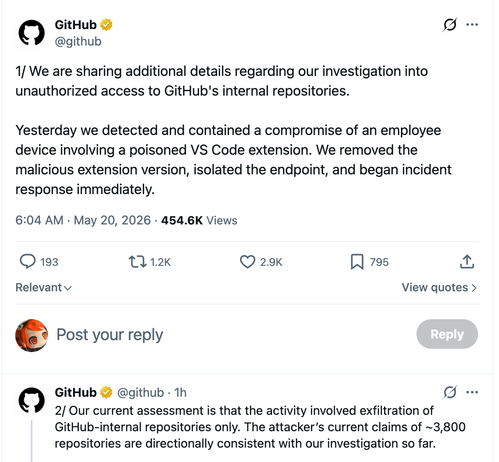
info on the github breach appears to only be available on xitter 🙄 , I fished it out for you.
@0xabad1dea Or the extension was legitimate and got compromised (their use of the term "poisoned" makes me think that).
Supply chain attacks are on the rise; the best course of action is to admit when they happen, learn from them, and use those learnings to prevent it in the future.
@radex sandboxing the web browser was reasonably easy at the start because web pages had extremely limited functionality. But every time that allowable functionality gets extended, there is another multi-year process of defining and standardizing new interfaces including new permissions.
You cannot do that in an IDE without severely compromising the usefulness of thr IDE's plugin model
@ratsnakegames @Nephrite @0xabad1dea Sure. I'd rather say that _not every_ extension can be meaningfully sandboxed.
Required permissions could be clearly displayed and those that require full unsandboxed access could be additionally flagged.
IMO this would go a long way towards reducing risk of pwnage via extensions. Long process, sure, but worth it.
@[email protected] This is literally true, and has been giving many of us nightmares for a long time. See also the package managers for most popular programming languages.

59 Posts, 94 Following, 50 Followers · Currently in recovery from burnout. Rediscovering the joy of creativity. Hobby page (very much still under construction): https://nephritescastle.neocities.org/
@0xabad1dea but it is the same company, so they are not at all absolved
Edit: and yes, you are very right about how problematic that is.
1/ We are sharing additional details regarding our investigation into unauthorized access to GitHub's internal repositories. Yesterday we detected and contained a compromise of an employee device involving a poisoned VS Code extension. We removed the malicious extension version, isolated the endpoint, and began incident response immediately.
I’ve thought about this for a while and I think the difference is the marketplace. I use a bunch of vim extensions but vim and emacs don’t have a built-in thing that advertises extensions to me. There’s no ‘click here to install…’ button with flashy marketing. There’s no built-in concept of ‘recommended extensions’.
When I install an extension in vim, it’s almost always because someone looks over my shoulder and says ‘wow, I forgot how bad vim was without [my favourite extension]’ and I try it and decide it actually does make life nicer. When people install extensions in VS Code it’s because they’ve been trained that there’s always an extension in the store and it’s the top result for their search. And that gives people a big incentive to put malicious extensions in the store.
@phil @0xabad1dea @david_chisnall No no, Emacs has a *far* more sophisticated security model than VSCode.
Malware authors sit down to learn Emacs, so they can write Elisp malware ...
... and ten years later they're still customising their editor, and haven't written a single line of malicious code.
(Posted with love as an  user for several decades ...)
@david_chisnall @0xabad1dea I could not ever have thought that to be a problem! Who has ever heard of it being problematic to download random code from the Internet and run it with full privileges on your computer? This realization is a breakthrough in infosec. Someone deserves a Nobel price for this. And a Turing award.
(#sarcasm just in case)
They wrote:
> "2/ Our current assessment is that the activity involved exfiltration of GitHub-internal repositories only. […]
3/ We moved quickly to reduce risk. Critical secrets were rotated yesterday and overnight with the highest-impact credentials prioritized first."
Do they really put "Critical secrets" in their "GitHub-internal repositories" !?
"Directionally consistent"
@0xabad1dea paraphrased comment I saw on xitter:
"how did the hackers find a window of uptime to get in?"
 Ian
Ian JA
JA Nephrite
 Ratsnake
 Radek Pietruszewski 🐶
 DerPumu (he/him)
 Michael Newton
 luna the doggie

 Kevin Boyd (he/him) 🇨🇦
 fat hairy chud
 mlen
mlen Irenes (many)
 SMillerNL
 tatiana
 Tom Head
 The Witch of Crow Briar
 tkissing
 groxx
groxx Ryan Finnie
 Cogito ergo mecagoendios
 David Chisnall (*Now with 50% more sarcasm!*)
 Phil
Phil Duncan Bayne
 Lars Wirzenius
 muddle
 Benoît B.
 endrift 🏳️⚧️
 degenerating degenerate
 James
James nick
nick tmaher
 Taggart

 Yossi
Yossi