 Prof. Emily M. Bender(she/her)
Wow some terrible reporting about Google's latest horrible ideas about how to distort information access in the name of "convenience" (or something):
https://techcrunch.com/2026/05/19/google-search-as-you-know-it-is-over/
A short thread
🧵>>
Wow some terrible reporting about Google's latest horrible ideas about how to distort information access in the name of "convenience" (or something):
https://techcrunch.com/2026/05/19/google-search-as-you-know-it-is-over/
A short thread
🧵>>
5 years ago (2021) Google researchers Metzler et al put out a preprint talking about how LLMs would change information access ("Rethinking Search"). It was full of TERRIBLE ideas, and Chirag Shah and I wrote a reply ("Situating Search"):
https://dl.acm.org/doi/10.1145/3498366.3505816
>>
We followed a couple of years later with further arguments about, inter alia, protecting the information ecosystem:
https://dl.acm.org/doi/10.1145/3649468
While Nora Lindemann was writing about similar ideas:
https://link.springer.com/article/10.1007/s00146-024-01944-w
>>
We observe a recent trend toward applying large language models (LLMs) in search and positioning them as effective information access systems. While the interfaces may look appealing and the apparent breadth of applicability is exciting, we are concerned ...
But all the academic papers in the world showing why something is a bad idea won't stop companies from doing it, if it's profitable and/or fits into their quasi-religious beliefs that "AI" is the future, alas.
So let's look at what Google is up to now, or at least says they are, via TechCrunch as stenographer:
>>
Not satisfied to cut people off from the important sense-making of looking at information in its context and finding and navigating different perspectives (what "AI overviews" do), Google also wants to tell you what to search for:
>>
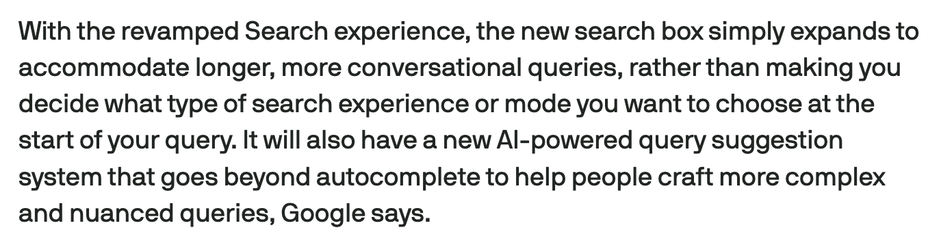
How infantilizing --- you thought you were looking to find something that someone else wrote on the web. But woah! Now you've been "dropped into" an "interactive experience". Yeah, Google can just fuck right off with that.
>>
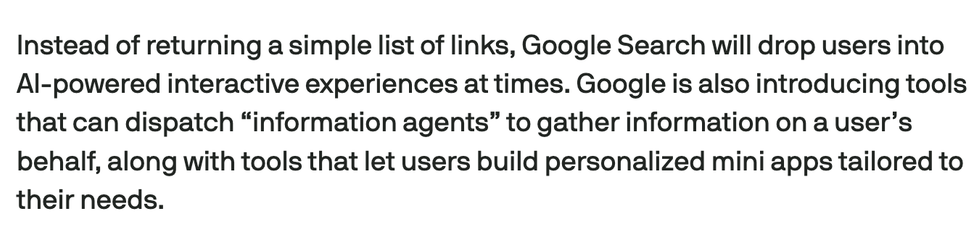
Look, I hate pointy-clicky interfaces as much as the next Gen-Xer (let me use the keyboard, dammit) but it is so weird to reduce the important, and importantly effortful, work of navigating the information ecosystem to the apparent drudgery of clicking on links that are (*shudder*) blue!!!
>>


Here is where it really starts to show that this journalist is just lightly paraphrasing a press release. "Links will become an afterthought," will they? What is your evidence for that confident statement about the future?
>>

Spot the magical thinking here. No, the "AI" isn't making sense of anything. It's making papier-mache of the input, and preventing the use from doing the sense-making.
Also, is that the Pokemon sense of "evolution"?
>>
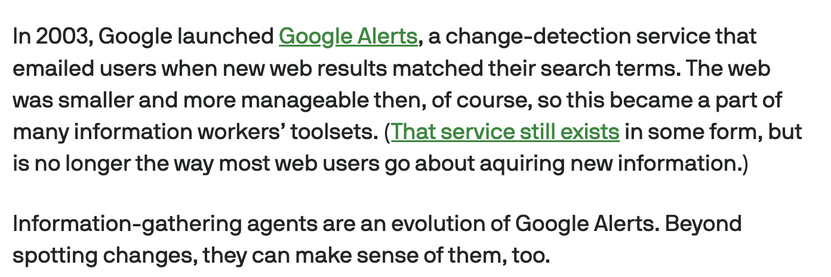
To expand just a little bit: the point of a Google Alert was to gain access to things that people were saying about a topic that you were tracking, which you otherwise might not turn up. And every (blue, even!) link that you clicked on brought you to a web page you could examine to get a sense of who was writing, in what context, and why.
>>
More stenography here. Google starting shoving the "AI Overviews" into query results as an opt-out situation. That is, you have to take action to have them not pop up. I don't doubt they are *shown to* 2.5 billion monthly users, but that doesn't mean they are used by as many or desired by them.
>>
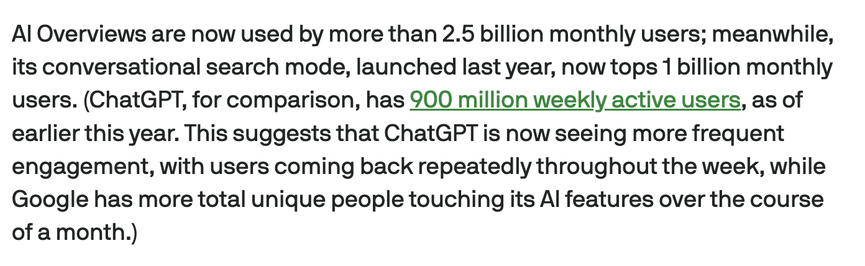
The comparsion to ChatGPT in the above screencap also really shows the PR origins of this piece. Google is clearly very very concerned about losing their advantage in this market to OpenAI.
>>
NO NO NO NO NO! Flashy polished looking webpages that no one has accountability for run absolutely counter to the common good when it comes to a health information ecosystem AND an informed public.
(Also, "Antigravity"? Yeah, you want us to think this is very cool science fiction and/or magic. Not buying it.)
>>

For one final shudder: Pichai here seems to want to think this is helping the world somehow? Gah.
>>

We don't have to buy this journalist's view of the future as already written by Google. Every time you click through to look at the actual source page you are helping to maintain our information ecosystem and build a better world.
/fin (for now)
@Guillotine_Jones @emilymbender or is it from Pichai's Google
(semiserious question, I never worked there under the other guys)
It sounds better than the truth. This helps Google, the ad-company, to better shape the “experience” as it best suits their paying ad-customers.

@emilymbender Exactly!
I understand that business value propositions change over time, but going from "we disrupted search by making a simple interface" to "we ruptured search by making our simple interface complicated (and terrible)" is. well, it's certainly. a choice.
Thank you for this thread and breakdown!
Antigravity is a fantastic name, though. A concept directly contrary to observable reality which can never provide what it purports to do, but which demands infinite money to research and build a la a Perpetual Motion machine? Perfect, and I look forward to them naming their future confidence tricks in a similar manner.
Google Phlogiston. Google Luminous Aether. Google Phrenology.
@ShadSterling @romli @hamishb @emilymbender use duckduckgo and you have simple ai opt out .
But anyway all this suppose there will be something left to search for on the web. Nowadays most often than not the first 10 links returned are AI generated web site slop.
Given that this slop is now used to generate further down the drain AI sites, the untrustworthy garbage'll soon supersede 100-1 trustworthy sources.
Maybe we'll have to come back to human indexed content of a curated list of sites.
@morqendi @tomtom @romli @hamishb @emilymbender the only time I use Google is when DDG results are useless so I prepend with “g! ” to try Google, and even the noai version doesn’t append “ -ai” so I still get the AI overview and an actual setting would still help.
I’ll try to remember to try prepending with “g! -ai “, but that’s not an acceptable way for them to interpret “opt out”
@ShadSterling @romli @hamishb @emilymbender
https://addons.mozilla.org/en-US/firefox/addon/no-shit-sherlock/
Would love to know if this works for you!
@emilymbender, that was exactly the point at which I started configuring browsers to add “&udm=14” to all searches done via G💩💩gle.
Most recent case? I noticed that Calibre does word lookup. It will happily do so via G💩💩gle; and, yes, the slop summary is shown.
@Qybat @emilymbender if no one sees the ads, the companies will stop buying adspace. That's not what google wants. So I guess they will embed the ads in the search results.
And the web will have finally evolved to be just like television. Just a bit more interactive because you'll be allowed to purchase directly what you see on screen (but probably nothing else).

 Tero Ykspetäjä
 Erotic Mythology 🌹
 Zekovski 🌼
 Luke Harby
 Guillotine Jones, Flâneur
 Alex is Adjusting
 Tormod
 Dr. Bruce Simpson
 lp0 on fire
 Michael Moore
 sleepfreeparent
 Damon L. Wakes
 arestelle
 Shar(yna)Tran/Shark(aeopteryx)
 Bill, organizer of stuff
 @
@ ✧✦Catherine✦✧
 jack
jack Jennifer Kayla | Theogrin 🦊
 Hugh Cayless
 Hamish Buchanan
 ShadSterling
 romli
romli Tom Tom
 Morqendi
 Saufian
 Michael Gale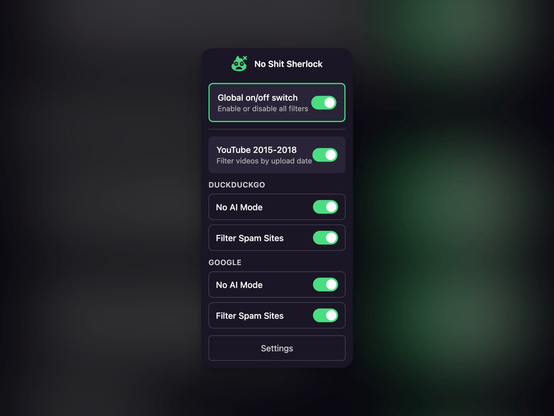
 LC Wanderlust
 En fri prins
 Mensch, Marina
 Space Hobo
 Mike Anderson
 ExcelAnalytics
 Gadfly (-booq-)
 Nicolas Évrard
 Niko Trimmel
 Tuuli M. (domestic goblin)
 Sister Lucy Fur