 Prof. Emily M. Bender(she/her)
Wow some terrible reporting about Google's latest horrible ideas about how to distort information access in the name of "convenience" (or something):
https://techcrunch.com/2026/05/19/google-search-as-you-know-it-is-over/
A short thread
🧵>>
Wow some terrible reporting about Google's latest horrible ideas about how to distort information access in the name of "convenience" (or something):
https://techcrunch.com/2026/05/19/google-search-as-you-know-it-is-over/
A short thread
🧵>>
5 years ago (2021) Google researchers Metzler et al put out a preprint talking about how LLMs would change information access ("Rethinking Search"). It was full of TERRIBLE ideas, and Chirag Shah and I wrote a reply ("Situating Search"):
https://dl.acm.org/doi/10.1145/3498366.3505816
>>
We followed a couple of years later with further arguments about, inter alia, protecting the information ecosystem:
https://dl.acm.org/doi/10.1145/3649468
While Nora Lindemann was writing about similar ideas:
https://link.springer.com/article/10.1007/s00146-024-01944-w
>>
We observe a recent trend toward applying large language models (LLMs) in search and positioning them as effective information access systems. While the interfaces may look appealing and the apparent breadth of applicability is exciting, we are concerned ...
But all the academic papers in the world showing why something is a bad idea won't stop companies from doing it, if it's profitable and/or fits into their quasi-religious beliefs that "AI" is the future, alas.
So let's look at what Google is up to now, or at least says they are, via TechCrunch as stenographer:
>>
Not satisfied to cut people off from the important sense-making of looking at information in its context and finding and navigating different perspectives (what "AI overviews" do), Google also wants to tell you what to search for:
>>
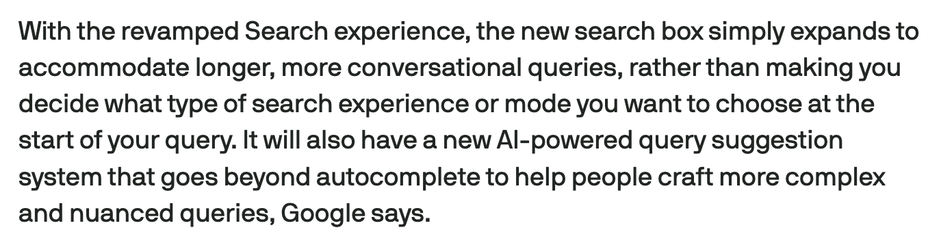
How infantilizing --- you thought you were looking to find something that someone else wrote on the web. But woah! Now you've been "dropped into" an "interactive experience". Yeah, Google can just fuck right off with that.
>>
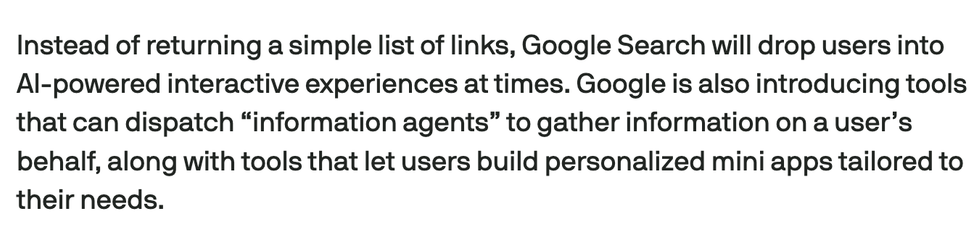
Look, I hate pointy-clicky interfaces as much as the next Gen-Xer (let me use the keyboard, dammit) but it is so weird to reduce the important, and importantly effortful, work of navigating the information ecosystem to the apparent drudgery of clicking on links that are (*shudder*) blue!!!
>>


Here is where it really starts to show that this journalist is just lightly paraphrasing a press release. "Links will become an afterthought," will they? What is your evidence for that confident statement about the future?
>>


 Tuuli M. (domestic goblin)