 LC Wanderlust
 Fabrizio Musacchio
#Deepfakes are everywhere, but #DigitalForensics investigators are fighting back:
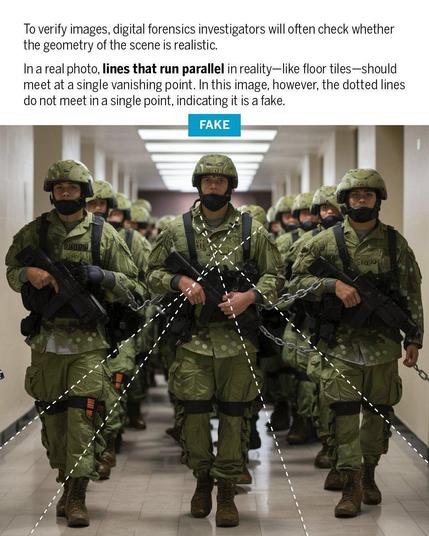
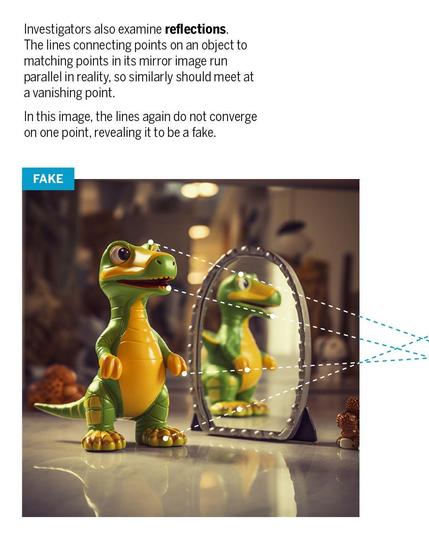
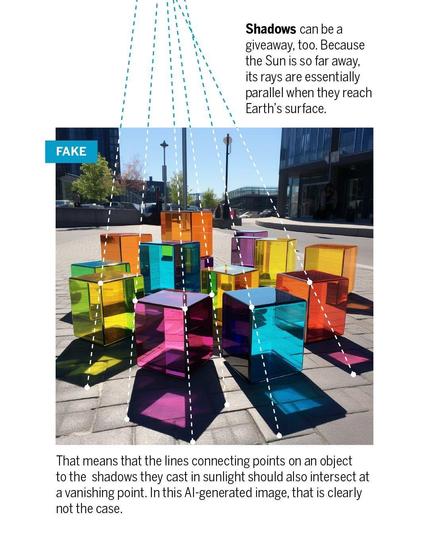
#Deepfakes are everywhere, but #DigitalForensics investigators are fighting back:
@mathieu_ @AudeCaussarieu Je mets ma main au feu que les IA génératives savent déjà le faire, si on leur demande dans le prompt 🙄
On va surement en arriver au même résultat que pour la presse ou la télévision : La confiance dans le média sera lié à la réputation du média et à rien d'autre...
@Mourioche bah j'avais vu une vidéo sur la musique généré par IA où on disait que le gros problème c'était que l'IA n'arrive pas à reconstituer les pistes/instrument et manipule le bazar comme un tout, et forcément qqn d'exercé arrivait à repérer des étrangeté dans les sons et la stéréo.
C'est le même problème pour la géométrie, vu qu'on crée l'image comme un tout, sans "calque" (qui permet de limiter ce genre de couilles en structurant les plans)
@mathieu_ @AudeCaussarieu fondamentalement, les AI generatives fonctionnent a l'echelle des pixels d'une image (ou video), et n'ont pas vraiment un model abstrait d'une scene (pas de plan 3D en tete)
C'est pour ca aussi sur les model plus vieux les doigts surnumeraires, les 3e mains mal placees, etc. Meme-si ces erreures la sont plus facilement corrigibles.
@legendarybassoon @grototo @AudeCaussarieu
Oui, je suppose ça ferait une forme pas exacte, mais pas random.
L'images des cubes par exemple, il y aurait de la symétrie, pas juste un des points qui va n'importe où.
Et j'imagine la gueule des prompts pour dire de se concentrer sur les points de fuite, difficile à décrire en langage "naturel". Avec un peu de chances ça va pas être facile à corriger.
@nartagnan @legendarybassoon @grototo @AudeCaussarieu je suppose qu'on est déjà entré dans une nouvelle guerre "génération de fakes crédibles" vs "détection de fakes", comme on a déjà les crawlers/rate-limiter, pub/ad-blocker, tracker/anti-tracker, etc. 😒
Donc oui, même si ce n'est pas facile (?), je ne serais pas surpris que les entreprises derrière ces générateurs d'images analysent les techniques de détection et fassent leur possible pour les rendre inopérantes.
@youen @legendarybassoon @grototo @AudeCaussarieu
Mais ça va coûter.
Même avec de la détection, s'ils veulent faire comme le claude code, aka "génère, on check, et tant que ça passe pas le check recommence, même si c'est 1000 fois", ça va leur coûter... 1000 fois plus cher.
Et ils n'auront pas ce luxe encore très longtemps.
@nartagnan l'uncanny valley dans 10 000 ans, si on est encore dans les parages : pourquoi la reconnaissance instinctive des lignes de fuite est devenue un enjeu de sélection naturelle ?
@nartagnan en fait, je vois même pas comment intégrer ça au process d'entrainement, sans que cela devienne une machine à gaz, ce qui est déjà le cas however, genre encoder un raytracer
@tk @nartagnan @legendarybassoon @grototo @AudeCaussarieu
Générer plein d'images par IA, demander a des petites sous payées de dessiner les lignes fuites. On fait deux jeux de données : les images avec un seul point d'intersection et les autres. On rajoute des vrais images dans la première catégorie. On lance l'entraînement d’un modèle ou un fine tunning d’un modèle existant.
@youen
@tk @legendarybassoon @grototo @AudeCaussarieu
Oui, c'est faisable.
Mais se concentrer sur X c'est délaisser Y.
Au début, quand il fallait compter les doigts des mains, les modeles qui étaient bons sur les mains étaient mauvais sur le reste.
L'amélioration n'est venue qu'en multipllant le nb de paramètre des modèles. Et donc le coût de génération d'une seule image.
C'est exponentiel.
Et j'ose croire qu'il n'y a plu moyen de multiplier encore par 2 leurs coûts, sans revenus.
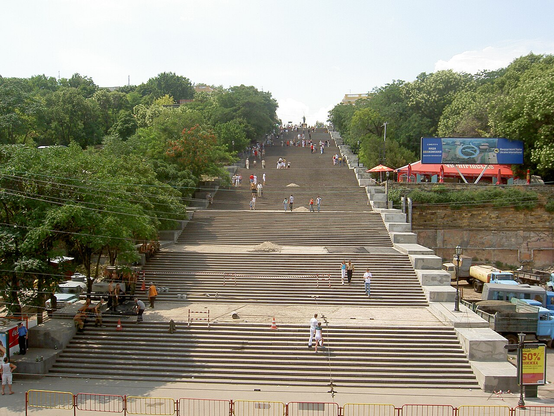
@leah agreed, I just wished the technique they described came with that as a warning, because the (obviously generated, "read" the uniform patches) hallway picture shown would be a *prime* candidate for taking with a fisheye lens or a similarly distorting lens; and the piece of flooring used to extrapolate the straight lines is already honestly too short in the example to be sure. I cannot, over the length of maybe 50px, draw a 1000px line with < 1° error.
@leah (and of course, a photojournalist in a government building is more likely to have a "low distortion as possible" lens equipped than a fishlens, but if you're preparing for e.g. reporting from a small, crowded room and want to get as many interacting politicians into the picture as possible, you'd not go in there with a superzoom lens alone. And if a picture is claimed to be from a publicity shot, the photographer certainly will pick from a wide range)
@nCrazed @leah @f4grx @FabMusacchio Sunrays are quasi-parallel in the 3rd dimension, however they all diverge from the sun when projected on a surface such as a camera sensor or our retina. What difference does it make if the trick works with lamps too ? The sun is just a big, faraway lamp, and the rules of convergence in 2d spaces apply just the same for all 1d-ish lightsources.
The trick works if you don't mind for lens distortion, which are really minor on most smartphone cameras nowadays (do not mess lens distortion with surface distortion caused by planar projection on sensors, the latter doesn't affect convergence even though it can exxagerate surfaces on the sides of the pic).
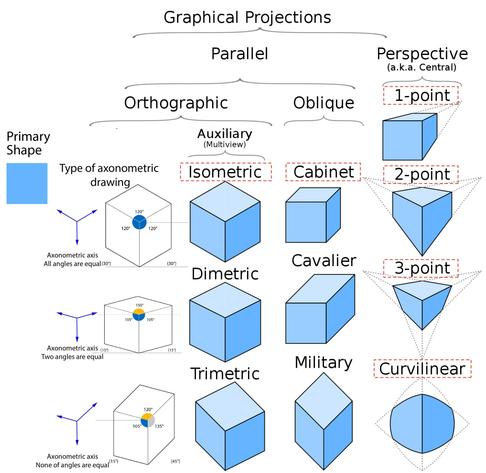
It's not the sun's rays that meet at a point, it's the lines from the objects' shadows to the corresponding points on the objects that should meet at a point.
The statement about the sun's rays being effectively parallel just means that the direction of the light source can be considered the same for all objects.

@seachaint
Yeah, I noticed that. All the example images have other things about them that are wrong and give them away as fake.
I think the OP wanted to just focus specifically on how to check for lines that should meet at a point, as one kind of objective test we can use, and not get into all the other stuff.
@XauriEL @FabMusacchio Yep. GenAI doesn't _understand_ anything - like 3D geometry - it just knows a lot of patterns. The same holds for LLMs. The way to test is to look for understanding, or the lack of it.
Like this
https://bsky.brid.gy/r/https://bsky.app/profile/did:plc:jdgad3rwwpboirmdcqx4qqvm/post/3mjs54ulm622n
@ilusenn @FabMusacchio It's legit - the website of the scientific journal, Science (they picked scim.ag because it is short for Science magazine).
Here's the full URL: https://www.science.org/content/article/deepfakes-are-everywhere-godfather-digital-forensics-fighting-back
 Aude Caussarieu 🌻
 Mathieu
 Mourioche ⏚
 Gérard Fadrelle
 ---> []
 frankiezafe
 DrYak
DrYak Dr Grototo
 Chèvre Mousse
 Nartagnan
 youen
youen tk 🍜
tk 🍜 Youen Péron
 The Marvelous Mx Tellington
 pulsation
 Mans R
 Klara
Klara ChookMother 🇦🇺🦘
 Microblog Castellano
 L'égrégore André ꕭꕬ
 Light
Light F4GRX Sébastien
 Leah Neukirchen
 Edvin Malinovskis
 Marcus Müller
 Stanley Coupdebrique
 Lea
Lea Seachaint
 Glenn Hoppe
 Xauri'EL Zwaan
 Martin Vermeer 86 47
 Ilusënn
 Jonathan T
 Petra van Cronenburg