

Drupal teamlead at VDAB
With Drupal User Group Belgium organizing https://www.drupalcamp.be
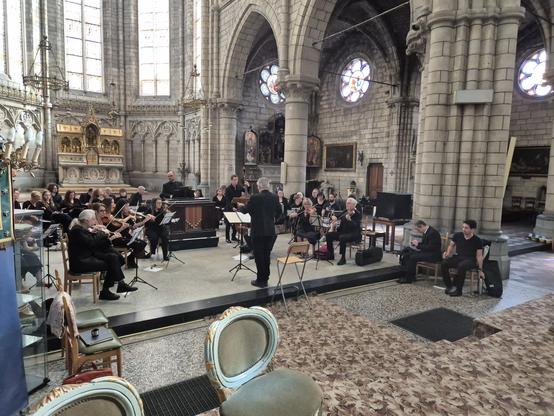
Singer at www.j4fun.be and at www.octopusensembles.be
Love nature, walking in the Ardennes, drawing, making things 🎨🎙🧶🥾🥧
Header picture shows cranes in the Ardennes evening sky, on their way south to the "Lac du Der"
🇧🇪
Currently debugging a set of opensource tools for automatic backyard bird detection using a Raspberry Pi.
Amazing as the tool is (it works!), it's an unholy goulash of procedural PHP, Python, and bash scripts.
I know we all like to swear at Drupal's code sometimes, but it's *immaculate* compared to this thing.
It pays off to leave the island once in a while. Puts things in perspective.
Huge respect for the EU Commission, @EUCommission, who have updated their webpage with a new follow button — X is out, Mastodon is in!
Remember to reward them with a follow! ♥️🇪🇺
Seen here: https://commission.europa.eu/index_en

Posted today by #Lego on their official Instagram account. Well done, Lego, well done. 😁
"Happy 100th birthday, Sir David Attenborough. There's no age limit for those who never stop playing 🎈"

RE: https://mastodon.social/@FabMusacchio/116529625252630872
People laughed at me when I said projective geometry could save the world.
@mcg - So, this is sort of true, but not really - especially in practice.
So *public* VPNs do go through a known IP address, and those lists can be generated and actioned upon / blocked - but... they often rotate IP addresses.
This does two negative things for people trying to block them. One, the block is only temporarily effective, and you're always playing catch-up. Two, once the IP is released by the VPN its often grabbed up by another non-VPN service, so you end up blocking something you didn't intend to.
You could certainly subscribe to a service that maintains a blocklist for you, but these aren't very effective either (and they cost money) for the above reasons. Lots of false negatives and false positives.
Further, anyone can spin up a VPN service. A simple OpenVPN service on a VPS can be done in less than 10 minutes with a simple guide.
And that's just one aspect of it.
Also, Utah is holding ALL websites? On the internet? Liable? How would they enforce it? How do THEY know the website is or is not blocking it? Are they going to visit every website from one random VPN connection and go "ah-ha! Gotcha!" ? Then what? Send a cease and desist letter? Fine each website on the internet? All over the world?
All this will do is at best be completely ineffective and at worst cause the entire internet to "de-federate" from Utah.
Long and short, VPN's do have IP ranges, kind-of, but they can't be meaningfully blocked. And there is no meaningful way to detect OR enforce it.
 Sophie 🏳️⚧️ 💜 🎹 🪗
 Christine Malec
 nest
nest jpoesen | 🇪🇺 | 🏳️🌈
 Randahl Fink
 John - 🎞️ Film Nerd 🎞️
 Eleanor 🫖🍵📚
 Tinker ☀️
 Dan Morgan