Lars
Lars codinginquarantine
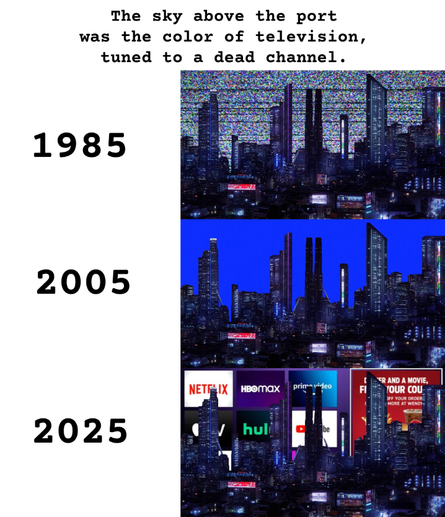
I couldn't stop thinking about this so I had to make it and share it
Thanks @Anke!
@codinginquarantine would you mind updating your toot's image description? This version is way more understandable for those who need it.
Daaaaang
I lol'd at the image.
"however", most NTSC TVs in the '80s would have shown a purely black and white signal.
The technical reasons why are interesting to me, and now I'm infodumping on you. Not because I hate you or your image.
The north american television system (NTSC) was adopted in 1941 and was a purely black and white system. These TVs would certainly have displayed static as black & white as there was literally no capability to display color.
Color NTSC, adopted in 1953, had to be compatible with existing B&W sets, and had to allow color TVs to receive and display B&W content correctly. They way they chose was adding a hidden signal on each line that told a color-capable set to display that particular line in color. This signal is called the "NTSC colorburst".
(Many modern NTSC receiving devices use color or black & white for the entire frame or field (or maybe don't support B&W at all?), but this is not what real CRT TVs and monitors did. This makes a particular difference for correctly displaying Apple II graphics: The split screen modes should display clear text in the bottom rows, not color-fringe artifacts! So .. this is not to say there weren't TVs that could have had the same "bugs" and displayed color static. I'd love to know if some did! I also don't know about other systems such as SECAM or PAL in this respect)
The random background noise of static is very unlikely to meet the requirements of the colorburst, so a color TV would fall back to the mode for B&W content.
The wikipedia article on video noise shows the kind of static I expect...
https://en.wikipedia.org/wiki/Noise_(video)
@stylus @codinginquarantine It was all analog (not just NTSC), and it was a “color killer”, that was basically a proxy for “low quality”. Whenever the signal quality was too low to sustain color decoding, this would kick in — and if you lived in a world where color was the “new” thing like widescreen or HD or 4K, your heart would sink to be losing it.
It was directly equivalent to having slow internet causing YouTube to drop to 480p and 360p.
So yeah, therefore pure snow was 100% B&W.
PAL stands for Phase Alternation Line, and it basically mucks around with the phase of the colour subcarrier to prevent drift. So random noise on an unused broadcast channel is as unlikely to be recognizable as a colour burst in #PAL as it is with #NTSC.
Amusingly, it didn't usually have entire blocks of blank lines, either. I suspect that the stock art that @codinginquarantine used here was not based upon broadcast noise, but upon video-tape noise, likely when watching in fast forward/rewind.
Noise re-modulated through a video tape player's RF analogue output had a different quality.
And of course the fake noise used in 21st century movies and telly programmes about the 20th century, dummied up by a computer, is usually wrong. It's one of those widespread telly errors, like the view through #binoculars having two circles centred far apart.
Tag, @bytebro. You're it.
It's not anyone's theory. It's how it worked years ago, and it's how it still works today. I'm reading this very message on a repurposed #PAL telly, in fact. If I switch it to the old analogue BBC1 channel, it shows the snow in black and white, because there's no proper PAL colourburst, and without large groupings of black lines.
@stylus @bytebro @grishka @codinginquarantine
#television #BroadcastEngineering
@bytebro @codinginquarantine @grishka @stylus @JdeBP ah, we seem to have understood different things. I understood this as "snow or not", you as "colourised or not snow"
(to which I honestly cannot give an answer, I stopped watching TV in the 1990s so I only remember snow but not if it was colourised)
@JdeBP @stylus @codinginquarantine @grishka @mirabilos
*Now* I understand where the thread came from - sorry, I was puzzled earlier.
I'm not qualified to comment on the 'dead noise' thing[1], but I do recall that when I saw US TV years ago there was a thing about NTSC stood for 'never the same colour'.
1. "I see dead people"!
But I do know that there were attempts to utilise images from dead TV signal channels as 'random noise generators' before the world moved to Linux and found /dev/random et al.
Stylus, well, I made a software SECAM decoder, so... it's even easier to detect the presence color there, although I didn't implement that, so it does show color static if you feed it noise.
The color information in SECAM is encoded as two frequency-modulated components (D'b and D'r) on alternating lines. The subcarrier is always present within the active area, even on parts of the image that have no color. In that case, there's just no deviation so it works out to black and white pixels. There are also several lines in the VBI that carry the color synchronization signals so the receiver knows which lines encode which of the two color components (they're visible on the screenshot in the repo as a green gradient), the presence of those can also be used to detect whether there's color.

20 track album
It's a long time since seeing the cosmic microwave background was a universal experience.
@codinginquarantine
More detailed alt text:
Under the quote "The sky above the port was the color of television, tuned to a dead channel." there are three panels. The first panel, labelled 1985, shows a cityscape with skyscrapers, with the sky beyond the buildings a dim multi-coloured static. The second, 2005, shows the same cityscape but now the sky is a solid, uniform blue, darker than a daylight blue. The final panel, 2025, shows the same cityscape but now the sky contains rectangles for half a dozen video services (Netflix, YouTube, etc) and a large ad for fast food delivery (possibly McDonalds)
I remember reading that 42 years ago and realizing that Gibson didn’t own a vcr.
 Anke
Anke Granny Art (Shrimp) (Joni)
 Greg
Greg Herzleid
 Lux
Lux 
 Григорий Клюшников
 🆘Bill Cole 🇺🇦
 mirabilos🐈⬛
 kolya
kolya D Ingram
 stib
stib Sam
Sam R.L. Dane

 🍵
🍵 
 Mason Loring Bliss
 EnidKapelsen
 punIssuer
 bigblen
 JordiGH
 william ⁂ maggos
 Jo
Jo esko
esko Totally Normal, Regular Guy
 Stylus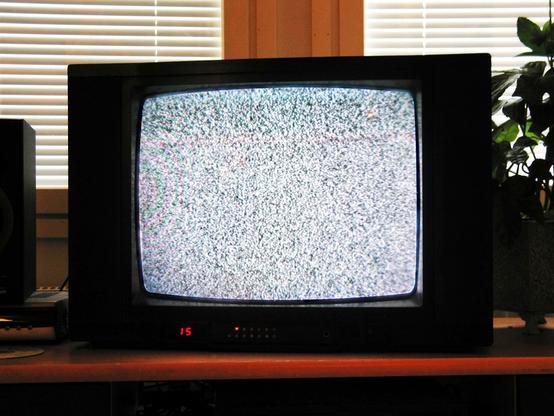
 jandi
jandi ScriptFanix💍
 Christian Kent 𝘊𝘒 :\﹥
 Alex Feinman
 JdeBP
JdeBP Bytebro 🇬🇧 🇺🇦 🇬🇱
 Dec [{(
 )}]
)}]
 schrotthaufen
 PointlessOne
 Profane tmesis
 SoonLeeNZ
 lonely extrovert
 markusde
 halcy
halcy 
 Infosec Spy
 lp0 on fire
 Super Owl
 Fuzz-Ra
 StarkRG
 nLupo
nLupo 
 Pseudonym Ken
 Incident Creator ❎
 Anthony Sorace
 sabik
sabik khol
khol Ratsnake
 KanaMauna
 d.o.c.w.u.
 Alexander Shendi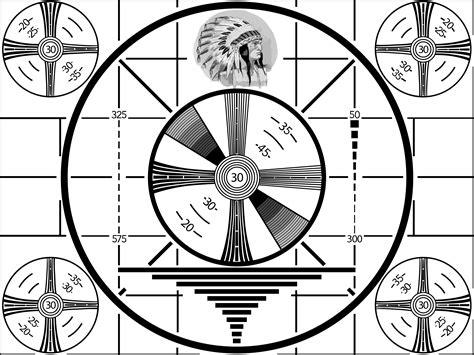
 Pip Gowenlock