You know there's something wrong with US politics when NASA is forced to communicate in Imperial measurements.

"Orion’s main engine provides up to 6,000 pounds of thrust, enough to accelerate a car from 0 to 60 mph in about 2.7 seconds. At the time of the burn, Orion’s mass was 58,000 pounds and burned approximately 1,000 pounds of fuel during the firing."
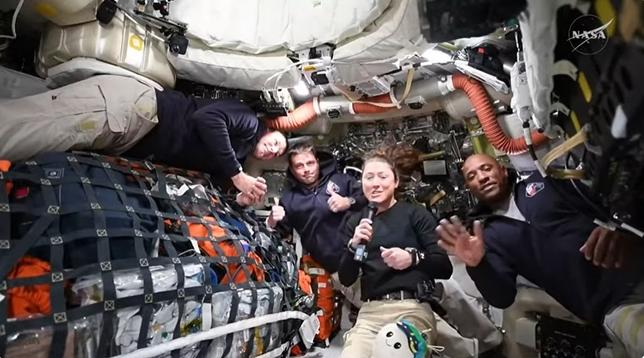

https://www.nasa.gov/blogs/missions/2026/04/02/artemis-ii-flight-day-2-orion-completes-tli-burn-crew-begins-journey-to-the-moon/

#space #artemis #nasa

Artemis II Flight Day 2: Orion Completes TLI Burn, Crew Begins Journey to the Moon - NASA

NASA’s Artemis II crew is on the way to the Moon.

NASA

OFFS "On the station, crews rely on more than 4,000 pounds of exercise hardware spread across roughly 850 cubic feet." 🙄

#science #nasa #artemis

NASA's use of Imperial measurements is similar to if US biologists started using species names in the Texas dialect instead of in Latin.

#science #nasa #artemis #space

I can't overstate this. NASA's use of pounds and cubic feet in its outreach efforts does not come across to science-literate people, inside or outside the US, as a sign that the country is a badass superpower that can do what it likes and ignore everyone else.

Instead it suggests that the US is a provincial nation of dungaree-wearing banjo players.

#science #nasa #artemis #space

@mrundkvist I actually wear dungarees and play a banjo.
@btrinen @mrundkvist hahaha me too except it's the cello instead of the banjo although I would very much like to learn the banjo.
@douglasvb @btrinen @mrundkvist yeah of all the things I'm prepared to be ashamed of, giving the world blue jeans and bluegrass is...uh, nowhere on the list

@mrundkvist Worse, NASA lost a spacecraft due to this oractice. https://en.wikipedia.org/wiki/Mars_Climate_Orbiter

I don’t see it as superpower bravado but rather the inability to adapt and the low values the public places I. Science and engineering.

Mars Climate Orbiter - Wikipedia

@tsrams @mrundkvist

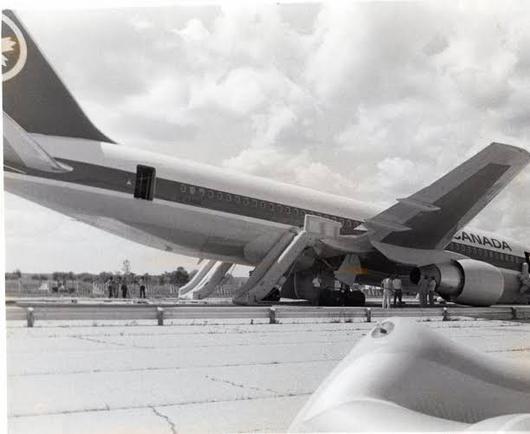
Having incompatible measurement units can lead to bizarre situations. One of these is the story of the Gimli Glider, a Boeing 767 which, after its fuel density was calculated in pounds per litre instead of kilograms per litre, had to land with no engines on a decommissioned runway on which a motorsport event was taking place.

https://en.wikipedia.org/wiki/Gimli_Glider

#metric

Gimli Glider - Wikipedia

@Anne_Delong @tsrams @mrundkvist why would you even?
Lucky it wasn’t forced to land in the middle of the North Atlantic.
There are vast swathes where there simply are no motorsports events.
@OneInterestingFact @Anne_Delong @tsrams @mrundkvist Did you read the description of the accident?
@SalemsLot @Anne_Delong @tsrams @mrundkvist
Certainly.
Someone decided to use the wrong units. At a national scale.
Ended up only putting 45% of the fuel they meant into the tanks. Luckily it wasn’t a flight to Europe.
@OneInterestingFact @Anne_Delong @tsrams @mrundkvist Yes. But there was no possibility to have foreseen the usage of a closed military Airport for Motorsports. And certainly not possible to check that in a timeframe of 17 minutes.

@SalemsLot @Anne_Delong @tsrams @mrundkvist

I think we may, in our own way, be making the same point.

@Anne_Delong @tsrams @mrundkvist Ahh yes, the Gimli Glider, a famously American cock-up on the American Air Canada airline operating between the noted American cities of Montréal and Edmonton.

@dresstokilt @tsrams @mrundkvist

Sorry, I didn't intend to imply that it was an American issue, just that dealing with two different measuring systems can lead to mistakes.

@Anne_Delong @dresstokilt @tsrams @mrundkvist

It was was one of the reasons Canada smartened up and switched to metric.

@chu @dresstokilt @tsrams @mrundkvist

Aside from the fuel issue, it seems that the pilots had not been trained on what to do if both engines were not working, and there was no item in the emergency manual about it. Only because the pilot flew gliders as a hobby did the plane get to the runway (which had a guardrail down the middle for safety during drag races).

@Anne_Delong @dresstokilt @tsrams @mrundkvist

We learnt about the glimi glider in flight school.

It was a long time ago in aviation terms. The industry was not as mature as it is now. It is important to remember that all safety regulations and protocols are written in blood. In general, until sometime fatal (or near fatal happens), things don't get regulated due to lack of information or just lack of understanding.

This was one of those incidents that added to the rule books.

@tsrams @mrundkvist Also without an international view.
@mrundkvist It is frustrating as well for the hundreds of millions of Americans who had no choice of measurement standards in school or everyday life, most of whom neither wear dungarees nor play banjo. Every day I am applying complex conversion formulae just to get by in Mexico. I still don't have an innate sense of either metric sizes or celsius temperatures. Metric is easier, but still a struggle. Poor me.

@farbel @mrundkvist I mean, it's not like we don't have inches and feet in Europe either. I've had to do conversions all my life too because they're commonly used in many contexts. Since the default is metric, I do the conversion the other way of course, but at the end of the day, it's still an additional cognitive load.

I was just discussing wind speed with my brother, who works at an airport. I'm used to metres per second wind speeds, but they use knots.

@veronica @farbel @mrundkvist in Europe? After Brexit? Ireland is (fairly) metric since 2005, isn’t it?

@Tho99 @veronica @farbel @mrundkvist

Ah, aviation...

Altitude is still measured in Flight Levels which are enumerated in thousands of feet (though they're actually a pressure altitude). Even metric flight levels in Russia named that way though the actual altitude varies slightly because of the difference between the metric flight levels and everybody else's feet-based flight levels. So planes may have to adjust their altitude slightly when entering or leaving Russia.

@resuna @Tho99 @farbel @mrundkvist I can think of at least 5 areas for myself. I grew up around boats, and they're still referred to in feet. I've also been around carpentry all my life and although everything is sold in millimetres, it's still often referred to as 2by4, 2by6, 4 inch nails, etc. In my church going days I did sound engineering, where everything is in inches, and I worked in electronics where it's all decimal inches. I also worked in IT where hardware is all inches as well.
@veronica @resuna @Tho99 @mrundkvist I worked with a Swiss carpenter in Tucson for a couple years as his helper. He would use inches, but 1 1/8 would be 1.1. 1 3/16 would be 1.15. Drove me crazy at first, but I got used to it.

@veronica @resuna @Tho99 @farbel @mrundkvist
A 2x4 is 1½ x 3½ inches
A 2x6 is 1½ x 5½ inches

My old house had an addition built by someone who didn't know that, and as a result there's an approximately 1-inch jog where one wall of the addition meets the original house.

@Tho99 @veronica @farbel @mrundkvist Ireland uses SI and has done for a long time. The pint is the most frequently encountered imperial unit but it's defined in SI units. Distances on road signs are in Km. In NI, still part of the UK, they're in miles.

Brexit has made no difference. A proposal by an arch clown politician in the UK to (Jacob Rees Mogg, aka the minister for the 18th century) revert to Imperial units was essentially laughed out of town.

@samueljohnson @Tho99 @farbel @mrundkvist Yeah, I wasn't referring to the official standards. It's the same here in Norway. Everything is labelled in metric. A 2-by-4 is labelled 48 by 98 mm, and a 3 inch nail is labelled 75 mm, but a lot of things are still made according to inches, and often referred to by the old units.

Not sure if our feet and inches were exactly the same as the imperial, but all of the old units are standardised and rounded to metric units these days.

@samueljohnson @Tho99 @farbel @mrundkvist I owned a house built in 1938, and it was really annoying renovating it because it was built with 3-by-3 and 3-by-6 inch lumber, but not using the 25.4 mm inches. The 3 inch stuff was around 79 mm I think.
@veronica @samueljohnson @Tho99 @mrundkvist The joke is, a 2x4 isn't even a 2x4, at least not in the US. It is a 2x4 prior to milling, so in reality measures more like 1 1/2x3 1/2, or 38mmx89mm.
@farbel We have 1.5-by-4 and 1.5-by-3 too, which are common for interior walls. At least when I renovated. I seem to remember they were 36x98 and 36x68 mm, respectively. I remember it being annoying that two 1.5-by-3 did not make a square, but 72x68 mm.
@farbel @mrundkvist I feel you. I've spent significant time living outside the US, and celsius temps are still all but meaningless to me.
@mrundkvist You know all of our standards are metric then converted to imperial? When you buy a pound of cheese, you’re really getting just under half a kilo.
@Mutedog @mrundkvist Yeah, though how “science literate” are people who can’t do the conversion when they need to.
@gdinwiddie @Mutedog @mrundkvist Yes one can do it, but it's extra load. I used to write about the Oil & Gas business and everyone measures oil in barrels. Which in the US are 50 gallons but only 45 in the UK, not because of barrels are smaller but because our gallons are bigger. Then there are tons. US ton = 2000 pounds, UK ton 2240 pounds so the US version is sometimes called a short ton. The SI tonne is 1000Kg which is almost the same as a UK ton
@pthane @gdinwiddie @mrundkvist hahaha, I meant both as in a super power country and also full of banjo playing yokels

@pthane @Mutedog @mrundkvist
@aumalatj

Which means that you should choose the units with an eye to the use, not that there should be one set of units required for every measure.

For NASA communicating with the American public, imperial measures will communicate with the least friction.

@pthane @Mutedog @mrundkvist
Another consideration for choosing units of measure is the precision needed. I once read an article that made a good argument to use units that resulted in useful numbers with two significant digits to the left of the decimal point. This allows easy reasoning without calculations.

This article pointed out that the best unit for studying the migration of tortoises was "furlongs per fortnight."

@gdinwiddie @pthane @Mutedog @mrundkvist I agree about NASA communicating primarily to the US taxpayers, but it feels silly not to also include SI-units when there is an international aspect to this as well. "For all mankind" and so on. Hell, the service module is from Europe.

The point about decimals is quite inconsequential when SI prefixes are a thing.

@gdinwiddie @Mutedog @mrundkvist These are simple conversions which a child can do. The "difficulty" of it isn't what's being discussed.

It's an annoying extra step which should be completely unnecessary given that under the hood NASA uses SI-units for everything. Don't know about you, but I think that converting from X to Y and then back to X is pretty dumb, when you could just leave the original value X visible for those who prefer that.

@mrundkvist It's 4,204,640 football fields to the moon.
@14mission @mrundkvist The UK media use 'football fields' too and it drives me crazy. I don't watch football, I *think* a European football pitch is 100 metres long but it might not be. Of course we get a lot of US media too and I've no idea how long their football pitches are.
@pthane @mrundkvist I think a soccer/rest-of-the-world-football field is 100m? A US football field is 100 yards. Except maybe in Canada? I dunno.
@14mission @pthane @mrundkvist soccer pitches are 100-130 yards long and 50-100 yards wide
@ColmDonoghue @14mission @mrundkvist So this 'handy' standard measure isn't even standardised?

@pthane @14mission @mrundkvist

No, it is officially sized in metres in the laws of the game, but length and width is up to each team to set, some teams change width day to day depending on opposing teams strength/weakness

A fairly standard size pitch is one that fits inside a running track, and there's a FIFA recommendation size that does this

@pthane @mrundkvist It's always kind of amusing when articles on astronomy give both metric and imperial. Like: the distance from the Sun to Jupiter is 784.38 million km (487.39 million miles). Is this so that I can relate it to things in my daily life? "Oh, it's like the distance fro San Francisco to San Jose x 10 million". It's silly. All I need to know is that it's a long-ass ways, farther than the distance to Mars but closer than Saturn.
@mrundkvist My daughter is a pilot and I'm in the Navy and we use non-SI units daily, and I don't think lesser of either of us as a result.
@mrundkvist Unfortunately NASA must pander to the illiterate banjo players to keep its funding. Internally they use metric for everything because that's how science works, even in the US.
@not2b @mrundkvist The people who impose such things on NASA are neither illiterate nor banjo players, they're just ivy league educated assholes who put on thick country accents when they run for congress.
@drhoopoe @not2b @mrundkvist You forgot cooking bacon on the barrel of a semi automatic machine gun.

@mrundkvist

Why you gotta do Dungaree Wearing Banjo Players so wrong? I'd take either Pete Seeger or Bela Fleck over Trump any day of the week.

@mrundkvist I’m not reflexively opposed to the use of old-school units (many of them have useful mathematical properties that metric lacks). But in science and engineering contexts, it should be all metric all the time.

I’m fortunate to have been a reasonably bright kid during the two weeks the US made a metric push in the late 70s, and then decently trained in science that I’m reasonably comfortable in both systems.

@mrundkvist

Well, these dungaree-wearing banjo players broke the interstellar barrier, did a fly-by of Pluto, and are currently flying a team around the moon.

Ain't nothin' wrong with the banjo.
Long as you do your science right.

😀