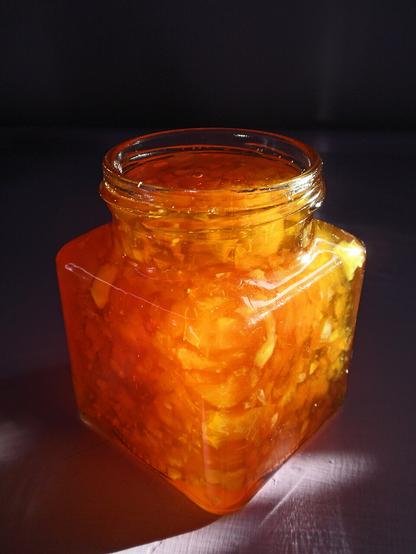
In the run up to Easter Brexiter fury was aimed at the requirement for Marmalade to be renamed if we (re)align UK food labelling regulations with the EU; this would be for the addition of the word 'citrus' in a blow to UK sovereignty.

What, the hysteria ignored was that most brands already do this: 'Orange Marmalade' or 'Seville Orange Marmalade' & that is fine, as the EU allowed (and continues to allow) the word 'citrus' to be replaced by the actual fruit!

#brexit #politics
h/t Observer

@ChrisMayLA6 Meanwhile, the German word for "jam" is "marmalade" (mar-ma-larder), which was banned as a product name in Germany because we had reserved it for the bitter orange stuff. Imagine the Brexiteer harumphing if the EU had stopped us from calling jam "jam"!

@tokensane @ChrisMayLA6
Also Marmalade is corrupted Portuguese (maybe via France) for a preserve made from Quince called marmelada.

Boris Johnson, while a journalist, started the tradition of twisting CM/EU statements and outright lying.

Also the rule was applying already as part of the NI agreement. Brexit was illegally instituted, voted against by Scotland & NI and incompatible with GFA.
It was to enable UK to continue money laundering via IoM, Ch Is. and BOT.

@ChrisMayLA6 @cstross There is a whole Yes Minister episode about how the EU would force the UK to rename their sausages. Absolutely nothing has changed in 45 years.

@tsturm @ChrisMayLA6 @cstross

The "Emulsified High-Fat Offal Tube" IIRC.

3:O)>

Then again, it does describe quite a number of companies products. šŸ™

@tsturm @ChrisMayLA6 @cstross I rewatch Yes Minister from time to time and it's amazing how relevant the situations seem to remain.

@tsturm @ChrisMayLA6 @cstross

It is very likely that the average British sausage is worse. Sausages are not the only food products where the average has been dragged down by industrial production for supermarkets.

@tsturm @ChrisMayLA6 @cstross

The recipe details are a bit of a tangle, but the core of the British sausage is the use of a filler material, with an effect on the texture. The traditional recipes use stale bread crumbs.

There are regional variations, using different herbs and spices. Industrial recipes used to supply the supermarkets replace the breadcrumbs with a finely ground powder that has no texture.

Some of the other details of how sausages are made can shock people, even though vegan sausage rolls are possible. My late brother had a sensitivity to pork, so I watched for alternatives.

Avoid supermarkets.

@ChrisMayLA6 @KimSJ Imagine if the French had deployed citrus at Agincourt! The horror! The horror!

@ChrisMayLA6

I remember "Rose's Lime Marmalade" and now want to go and buy a jar of the stuff (and I can't because it's Easter Sunday and everywhere is shut). 3:O((>

@ChrisMayLA6

I dread to think what Olde English marmalade is made from šŸ˜‰

@ChrisMayLA6 Finally, we'll be able to sell tomato marmalade, chocolate marmalade, and sweet potato marmalade. Yes, sweet potato is listed as a fruit, so are carrots. No, I don't know why.

Now if the EU could also fix the definition of "wine" in the same way it would be great.

@geoffl @ChrisMayLA6 onion marmalade is already a thing/abomination
@Ighostrider @geoffl @ChrisMayLA6 you have not met my local baker's cheese and onion marmalade roll; it is a delight.

@Ighostrider @ChrisMayLA6

You'll be pleased to hear that onion marmalade is in breach of the labelling rules and a clear misuse of the term 'marmalade'. A call to your local trading standards office is in order. ;)

https://www.legislation.gov.uk/uksi/2003/3120

The Jam and Similar Products (England) Regulations 2003

These Regulations, which apply to England, implement Council Directive 2001/113/EC concerning fruit jams, jellies and marmalades and sweetened chestnut purƩe intended for human consumption (OJ No. L10, 12.1.2002, p. 67) and also contain national measures. They revoke and replace the Jam and Similar Products Regulations 1981, as amended, in relation to England.

@ChrisMayLA6 always end up feeling very tired when this sort of nonsense pops up šŸ˜”
@ChrisMayLA6 Also what Putin's 17.4m #brexshitters seem to be missing is that this is down to them - without #brexshit we'd have had a say in the regulations.

@ChrisMayLA6 @TimWardCam

Brtish governments were never shy of complaining bitterly about EU regulations that they themselves had voted in favour of in the Council of Ministers, were they?

@only_ohm @TimWardCam

and one of the most shameful parts of the UK political engagement with the EU.... many used the EU to blame for policies they supported but wanted to tell voters they opposed - political cowardice & hypocrisy are key characteristics of the UK's political class.

@ChrisMayLA6 @only_ohm @TimWardCam Politicians around the world behave like this - endless pursuit of sound bites for tonight's headlines - because they think it is the only way to deal with the "media cycle". So they flip and flop and flap, and stand for nothing.

Yet the evidence is abundantly clear that it doesn't work - and those politicians have short shelf-lives.

Conversely, those that establish a clear set of values and, dare I say it policies, last much longer... /1

@ChrisMayLA6 @only_ohm @TimWardCam This is especially true of eg Australia's community independent movement (including my brilliant MP in Sydney).

For me, the point is that clarity of long-term objectives is the best platform for short-term success.

@ChrisMayLA6 @only_ohm @TimWardCam Perfidious Albion at it again.
@ChrisMayLA6 @only_ohm UK central government did this in both directions. Sometimes an unpopular but necessary decision was punted down to councils to implement so that councils would get the blame for it.
@ChrisMayLA6 or "castle" marmelade made in Floors Castle kitchens and absolutely delicious-my favourite!!! šŸŠšŸŠšŸŠšŸŠ
@ChrisMayLA6 the name marmalade originates from the arrival of a cargo of oranges arriving in Dundee which had frankly passed their best and the ship owner despairing of offloading his oranges showed the buyer how to make orange jam whereupon the buyer inquired what it was called.
He responded ā€œmermeladaā€ which of course is the Spanish word for jam.
And that is why we use the word jam unless it’s made from oranges when we call it marmalade.
Sometimes it is even called Dundee marmalade.
@ChrisMayLA6 by extension Dundee cake is made with orange peel.
The area surrounding Dundee produces huge amounts of raspberries and strawberries and Dundee has always been famous for jam production so adding marmalade was a small incremental step.

@peterbrown

I was about to say; they can make Dundee into marmalade & then I thought better of it (oh.hold on, no I didn't)

@ChrisMayLA6 maybe I’m missing the joke but it doesn’t sound very appetising. And I don’t think the inventors of Grand Theft Auto would be particularly impressed at being made into marmalade.
However, at least it wouldn’t be full of stringy indigestible strands of jute like it would have been in the early 20th century.

@peterbrown @ChrisMayLA6

A myth, it seems.

'According to a Scottish legend, the creation of orange marmalade in the Scottish city of Dundee occurred by accident. The legend tells of a ship carrying a cargo of oranges that broke down in the port, resulting in some ingenious locals making marmalade out of the cargo. .... However, this legend was "decisively disproved by food historians", according to a New York Times report.'

https://en.wikipedia.org/wiki/Marmalade

Marmalade - Wikipedia

@bodhipaksa @ChrisMayLA6 well done them. But even they can’t take away the predominance of Dundee marmalade and Dundee cake both of which are based on oranges. Many marmalades are still called Dundee marmalade And they can’t change the fact that the name marmalade comes from Spain.
I really can’t understand why people make it their business to try to cast shade on historical origins just because they don’t like them.
Saying kilts and bagpipes are not Scottish is correct but not marmalade

@bodhipaksa @ChrisMayLA6 ā€œThe Scots are credited with developing marmalade as a spread, with Scottish recipes in the 18th century using more water to produce a less solid preserve than before.[5]

The Scots were the people who made marmalade a breakfast item. James Boswell and Samuel Johnson were given it at breakfast while in Scotland in 1773. In the 19th century, the English followed suit and began to eat marmalade in the morning.ā€
This is also from Wikipedia.

@bodhipaksa @ChrisMayLA6 notable that the Wikipedia entry attempts to debunk the Dundee connection without offering an alternative and without offering evidence or to link to evidence. It’s a simple debunking with no evidence whatsoever and somebody should report it to Wikipedia as references should always be included.
@peterbrown @ChrisMayLA6 They reference an NYT article, which in turn cites C. Anne Wilson's ''Book of Marmalade''. I can only see part of the book on archive.org, but Wilson points out that marmalade recipes had been common prior to the Keillers and marmalade was already widely available for purchase. What Dundee did was to start mass-production, which associated an existing product with the city. The Keillers also invented a machine for shredding peel.
@bodhipaksa @ChrisMayLA6 if Samuel Boswell and Dr Johnstone, discerning connoisseurs, had not come across it before I don’t think you could regard it as ā€œcommonā€. And most early references to marmalade involve quince, not oranges. I actually think we would complain quite vehemently if we were given quince in our marmalade.
I can’t find anybody offering quince marmalade for sale, although it is available in recipes. Quince jelly, quince jam or quince preserve but not quince marmalade.

@peterbrown @ChrisMayLA6 You're kind of proving my point. Boswell's encounter with marmalade took place almost 25 years before the Keiller company was even established.

He does not say it was the first time either of them had had marmalade, and in fact he doesn't remark on it at all, suggesting it was commonplace. He does comment on other aspects of the breakfast, which were presumably new to him.

So the Keillers definitely did not invent marmalade, although they certainly popularized it.

@bodhipaksa @ChrisMayLA6 at no time did I even mention the name Keiller and I certainly didn’t suggest they invented marmalade.
But from all the references it does appear clear that Dundee brought marmalade to the world. And I can see no reason whatsoever to discredit the original story of the ship with the oranges. There is no alternative narrative.

ļæ¼It has always been the fashion to attack oral tradition and it is astonishing how often it is later found to be absolutely true.

@peterbrown @ChrisMayLA6 As far as I'm aware, the story of Dundee's connection with marmalade is that the Keillers bought a shipload of oranges and invented marmalade. (The ship probably happened. The invention didn't.)

I'd love to see a source for this alternative story that is about someone other than the Keillers, and would be very interested if you could share sources about the manufacture of marmalade in Dundee before their industrialization of the process.

@bodhipaksa @ChrisMayLA6 nope, no sources.
But more than once over the last 60 odd years I have been told the same story.
Oral tradition.
It’s a thing.
And it’s amazing how often it’s right. And since no other port is making claims and #dundee already had an important jam making tradition it sounds to me to be utterly believable and logical and I can’t understand why people would discredit it.

Just because of an American journalist and an English food writer?

@peterbrown @ChrisMayLA6

It sounds very unlikely that on two separate occasions a ship laden with Seville oranges would end up in Dundee, and on both those occasions someone would "invent marmalade," so I'm afraid your oral version simply sounds like a garbling of the Keillers' story.

@bodhipaksa @ChrisMayLA6 I think it is far more likely that the first event would be accidental. A delivery of oranges arrives in an unsellable condition and the buyer is persuaded to take it to make marmalade. As you correctly observe Keillers then started mass production and they needed a backstory.
I find it very difficult to believe they would order a shipload of oranges unless they knew very well beforehand what they were going to do with it. So they couldn’t have been the first.

@peterbrown @ChrisMayLA6 The story is indeed that a ship ended up in Dundee accidentally, probably having originally aimed for Leith, and one of the Keiller women bought the cargo (probably in good condition — I doubt she would have been interested otherwise). The myth is that she invented marmalade, but it already existed and cookery books at that time included recipes for it.

It's quite possible, though, that in reality the shipment was ordered, the Keillers having planned to make marmalade.

@bodhipaksa @ChrisMayLA6 no doubt the full story will crawl out in the fullness of time. Meantime perhaps a selection of hashtags might hook an expert somewhere #marmalade #orange #dundee #keiller #DrJohnson #boswell
@peterbrown @ChrisMayLA6 Perhaps. BTW, I just wanted to point out that the woman you descibed as an "English food writer" was a scholar who specialized in the history of recipe books. Her bibliography as an author and editor is quite impressive.

@bodhipaksa @ChrisMayLA6 so I now have an update from local historical sources.

ā€œThe most reliable version I know is that a shipment of Seville oranges arrived at the docks and the person that had ordered them no longer wanted them. Mr Keiller who was a grocer at the time took them to sell in his shop, but unfortunately he was unable to sell them all. As they were going to spoil his wife suggested that she made them in to marmalade to preserve them, she already had a recipe to do so.ā€

@ChrisMayLA6 UK shoots self in foot then withers about jam. They're toast.
@Oldfartrant @ChrisMayLA6 Eh, these right-wing writers have to earn a crust somehow.

@ChrisMayLA6
I have a small strategic store of Marmalades, which is to say all Orange, and mostly coarse cut - proper marmalade.

I doubt that anyone will complain at Cooper's Oxford Marmalade acquiring the word Orange, although we all know perfectly well what it is made of.

The others, from a look at the front of the shelf, already seem to have +/-Seville Orange on their label.

And Coopers mention what it is made of on the less obvious part o the label.

@Photo55 @ChrisMayLA6 And to be honest, a marmalade made of Oxford sounds foul.