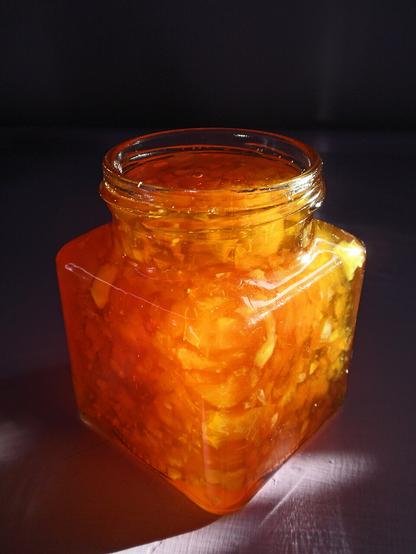
In the run up to Easter Brexiter fury was aimed at the requirement for Marmalade to be renamed if we (re)align UK food labelling regulations with the EU; this would be for the addition of the word 'citrus' in a blow to UK sovereignty.

What, the hysteria ignored was that most brands already do this: 'Orange Marmalade' or 'Seville Orange Marmalade' & that is fine, as the EU allowed (and continues to allow) the word 'citrus' to be replaced by the actual fruit!

#brexit #politics
h/t Observer

@ChrisMayLA6 the name marmalade originates from the arrival of a cargo of oranges arriving in Dundee which had frankly passed their best and the ship owner despairing of offloading his oranges showed the buyer how to make orange jam whereupon the buyer inquired what it was called.
He responded “mermelada” which of course is the Spanish word for jam.
And that is why we use the word jam unless it’s made from oranges when we call it marmalade.
Sometimes it is even called Dundee marmalade.

@peterbrown @ChrisMayLA6

A myth, it seems.

'According to a Scottish legend, the creation of orange marmalade in the Scottish city of Dundee occurred by accident. The legend tells of a ship carrying a cargo of oranges that broke down in the port, resulting in some ingenious locals making marmalade out of the cargo. .... However, this legend was "decisively disproved by food historians", according to a New York Times report.'

https://en.wikipedia.org/wiki/Marmalade

Marmalade - Wikipedia

@bodhipaksa @ChrisMayLA6 well done them. But even they can’t take away the predominance of Dundee marmalade and Dundee cake both of which are based on oranges. Many marmalades are still called Dundee marmalade And they can’t change the fact that the name marmalade comes from Spain.
I really can’t understand why people make it their business to try to cast shade on historical origins just because they don’t like them.
Saying kilts and bagpipes are not Scottish is correct but not marmalade

@bodhipaksa @ChrisMayLA6 “The Scots are credited with developing marmalade as a spread, with Scottish recipes in the 18th century using more water to produce a less solid preserve than before.[5]

The Scots were the people who made marmalade a breakfast item. James Boswell and Samuel Johnson were given it at breakfast while in Scotland in 1773. In the 19th century, the English followed suit and began to eat marmalade in the morning.”
This is also from Wikipedia.

@bodhipaksa @ChrisMayLA6 notable that the Wikipedia entry attempts to debunk the Dundee connection without offering an alternative and without offering evidence or to link to evidence. It’s a simple debunking with no evidence whatsoever and somebody should report it to Wikipedia as references should always be included.
@peterbrown @ChrisMayLA6 They reference an NYT article, which in turn cites C. Anne Wilson's ''Book of Marmalade''. I can only see part of the book on archive.org, but Wilson points out that marmalade recipes had been common prior to the Keillers and marmalade was already widely available for purchase. What Dundee did was to start mass-production, which associated an existing product with the city. The Keillers also invented a machine for shredding peel.
@bodhipaksa @ChrisMayLA6 if Samuel Boswell and Dr Johnstone, discerning connoisseurs, had not come across it before I don’t think you could regard it as “common”. And most early references to marmalade involve quince, not oranges. I actually think we would complain quite vehemently if we were given quince in our marmalade.
I can’t find anybody offering quince marmalade for sale, although it is available in recipes. Quince jelly, quince jam or quince preserve but not quince marmalade.

@peterbrown @ChrisMayLA6 You're kind of proving my point. Boswell's encounter with marmalade took place almost 25 years before the Keiller company was even established.

He does not say it was the first time either of them had had marmalade, and in fact he doesn't remark on it at all, suggesting it was commonplace. He does comment on other aspects of the breakfast, which were presumably new to him.

So the Keillers definitely did not invent marmalade, although they certainly popularized it.

@bodhipaksa @ChrisMayLA6 at no time did I even mention the name Keiller and I certainly didn’t suggest they invented marmalade.
But from all the references it does appear clear that Dundee brought marmalade to the world. And I can see no reason whatsoever to discredit the original story of the ship with the oranges. There is no alternative narrative.

It has always been the fashion to attack oral tradition and it is astonishing how often it is later found to be absolutely true.

@peterbrown @ChrisMayLA6 As far as I'm aware, the story of Dundee's connection with marmalade is that the Keillers bought a shipload of oranges and invented marmalade. (The ship probably happened. The invention didn't.)

I'd love to see a source for this alternative story that is about someone other than the Keillers, and would be very interested if you could share sources about the manufacture of marmalade in Dundee before their industrialization of the process.

@bodhipaksa @ChrisMayLA6 nope, no sources.
But more than once over the last 60 odd years I have been told the same story.
Oral tradition.
It’s a thing.
And it’s amazing how often it’s right. And since no other port is making claims and #dundee already had an important jam making tradition it sounds to me to be utterly believable and logical and I can’t understand why people would discredit it.

Just because of an American journalist and an English food writer?

@peterbrown @ChrisMayLA6

It sounds very unlikely that on two separate occasions a ship laden with Seville oranges would end up in Dundee, and on both those occasions someone would "invent marmalade," so I'm afraid your oral version simply sounds like a garbling of the Keillers' story.

@bodhipaksa @ChrisMayLA6 I think it is far more likely that the first event would be accidental. A delivery of oranges arrives in an unsellable condition and the buyer is persuaded to take it to make marmalade. As you correctly observe Keillers then started mass production and they needed a backstory.
I find it very difficult to believe they would order a shipload of oranges unless they knew very well beforehand what they were going to do with it. So they couldn’t have been the first.

@peterbrown @ChrisMayLA6 The story is indeed that a ship ended up in Dundee accidentally, probably having originally aimed for Leith, and one of the Keiller women bought the cargo (probably in good condition — I doubt she would have been interested otherwise). The myth is that she invented marmalade, but it already existed and cookery books at that time included recipes for it.

It's quite possible, though, that in reality the shipment was ordered, the Keillers having planned to make marmalade.

@bodhipaksa @ChrisMayLA6 no doubt the full story will crawl out in the fullness of time. Meantime perhaps a selection of hashtags might hook an expert somewhere #marmalade #orange #dundee #keiller #DrJohnson #boswell
@peterbrown @ChrisMayLA6 Perhaps. BTW, I just wanted to point out that the woman you descibed as an "English food writer" was a scholar who specialized in the history of recipe books. Her bibliography as an author and editor is quite impressive.

@bodhipaksa @ChrisMayLA6 so I now have an update from local historical sources.

“The most reliable version I know is that a shipment of Seville oranges arrived at the docks and the person that had ordered them no longer wanted them. Mr Keiller who was a grocer at the time took them to sell in his shop, but unfortunately he was unable to sell them all. As they were going to spoil his wife suggested that she made them in to marmalade to preserve them, she already had a recipe to do so.”