Flipboard Tech Desk
Wikipedia has banned its editors from using AI to create articles, @404mediaco reports. @emanuelmaiberg talked to the Wikipedia editor who proposed the guideline about why.
 💡𝚂𝗆𝖺𝗋𝗍𝗆𝖺𝗇 𝙰𝗉𝗉𝗌📱
@TechDesk @404mediaco @emanuelmaiberg
The problem is Wiki already contains a lot of wrong info. I saw an article yesterday which I'm pretty sure was mostly AI slop regurgitaed from a very wrong Wiki page. The problem with it is your next-door-neighbour Joe Blow, who has forgotten the rules of Maths, is totally allowed to admin a page about Maths. Welcome to why I post it here instead. Wikipedia is "like an encyclopedia" in the same way that Madonna is like a virgin
The problem is Wiki already contains a lot of wrong info. I saw an article yesterday which I'm pretty sure was mostly AI slop regurgitaed from a very wrong Wiki page. The problem with it is your next-door-neighbour Joe Blow, who has forgotten the rules of Maths, is totally allowed to admin a page about Maths. Welcome to why I post it here instead. Wikipedia is "like an encyclopedia" in the same way that Madonna is like a virgin
 Furbland's Very Cool Mastodon™
@SmartmanApps @TechDesk @404mediaco @emanuelmaiberg for every troll who edits an article, there’s 5 dedicated editors standing by to correct it. the beauty of wikis is that they’re constantly being fact-checked by tons of experts. @wikipedia even has a dedicated counter-vandalism team!
@SmartmanApps @TechDesk @404mediaco @emanuelmaiberg @wikipedia the problem with traditional encyclopedias is they tend to be biased and can be hard to update. Wikipedia and its many policies bypass all that
@GroupNebula563 @TechDesk @404mediaco @emanuelmaiberg @wikipedia
"for every troll who edits an article" - Professor Rick Norwood isn't a troll https://www.researchgate.net/profile/Rick-Norwood and yet his Maths corrections keep getting backed out by admins. Welcome to why I post my Maths facts on Mastodon, where no-one can back them out https://dotnet.social/@SmartmanApps/110968910722113903
@GroupNebula563 @TechDesk @404mediaco @emanuelmaiberg @wikipedia
"they’re constantly being fact-checked by tons of experts" - and getting backed out again by admins. See previous comment. None of the Maths pages ever cite any Maths textbooks, despite the fact there are many available for free on the Internet Archive
"many policies bypass all that" - including bypassing fact-checking 🙄 so either the policies don't work, or aren't followed. Either way Wikipedia has a facts problem
@SmartmanApps @TechDesk @404mediaco @emanuelmaiberg @wikipedia the policies do work, and are followed. they work quite well, in fact. the articles don't cite textbooks, but they *do* cite papers from credible mathematicians/universities, which IMO tend to be far more authoritative. if this rick norwood is a highly credible mathematician, he himself would likely have a wikipedia article, and unless he died in 1675, he does not. https://en.wikipedia.org/wiki/Richard_Norwood

@SmartmanApps @TechDesk @404mediaco @emanuelmaiberg @wikipedia the only "rick norwood" i can find on wikipedia, unless he goes under another username there, is an avid contributor to the project and seems to quite enjoy it: https://en.wikipedia.org/wiki/User:Rick_Norwood
@SmartmanApps @TechDesk @404mediaco @emanuelmaiberg @wikipedia ...or he was, until he was diagnosed with alzheimer's and begun making disruptive edits to pages, which are probably the ones getting reverted that you're talking about. not to mention, there's zero indication i can find that the wikipedia editor rick and the researchgate rick are the same person
@SmartmanApps @TechDesk @404mediaco @emanuelmaiberg @wikipedia if you have any further concerns about wikipedia or any other wikimedia projects, i highly suggest taking that up with @LucasWerkmeister, the only person i can think of off the top of my head who is more qualified than i to answer this sort of thing
@GroupNebula563 @TechDesk @404mediaco @emanuelmaiberg @wikipedia @LucasWerkmeister
"the policies do work, and are followed" - clearly not, given pages like https://en.wikipedia.org/wiki/0.999... exist
"IMO tend to be far more authoritative" - I see you haven't read any of their blog posts then, where they can't even get order of operations right (spoiler alert: they don't teach it at university, it's taught in high school, which they've long since left - high school textbooks are the references to use)
@SmartmanApps @TechDesk @404mediaco @emanuelmaiberg @wikipedia @LucasWerkmeister ...you can see right here where it cites two textbooks explaining exactly why the article is correct
https://books.google.com/books?id=jWgPAQAAMAAJ
https://archive.org/details/mathematicalanal02edtomm/page/n3/mode/2up
Elements of Algebra
Algebra is abstract mathematics - let us make no bones about it - yet it is also applied mathematics in its best and purest form. It is not abstraction for its own sake, but abstraction for the sake of efficiency, power and insight. Algebra emerged from the struggle to solve concrete, physical problems in geometry, and succeeded after 2000 years of failure by other forms of mathematics. It did this by exposing the mathematical structure of geometry, and by providing the tools to analyse it. This is typical of the way algebra is applied; it is the best and purest form of application because it reveals the simplest and most universal mathematical structures. The present book aims to foster a proper appreciation of algebra by showing abstraction at work on concrete problems, the classical problems of construction by straightedge and compass. These problems originated in the time of Euclid, when geometry and number theory were paramount, and were not solved until th the 19 century, with the advent of abstract algebra. As we now know, alge bra brings about a unification of geometry, number theory and indeed most branches of mathematics. This is not really surprising when one has a historical understanding of the subject, which I also hope to impart.
@GroupNebula563 @TechDesk @404mediaco @emanuelmaiberg @wikipedia @LucasWerkmeister
""you can see right here where it cites two textbooks" - nope. I can see quite clearly they are NOT Maths textbooks, as I said
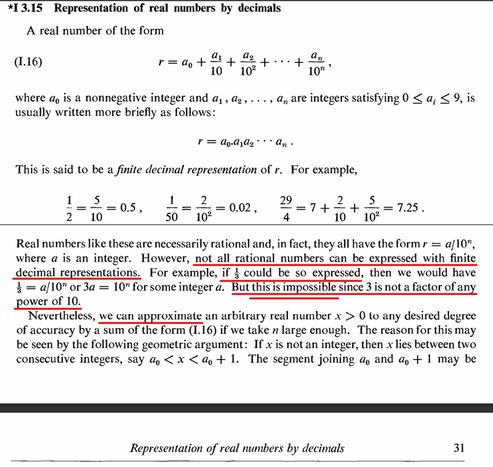
"explaining exactly why the article is correct" - now go read about limits and/or decimal representations in Maths textbooks and you'll discover why it's wrong. Here's a free head-start explaining why 1/3 isn't actually equal to 0.333... and is only an approximation (now multiply by 3)
 Steffi the Redhead
@SmartmanApps @GroupNebula563 @TechDesk @404mediaco @emanuelmaiberg @wikipedia @LucasWerkmeister you have to make the line for "period" over the 3 of 0,3.
@fuchsi @GroupNebula563 @TechDesk @404mediaco @emanuelmaiberg @wikipedia @LucasWerkmeister
"you have to make the line for "period" over the 3 of 0,3" - yes, and is an approximation of 1/3, since it's literally impossible to have an exact decimal representation of 1/3 in base 10, since 3 isn't a factor of 10, as per the textbook
@SmartmanApps @GroupNebula563 @TechDesk @404mediaco @emanuelmaiberg @wikipedia @LucasWerkmeister but it's 3 until infinity. That limes should do that, no?
@fuchsi @GroupNebula563 @TechDesk @404mediaco @emanuelmaiberg @wikipedia @LucasWerkmeister
"but it's 3 until infinity. That limes should do that, no?" - I'm not sure what you mean. Even at 3 to infinity, it's still only an approximation of 1/3, so 0.9 to infinity is only an approximation of 1. ALL non-terminating decimals are only approximations, again as per the textbook. Only terminating decimals are exactly equal to a fraction, such as 0.25 is exactly equal to 1/4, as per the textbook
@fuchsi @GroupNebula563 @TechDesk @404mediaco @emanuelmaiberg @wikipedia @LucasWerkmeister
In other words, no matter how many steps you do your long division to, you're still left with remainder 1 - that remainder 1 literally never disappears, even at preceded by infinite zeroes. It's because 3 isn't a factor of 10, and we're doing it in base ten. In base 3 you can exactly represent 1/3 - it's 0.1 - in base ten you can't. The same thing happens in the other direction converting back.
@SmartmanApps @GroupNebula563 @TechDesk @404mediaco @emanuelmaiberg @wikipedia @LucasWerkmeister That's not how ifinity works. You don't have the remaining 1. That also gets divided by 3.
@fuchsi @GroupNebula563 @TechDesk @404mediaco @emanuelmaiberg @wikipedia @LucasWerkmeister
"You don't have the remaining 1. That also gets divided by 3" - which then also gives a remainder of 1, divide by 3 again, another remainder of 1, ad infinitum. That's EXACTLY how infinity works - a never-disappearing remainder of 1, infinitely repeating 3's. Again, every non-terminating decimal is only an approximation, only terminating decimals are exactly equal to fractions, as per Maths textbooks
@SmartmanApps @GroupNebula563 @TechDesk @404mediaco @emanuelmaiberg @wikipedia @LucasWerkmeister I am not sure that's how it works.
@fuchsi @GroupNebula563 @TechDesk @404mediaco @emanuelmaiberg @wikipedia @LucasWerkmeister
"I am not sure that's how it works" - That's exactly how it works. Sit down with pen and paper and start doing long (or short) division. 3 doesn't go into 1, add a zero. 3 goes into 10 3 times with 1 remainder, repeat ad infinitum. Again, every non-terminating decimal is only an approximation due to a never-disappearing remainder, due to not being a factor of 10
@SmartmanApps @GroupNebula563 @TechDesk @404mediaco @emanuelmaiberg @wikipedia @LucasWerkmeister yeah, but you do that with limit analysis
@fuchsi @GroupNebula563 @TechDesk @404mediaco @emanuelmaiberg @wikipedia @LucasWerkmeister
And the limit is defined as the number it can never reach, hence the name, limit.
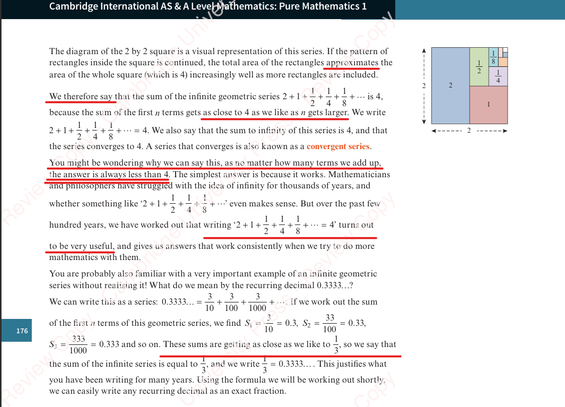
@SmartmanApps @GroupNebula563 @TechDesk @404mediaco @emanuelmaiberg @wikipedia @LucasWerkmeister In your text: read the line with the long term. On the right side you see "=4".
That means if you take the infinite term you can make an integer out of it.
That means if you take the infinite term you can make an integer out of it.
@fuchsi @GroupNebula563 @TechDesk @404mediaco @emanuelmaiberg @wikipedia @LucasWerkmeister
Now read all the underlined parts, especially the double-underlined part. You can lead a horse to water...
"That means if you take the infinite term you can make an integer out of it" - no, had you read it, you would understand that means if you take THE LIMIT you can get an integer out of it. The "infinite term" is still less than it, still less than 4, as per the textbook...
@SmartmanApps @GroupNebula563 @TechDesk @404mediaco @emanuelmaiberg @wikipedia @LucasWerkmeister as far as I understand it it's 4.
@fuchsi @GroupNebula563 @TechDesk @404mediaco @emanuelmaiberg @wikipedia @LucasWerkmeister
"as far as I understand it it's 4" - the limit is 4, yes, the infinite sum isn't - see double-underlined part (I'm starting to think you didn't read any of it and are just a time-waster)
"as far as I understand it it's 4" - the limit is 4, yes, the infinite sum isn't - see double-underlined part (I'm starting to think you didn't read any of it and are just a time-waster)
@SmartmanApps @GroupNebula563 @TechDesk @404mediaco @emanuelmaiberg @wikipedia @LucasWerkmeister And I think you ignored the not underlined parts behind.
@fuchsi @GroupNebula563 @TechDesk @404mediaco @emanuelmaiberg @wikipedia @LucasWerkmeister
"And I think you ignored the not underlined parts behind" - so rather than leave us in any doubt, you decided to confirm you're a time-waster who couldn't take issue with anything the textbooks said and made up an ad hominem instead. Got it. Bye then.
"And I think you ignored the not underlined parts behind" - so rather than leave us in any doubt, you decided to confirm you're a time-waster who couldn't take issue with anything the textbooks said and made up an ad hominem instead. Got it. Bye then.
@SmartmanApps @GroupNebula563 @TechDesk @404mediaco @emanuelmaiberg @wikipedia @LucasWerkmeister Sorry, but I don't have math textbooks in my house. My study time was 20 years ago.
@fuchsi @GroupNebula563 @TechDesk @404mediaco @emanuelmaiberg @wikipedia @LucasWerkmeister
There's plenty of textbooks available for free on the Internet Archive, none of which have been referenced in the Wikipedia page, which is contradicted by what textbooks say https://dotnet.social/@SmartmanApps/115365316775919939 The 2 textbooks I referenced in this thread, which say that infinite decimals are only approximations, and the infinite sum never reaches the limit, are also available for free online, also unreferenced by Wiki
There's plenty of textbooks available for free on the Internet Archive, none of which have been referenced in the Wikipedia page, which is contradicted by what textbooks say https://dotnet.social/@SmartmanApps/115365316775919939 The 2 textbooks I referenced in this thread, which say that infinite decimals are only approximations, and the infinite sum never reaches the limit, are also available for free online, also unreferenced by Wiki
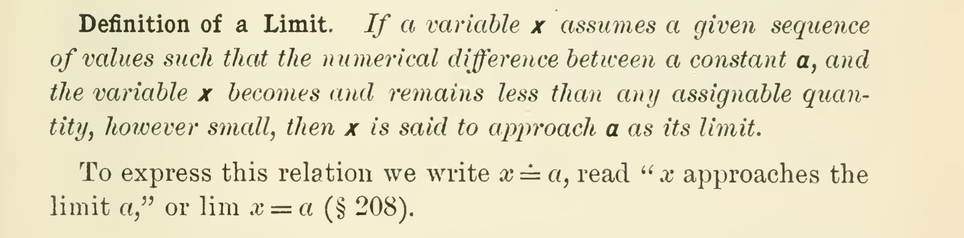
💡𝚂𝗆𝖺𝗋𝗍𝗆𝖺𝗇 𝙰𝗉𝗉𝗌📱 (@[email protected])
Attached: 1 image 4/5 We can see in this textbook, it uses a dot above an equals sign to show "x approaches the limit a", and says we can also write it as "lim x=a". I have also seen textbooks say x:=a, where := means "is defined as". Note that in all 3 cases, the textbook has quite conspicuously never said x=a, only variations on the limit of x is defined as a, which we do so that we have a finite number that we can perform further calculations with...
@SmartmanApps @GroupNebula563 @TechDesk @404mediaco @emanuelmaiberg @wikipedia @LucasWerkmeister Wait, what? Are you saying I should only read books that are not referenced by Wikipedia?
Isn't that a bit extreme from "I would change one sentence about infinity"?
 Fish Face
@fuchsi
He's saying the only textbooks that are correct are the ones that agree with him, of course ;)
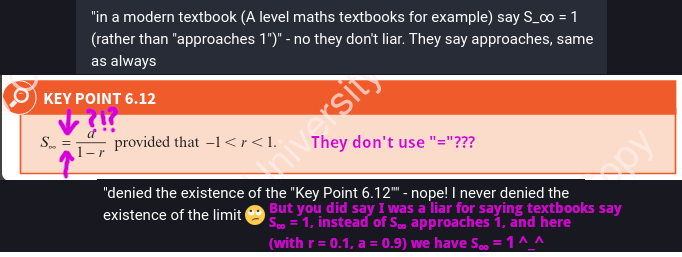
God knows how old the one (or maybe it's more than one) he's using there is; the dotted equal symbol isn't used any more. The symbol S_∞ introduced there has no different meaning than S_n (that is, both are said to "approach" the limit) whereas in a modern textbook (A level maths textbooks for example) say S_∞ = 1 (rather than "approaches 1").
Again he confuses the terms of a sequence with its limit. This is genuinely interesting though, because this textbook uses the ellipsis to mean an unwritten finite number of terms rather than infinitely many, so could really explain why he has this misconception.
@FishFace So I assume math books wording did change?
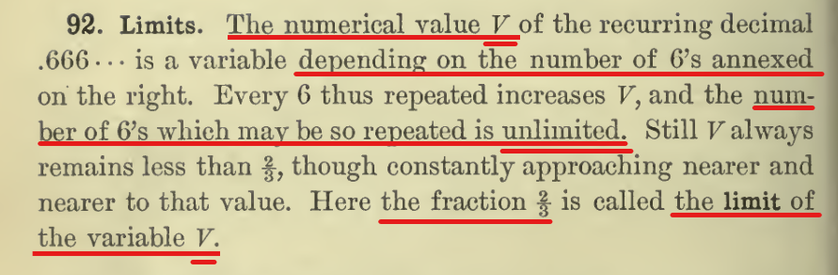
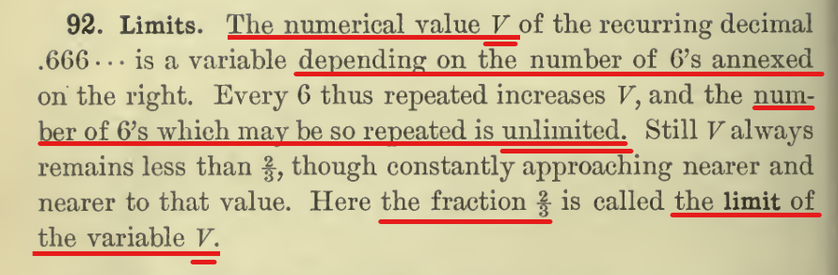
@fuchsi Regarding recurring decimals, yes the language used in that book is very much not standard. Actually we should be clear that, in the language of that book (Second Algebra by Hawkes, Luby and Touton, published 1911), SmartmanApps is correct; in that book 0.999... is not 1, because 0.999... does not represent a real number at all. From his screenshot of p176: "The numerical value of 0.666... is a **variable** depending on the number of 6s annexed to the right". (My emphasis)
So this is where he's coming from: for him, 0.999... has *no* fixed value but is more like a variable symbol that is restricted to taking values in the sequence of finite decimals 0.9, 0.99, 0.999, etc. In normal mathematical language we would say it refers to the sequence (or perhaps set) of such values, because the idea that a variable can take on multiple different values within the same piece of mathematical discourse is unnecessary and confusing. (Because if x can take on multiple values, you are forced to accept the statements "x = 0.9" and "x = 0.99" in the same argument, because they might represent different values of x at different times. Can we therefore conclude that x - x = 0.09? No! You must at all times pay attention to whether your statements about a variable were only true contingently. Normal mathematical argument would enclose such sub-scenarios in conditional language, making this explicit.)
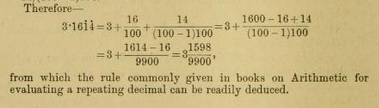
I'm not convinced that the wording here "changed" in the sense it being normal in 1911 and rare now. Euler spoke of recurring decimals as definite, not variable quantities in the 1700s, and the textbook Introduction to Algebra by G. Chrystal first printed in 1898 clearly does so too (first screenshot)
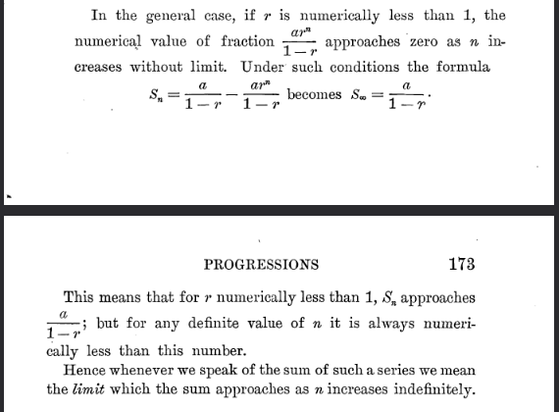
Regarding S_∞ actually I think the language hasn't changed, but that book he's quoting is a little sloppily written here. The second screenshot is the modern development, including the "S_∞ = a/(1-r)", from the A-level textbook he's using.
The third screenshot is from the bottom of page 172 of Second Algebra which he clipped, and the top of 173. Notice in fact that the authors abandon the language of "S_∞ approaches..." in favour of giving it a definite value. Their treatment on p173 is in fact quite clear and in contradiction with the Smart Man's conclusion: "when we speak of the sum of the series, we **mean the limit**". From what he says, I don't think he is quite capable of understanding what a mathematician is saying when they say, "by these words we mean this thing", else he wouldn't have underlined all those words which contradict him :P
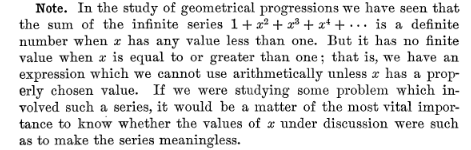
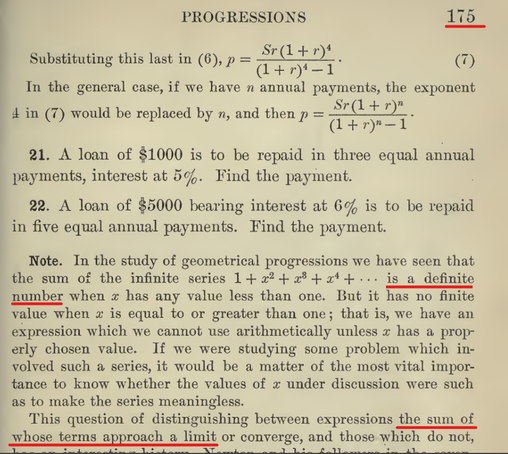
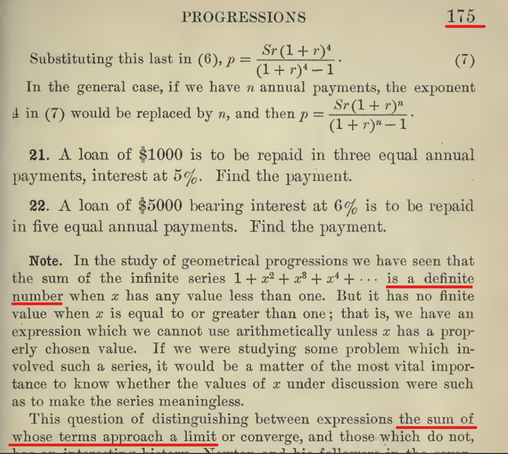
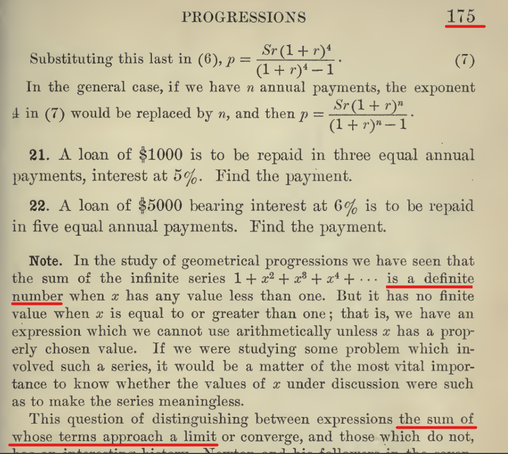
Further to this, on p175 there is the fourth screenshot, which says that (when x < 1), "the sum of the series 1 + x + x² + x³ + ... is a definite number". "Definite numbers" are just themselves; they don't change and cannot "approach" anything.
I am ashamed that I skipped over his screenshot of p176, because that finally actually clarifies what he thinks recurring decimal notation means in a way that his posts dating back to 2024 failed to. Presumably he also thinks infinite summation is similarly a "variable" waiting for you to decide how many terms to add up.
Sadly he doesn't have the ability to explain this: he doesn't write, "0.999... ≠ 1 because the notation on the left does not denote a specific number, but is a placeholder for one of 0.9, 0.99, 0.999, ... and 1 is not any one of those". Instead he ridicules and dodges questions. And sadly, while he'll probably never respond to this way of putting things, even if he did he would not be able to understand or admit that his preferred language, from one textbook written over 100 years ago, is not standard and that in the language used by everyone else, 0.999... denotes a single, definite number, and that number is 1.
I think this way of writing maths invites such imprecise thinking though - do you agree? If we see a symbol used *as a number* the way recurring decimals universally are, then I think it will always lead to people treating them as a particular number.
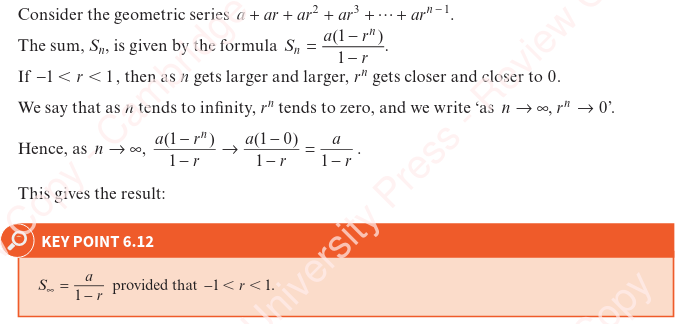
@fuchsi haha, it's very unfortunate that he denied the existence of the "Key Point 6.12" mere minutes before I linked it.
@FishFace I think you both should kiss and make up.
I think you are both more passionate about mathematical problems than I ever was. (Even though I competed in math olympiads as a child.)
@fuchsi @[email protected]
"passionate about mathematical" - I'm passionate about #debunking #Gaslighters and their #bullying. He's just passionate about Gaslighting/bullying people. Note in the following how often he edited out the references which contradict him...
"The numerical value of 0.666... is a **variable** depending on the number of 6s annexed to the right". (My emphasis)" - also your EDIT, where you deliberately omitted V is the Variable being described, hence your lack of a screenshot
@fuchsi @[email protected]
"Notice in fact that the authors abandon the language of "S_∞ approaches..." in favour of giving it a definite value" - notice that your screenshot in fact deliberately omits the very next paragraph, which says that the sum of the terms is approaching the limit 🙄
"when we speak of the sum of the series, we **mean the limit**"" - says person who can't provide a screenshot of them saying that anywhere, given they make the quite clear distinction between them repeatedly
@fuchsi @[email protected]
""Definite numbers" are just themselves; they don't change and cannot "approach" anything" - and, yet again, your screenshot leaves out the very next paragraph, which clearly states "the sum of whose terms approach a limit". Gaslighters gonna gaslight
""Definite numbers" are just themselves; they don't change and cannot "approach" anything" - and, yet again, your screenshot leaves out the very next paragraph, which clearly states "the sum of whose terms approach a limit". Gaslighters gonna gaslight
@fuchsi @[email protected]
""the sum of the series 1 + x + x² + x³ + ... is a definite number". "Definite numbers" are just themselves; they don't change and cannot "approach" anything" - says person who, yet again, left the very next paragraph out of their screenshot, which quite clearly states "the sum of whose terms approach a limit", the limit being the "definite number" being discussed 🙄
"Instead he ridicules and dodges questions" - #EveryAccusationIsAConfession 🙄
@fuchsi @[email protected]
"he'll probably never respond" - why would you think I'd stop debunking your Gaslighting?? 😂
"people treating them as a particular number" - they treat the limit as being the result of the infinite sum because that's what textbooks have been teaching them for more than 100 years, 🙄 whilst making the clear distinction between the two (which you keep editing out of your replies)
"denied the existence of the "Key Point 6.12"" - nope! I never denied the existence of the limit 🙄
@fuchsi @[email protected]
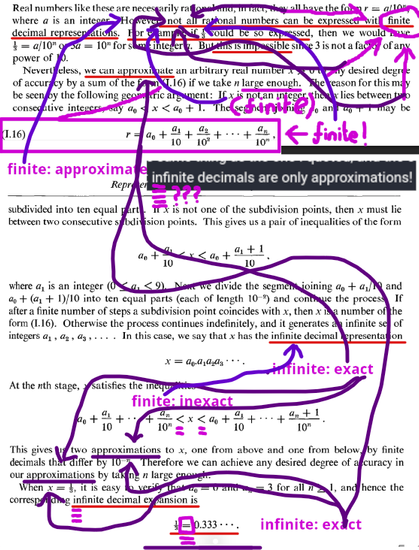
From your other reply "despite my helpful purple annotations ^_^" - I'm pointing out all the times "approximate" and "approximation" are used that you're trying to draw people away from noticing Gaslighter 🙄
P.S. you also need to learn the difference between equals and identically equal
"he hasn't read it" - and you haven't quoted it, so??
"Elsewhere I suggested he doesn't have a maths degree" - because you can't back anything you say up and thus make up lying ad hominems
@fuchsi @[email protected]
P.S. "It would explain his dedication to these old textbooks" - you mean the ones which are out of copyright and are thus available for anyone at all to download for free from the Internet Archive and see for themselves what ALL of the pages say, not just your selective cherry-picking quotes, THOSE "old textbooks"? 😂
P.S. "It would explain his dedication to these old textbooks" - you mean the ones which are out of copyright and are thus available for anyone at all to download for free from the Internet Archive and see for themselves what ALL of the pages say, not just your selective cherry-picking quotes, THOSE "old textbooks"? 😂
@fuchsi @[email protected]
"I don't see how a graduate of a mathematics degree comes away thinking that there is a difference here" - says person who deliberately omitted it in their "quote" 🙄
"since he ignored this question the last time I asked it" - nope, you ignored that I answered it, same as every time, because you have this running false narrative that I can't answer your questions, despite the fact I always do 🙄
@fuchsi @[email protected]
"means that the equality symbol does not have its usual meaning" - I already said that it's usual meaning is DIFFERENT from the meaning of IDENTICALLY EQUAL, and here you are yet again ignoring that I pointed that out to you Gaslighter
"And so does Wikipedia" and so does the textbook, explicitly stating the number of appended 6's is "unlimited"
"No-one believes this extends to the recurring decimal, except you" - and Maths textbooks, and other Maths teachers 🙄
@fuchsi @[email protected]
"It was nice of him to link another textbook" - says Gaslighter outright making stuff up, given I did nothing of the sort 🙄
"in that textbook (p38, screenshot)" - he says, without a screenshot of this mysterious page and book
"(p42, same screenshot)" - there are no screenshots of mine which include 5 whole pages. Pull the other one dude - it's got bells on it
"Now's a good time to make a table of sources in support of writing 0.999... = 1" - in which you lied, as usual
@fuchsi @[email protected]
And in response to this rubbish comment in the screenshot... here's another part of the EXACT SAME TEXTBOOK, saying that the limit APPROXIMATES the infinite sum 🙄
"not a response to what I wrote" - that was in the other 6 posts, you know, the ones you ignored
"That looks pretty consistent to me" - consistent lies
"it's confusing that 0,9999... = 1" - it isn't, as per multiple textbooks, not to mention you can prove it yourself by doing long division of 1/3 and other methods
@fuchsi @[email protected]
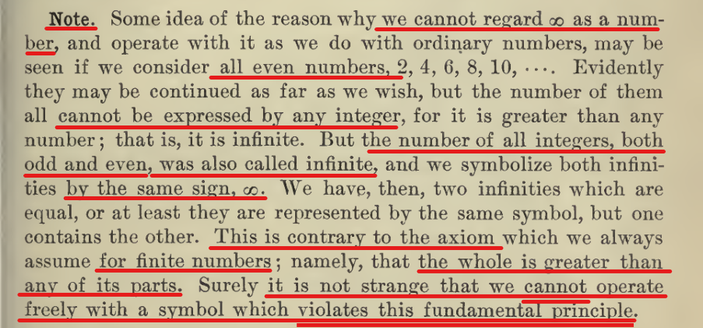
"Infinity is strange" - no it's not. See screenshot (which is a direct rejection of Cantor's "proof", who tried to treat it as a number)
"Infinity is strange" - no it's not. See screenshot (which is a direct rejection of Cantor's "proof", who tried to treat it as a number)
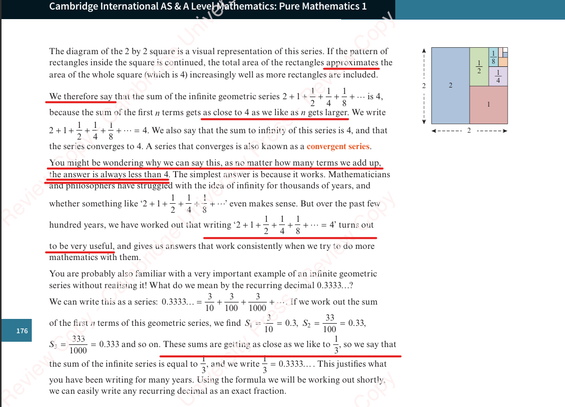
@SmartmanApps "the sum of the series to infinity is 4".
Do you think that's correct or do you think the textbook is wrong?
Do you think that's correct or do you think the textbook is wrong?
@fuchsi
"Do you think that's correct or do you think the textbook is wrong?" - says person who left out the whole previous sentence 🙄 "WE THEREFORE SAY THAT the sum of the infinite geometric series… is 4, because the sum of the first n terms gets AS CLOSE TO 4 AS WE LIKE as n gets larger", and also ignored the latter sentence... "You might be WONDERING WHY we can say this, as NO MATTER HOW MANY TERMS WE ADD UP, THE ANSWER IS ALWAYS LESS THAN 4", AND also ignored the diagram depicting the proof
"Do you think that's correct or do you think the textbook is wrong?" - says person who left out the whole previous sentence 🙄 "WE THEREFORE SAY THAT the sum of the infinite geometric series… is 4, because the sum of the first n terms gets AS CLOSE TO 4 AS WE LIKE as n gets larger", and also ignored the latter sentence... "You might be WONDERING WHY we can say this, as NO MATTER HOW MANY TERMS WE ADD UP, THE ANSWER IS ALWAYS LESS THAN 4", AND also ignored the diagram depicting the proof
@fuchsi
So yes, the textbook is correct - the infinite sum is always less than the limit, but we use the limit in it's place when doing arithmetic. It's not complicated. Every textbook that covers this topic says the same thing in different ways
So yes, the textbook is correct - the infinite sum is always less than the limit, but we use the limit in it's place when doing arithmetic. It's not complicated. Every textbook that covers this topic says the same thing in different ways
@SmartmanApps "the infinite sum is always less than the limit, but we use the limit in it's place when doing arithmetic. "
Isn't that also what Wikipedia and our friend said?
Just in more words?
Edit: and I didn't leave the rest out. I am sorry if it looked that way. I just try to find common ground and go on from there. I don't think it's useful to always write a whole page if we don't find the starting point first.
@fuchsi
"Isn't that also what Wikipedia and our friend said?" - no. The infinite sum is 0.(9), the limit is 1, both say they're equal, but it's literally impossible for them to be equal, as per all the textbooks and proofs. Using the limit in it's place for arithmetic doesn't mean they're equal, any more than using 22/7 for pi now means pi is equal to 22/7. A value you use for a calculation isn't the same as that thing actually having that value in reality
"Isn't that also what Wikipedia and our friend said?" - no. The infinite sum is 0.(9), the limit is 1, both say they're equal, but it's literally impossible for them to be equal, as per all the textbooks and proofs. Using the limit in it's place for arithmetic doesn't mean they're equal, any more than using 22/7 for pi now means pi is equal to 22/7. A value you use for a calculation isn't the same as that thing actually having that value in reality
@SmartmanApps your textbook also says they are equal "The simplest answer is because it works".
The text also says it's strange and "mathematicians and philosophers have struggled with the idea". So you are not alone.
And they conclude that 0,333... = 1/3 (is equal)
They don't say 0,333... < 1/3 (is smaller) or 0,333... ~ 1/3 (is rounded). They explain that they use the symbol "equal" because in infinity there is no difference between both.
And again: the text also sees this contradiction.
@SmartmanApps Another way to say it is: we defined it that way.
Because mathematics is a sort of language for numbers.
We made up new words for this phenomenon: converging series and limit. And we defined both to be equal. Because it works.
Because mathematics is a sort of language for numbers.
We made up new words for this phenomenon: converging series and limit. And we defined both to be equal. Because it works.
@fuchsi
"your textbook also says they are equal" - no it doesn't. "the answer is always less than 4"
"So you are not alone" - I'm not struggling with the idea at all. This has been well-established for a very long time
"And they conclude that 0,333... = 1/3 (is equal)" - no they don't. They conclude we use it in it's place "because it works", just like we can use 22/7 in place of pi if we choose
"They don't say 0,333... < 1/3 (is smaller)" - yes they do. "the answer is always less than 4"...
@fuchsi
You're also ignoring the textbook which explicitly stated that 0.(6) is less than 2/3. Now divide by 2
"Another way to say it is: we defined it that way" - nope. We've defined infinite sums one way, the limit another way
"mathematics is a sort of language for numbers" - no it isn't - it's a tool for calculating things, and sometimes we do things to make the calculations easier, like using 22/7 for pi
"And we defined both to be equal" - no we didn't, just like pi isn't defined as 22/7
@SmartmanApps
"You're also ignoring the textbook which explicitly stated that 0.(6) is less than 2/3. Now divide by 2"
I am not exactly sure what you mean by that.
Yes 0,6 < 2/3
But we are talking about sums that go into infinity.
So you can say
6/10+6/100+6/1000+... = 0,6666... = 2/3
(Not < 2/3 because we don't stop the sum. We take all of it. Until infinity. That's why there are 3 dots "..." behind the term. Because it goes on and on.
Funfact:In Germany you would write a line above the 6.)
@SmartmanApps
Okay. Now I am struggling to understand you.
>"And they conclude that 0,333... = 1/3 (is equal)" - no they don't.
But they literally do. It's in the text. Third line from the bottom.
> They conclude we use it in it's place "because it works"
Yes. And if we can use it in it's place, it's equal. (Note that they use the word "equal" several times.)
@SmartmanApps
> "They don't say 0,333... < 1/3 (is smaller)" - yes they do. "the answer is always less than 4"...
Mathematical symbols are important. They use = and not <
And again: they also confirmed that contradiction. And they still concluded that
"The sums are getting as close to 1/3 as we want, so we say that the sum of the infinite series is equal to 1/3, and we write 0,333... = 1/3"
"We can easily write any recurring decimal as an exact fraction."
@SmartmanApps why do you call him gaslighter?
It's not like he can manipulate your perception of reality or something. You are just discussing things. (And both of you think you are right. And argue very passionately.)
It's not like he can manipulate your perception of reality or something. You are just discussing things. (And both of you think you are right. And argue very passionately.)
@fuchsi
"why do you call him gaslighter?" - because that's what he is
"You are just discussing things" - no he's not
"both of you think you are right" - no, he knows full well he's not. Did you miss where he edits out the bits that prove he is wrong, proving that he has seen them?
@fuchsi Do you not feel the power of my typing compelling you? Damn, I must have forgotten to switch my internet to "hypnotise"...
I am fascinated though. Apparently, "the numerical value of" a number can be different from "the numerical value V of" the same number? At least, that's how I interpret his complaint that I did not include the "V" in that quote (and it's true, I didn't. *And* it's true that I didn't include the screenshot that we had already seen :) ).
This IMO would be a fundamental lack of understanding of one of the most basic aspects of mathematics, that the value of a variable symbol is, exactly and always, the value of the object it denotes. I don't see how a graduate of a mathematics degree comes away thinking that there is a difference here.
Either way it's bizarre, because that was the one chance he had to actually be saying something true (albeit wrongly expressed, albeit contrary to all ordinary mathematical language, but nevertheless true on its own terms), and he's denying it! Maybe next time he'll enlighten us as to whether 0.666... is:
* a number
* greater than 0.6, 0.66, 0.666, and every decimal number 0.66..66 with a finite number of sixes
* at most two thirds
but since he ignored this question the last time I asked it (about 0.999...) I doubt it :( Will he say whether "the numerical value of 0.666..." is actually different from "the numerical value V of 0.666..." and if so, how? Still less likely. He doesn't like making precise assertions.
It would be fascinating to sit down with him and see exactly how his brain works. Apparently the mere presence of the word "approximate" on a page means that the equality symbol does not have its usual meaning, so the statement "⅓ = 0.333..." can be ignored. Can anyone really believe that "this gives us two approximations to x" implies that "the infinite decimal expansion of x", then denoted with the "=" symbol, is approximate? I assume this is what he's trying to say by drawing lines between the word "approximations" there and my highlighting of the exact equality below.
Yes, Donald, we all agree that the finite terms 0.3, 0.33, 0.333, etc are approximations to ⅓! And so does Wikipedia, where this discussion started. No-one believes this extends to the recurring decimal, except you.
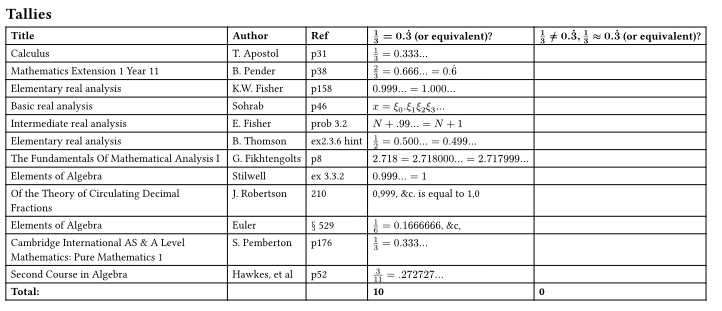
It was nice of him to link another textbook, but the part about graphs, rather than about recurring decimals. Still, in that textbook (p38, screenshot), fractions *are* equated, using the equality symbol, to recurring decimals. But this book does one better, because it strictly uses a different symbol for "approximately equal" (p42, same screenshot), which is nowhere to be found on p38. Surely *this* will convince him that recurring decimals are exact representations of rational numbers! Now's a good time to make a table of sources in support of writing 0.999... = 1. I think maybe the time has come for the Smart Man to find some entries which can fill in the final column, or to admit that Wikipedia is entirely justified in writing 0.999... = 1 :) Surely if he believes 0.999... ≠ 1, he can find at least one source which says so in clear, unambiguous symbols. *Surely!*
In partial answer to your question, I believe his use of the term "gaslighter" may have started when someone else said that a "+=" key on a calculator was not an equals key. (It combines the functions of both + and =, and featured on early electronic calculators and on mechanical adding machines. This is a whole other story!). Shortly after he directed it at me for unclear reasons, and now he throws it out at anyone who disagrees with him.
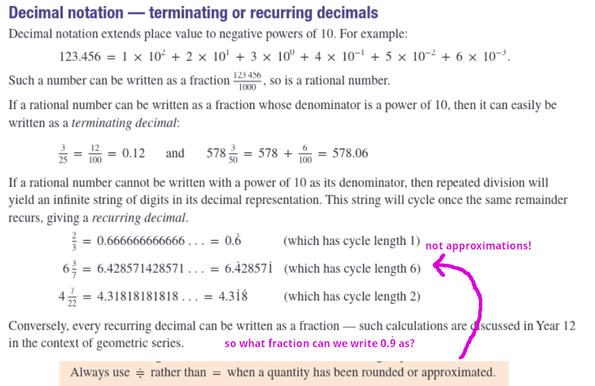
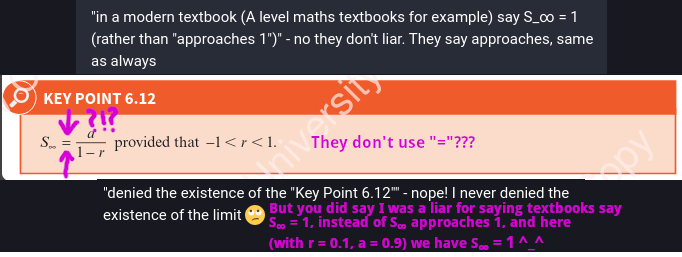
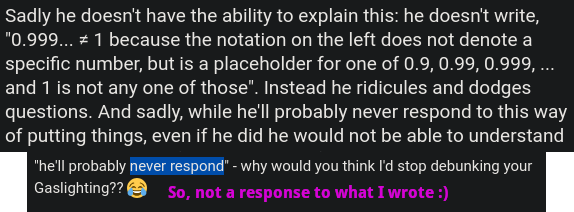
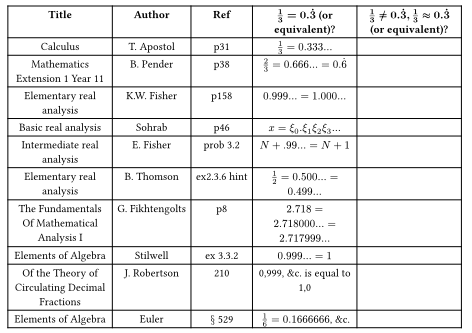
That looks pretty consistent to me.
And yes, it's confusing that 0,9999... = 1 .
Infinity is strange.
I also had some mind blockers in university that were similar. I needed some time to get over them.
> Nope, you ignored that I answered it
If I misplaced a comment of yours in this long (and hard to read, due to blocking - happy to reverse that at any point) thread, I do apologise. It's not intentional, and you can swiftly rectify the situation by linking to the comment I missed.
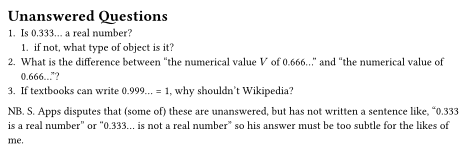
I asked the question here: https://ioc.exchange/@FishFace/116317586606785481 and as far as I'm aware you haven't replied. Please do tell us whether recurring decimals like 0.999... are real numbers - feel free to link to somewhere you said this if you already did. But to be clear, it's a yes-or-no question: a mathematical object either is or is not a real number. Whatever your answer is should be obviously an answer, when we read it.
And of course we still await your explanation (always sad to be proven correct) of the difference between the sentences "the numerical value V of 0.666..." and "the numerical value of 0.666...". If there is no such explanation, you might wish to consider retracting your outrage at my omission :)
> "And so does Wikipedia" and so does the textbook
So you're happy that Wikipedia and the textbook both use the notation 0.999... = 1 viz. 0.333... = ⅓. Can you now explain why the Wikipedia article is wrong to write such an equation, but the textbooks are not?
The screenshot you couldn't find is the first one of my comment https://ioc.exchange/@FishFace/116335108529026456, which is from p38 of Mathematics Extension 1 Year 11, and which you referred to here: https://dotnet.social/@SmartmanApps/116323534108291577
It's not especially important; it's in the table already.
> "Now's a good time to make a table of sources in support of writing 0.999... = 1" - in which you lied, as usual
The full titles, authors and page/other references are all there for you to dispute any cases where I've misquoted them - or indeed to find a reference for where it says something like ⅓ ≠ 0.333...
> "not a response to what I wrote" - that was in the other 6 posts, you know, the ones you ignored
Then I'll have to request that you organise your thoughts better, so that I can see what is supposed to be a response to what. Thanks in advance.
I've added some missing texts to the tally, and created an unanswered questions log to help us keep track.
Whenever you're ready to add some sources that actually explicitly say 0.999... ≠ 1 (other recurring decimals are available) please do link them.
> (which is a direct rejection of Cantor's "proof", who tried to treat it as a number)
Oh dear, that topic. Cantor treated infinity as a type (actually two different types) of equivalence class of sets. Let's not get distracted though.
> NO MATTER HOW MANY TERMS WE ADD UP, THE ANSWER IS ALWAYS LESS THAN 4
Do you think this is supposed to mean that, "if we add up 'infinitely many' terms, the answer is still less than 4"? Because that would be doing exactly what you just said not to do, and treating infinity as a number. It means "for all natural numbers n, the partial sum of n terms is less than 4". Infinity is not a natural number. It would be incorrect to say "the sum to infinity is less than 4", which is why you have seen many textbooks say "the sum to infinity is ..." and then the limit.
> So yes, the textbook is correct - the infinite sum is always less than the limit, but we use the limit in it's place when doing arithmetic
Sorry, you said "the textbook is correct", and then some words that were not in the textbook. It did not say "the infinite sum is always less than the limit". It said "the sum of the infinite geometric series ... is 4".
Perhaps you would like to try answering Steffi's question again? It was a simple yes-or-no affair, and didn't need the application of your imagination ;)
@FishFace seems that I am now a gaslighter, too. And your alt account.
That's interesting.
Yep, how does it feel? Do you feel our identities blending together? XD Any excuse for all the pushback he gets, I suppose.
Did you enjoy yourself? I did but I think these kinds of interactions are nothing but frustrating to most people. (I find it frustrating as well, but also fascinating).
My next question to him was going to directly be what he would add to Wikipedia to make it correct - given that he accepts the equation 0.999... = 1, there must some verbiage that he would like to add and be happy. Sadly, because he persistently misquotes textbooks, inserting his own incorrectly-synthesised understanding of two separate domains (finite and infinite) I suspect that he would answer with a sentence that is not in fact present in any of the textbooks.
Never mind that the Euler and Robertson sources have no such precise discussion of limits because the concept didn't exist yet.
Never mind that, just as with getting that answer to what exactly 0.666... *is*, he'd probably ignore the question :)
The thing about "using" an approximation in a calculation is an interesting one. I don't know about you, but I was always taught that, when using an approximation like 3.142 for pi, to write ≈ instead of = throughout. Or else, to write "to 3 decimal places" after each such statement. Given that the textbook by Pender he used specifies a specific approximation symbol, it's clear that in such texts they do not mean an approximation.
In such a discussion I am always trying to find the internal consistencies as well as the inconsistencies. I think there is a way you could get muddled into believing this "using" idea if you for some reason really strongly believed that recurring decimals are not equal to their equivalent fractions, but how do you get to that point? No matter what he says, it's *not* how it's taught in schools!
I think the fundamental inconsistency that he will never get over can be summed up with his statement, "We've defined infinite sums one way, the limit another way" - compare this to "it's literally impossible to calculate an actual infinite sum". So are they "defined" or "impossible to calculate"? What are they defined as? We'll never know - so sad!
But what I'm most interested in is whether you think he's trolling or serious, and whether he actually ever studied maths at university (as we mean it, not as part of a teaching qualification or something)? I don't think it's possible to believe that defining two things as equal is akin to an approximation if you got a maths degree. I am not sure whether he's trolling though - he's pretty subtle if so, and moreover he *only* has these few special topics he spreads misinformation about, and he has done so on the topic of Order of Operations *persistently* on many websites, since at least 2023. I feel like a troll would be more wide-ranging, but I would love to know if you agree.
Oh btw, the "identically equal" thing is a weird one that I never did pick up on. If you look this up in a school textbook, it's the difference between an identity like sin² x + cos² x = 1 (true for all x) and an equation like x² - 4 = 0 (only true if x is ±2). In school we were inconsistently presented with identities using the ≡ symbol. Yet another tell-tale, I think: you don't use this in university maths courses at all because you learn quantifiers. But this distinction is obviously only relevant for equations with variable symbols in, so I think it speaks to an even worse misunderstanding.
@fuchsi
P.S. if you don't block him back, expect to still get notifications from him replying to you. You may or may not want that ;)
P.S. if you don't block him back, expect to still get notifications from him replying to you. You may or may not want that ;)
@FishFace I muted him
@FishFace looks like the dunning kruger effect for me.
But I am too long out of it to know it better. So I can only parrot the book.
@fuchsi honestly parroting the book is all it takes if you understand English (or the language of the book) (maybe you need a tiny understanding of mathematical language?)
You probably remember more than you give yourself credit for - I surprised myself by being able to prove a limit/supremum from first principles when talking about it before 😁
@FishFace I mean he was completely right with the asymptotic behaviour. I just don't understand why he has to power through with his own wording and say everyone else is wrong.
I mean if there are 69 sources on a page I want to change, I would seriously reconsider my "expertise" if all 69 sources say something else.
I mean they could be wrong, but Occam's razor says otherwise .
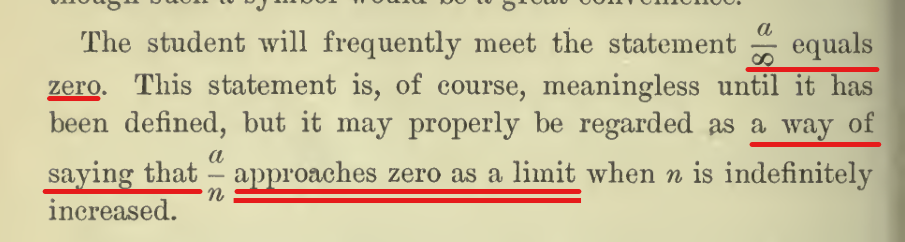
@fuchsi yeah. It is eye-opening how unhelpfully old books treat limiting behaviour and infinity - nowadays I think educators are very careful to avoid using ∞ in expressions where it looks like it's being used as a number. E.g. we would never write ³/∞ = 0; if we needed a shorthand we'd always use an arrow: 3/n --> 0.
It seems to me like he just hasn't quite understood this distinction, so when a textbook says "every term is less than 4" he thinks this includes a non-existent "infinitieth term".
But how do you quote the textbook explanation of a/∞ = 0, and not realise that explanation is the only thing that gives meaning to such an expression, then apply the same logic to infinite sums? Either trolling or a fanatical devotion to whatever he thinks recurring decimals are.
Another thing I never got a chance to ask was whether 0.999... is rational or not, and if so, how you write it as a fraction. I suspect we'd get to the same kind of thing where he says "you can write it as a fraction but it's not equal" :/