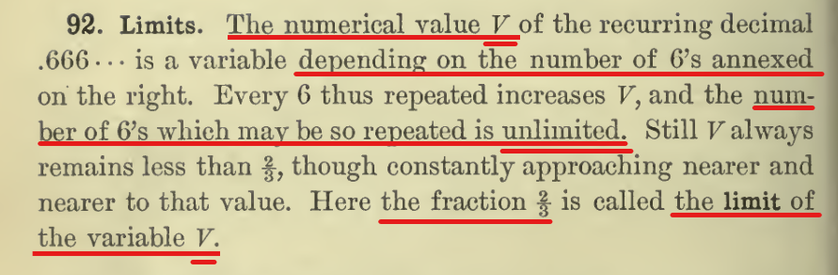
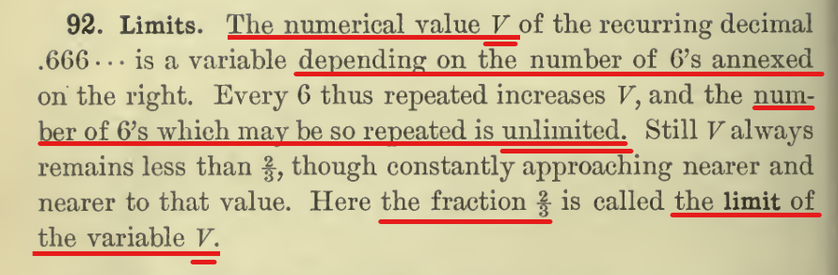
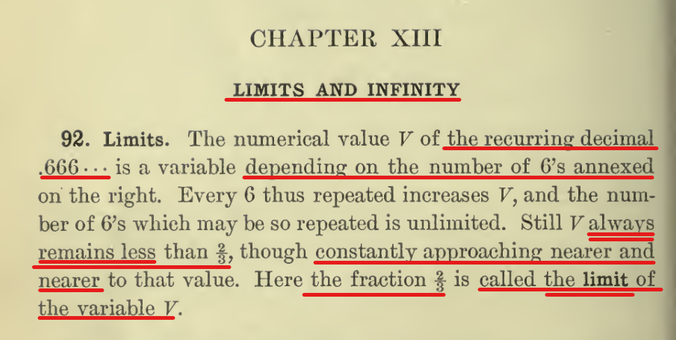
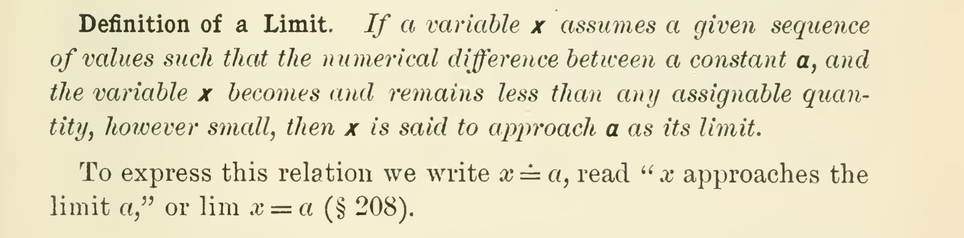
@fuchsi Regarding recurring decimals, yes the language used in that book is very much not standard. Actually we should be clear that, in the language of that book (Second Algebra by Hawkes, Luby and Touton, published 1911), SmartmanApps is correct; in that book 0.999... is not 1, because 0.999... does not represent a real number at all. From his screenshot of p176: "The numerical value of 0.666... is a **variable** depending on the number of 6s annexed to the right". (My emphasis)
So this is where he's coming from: for him, 0.999... has *no* fixed value but is more like a variable symbol that is restricted to taking values in the sequence of finite decimals 0.9, 0.99, 0.999, etc. In normal mathematical language we would say it refers to the sequence (or perhaps set) of such values, because the idea that a variable can take on multiple different values within the same piece of mathematical discourse is unnecessary and confusing. (Because if x can take on multiple values, you are forced to accept the statements "x = 0.9" and "x = 0.99" in the same argument, because they might represent different values of x at different times. Can we therefore conclude that x - x = 0.09? No! You must at all times pay attention to whether your statements about a variable were only true contingently. Normal mathematical argument would enclose such sub-scenarios in conditional language, making this explicit.)
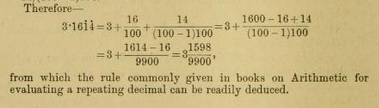
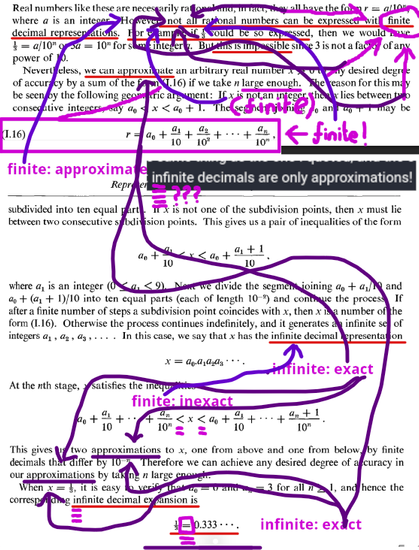
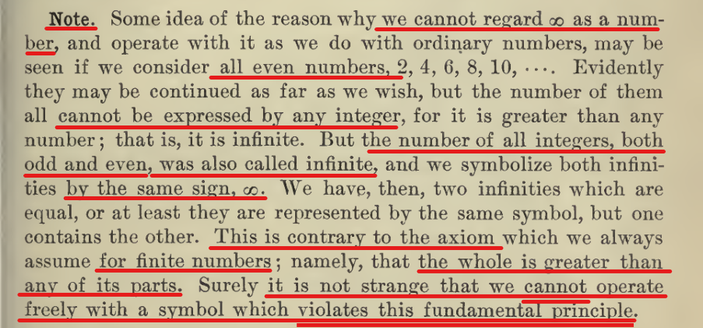
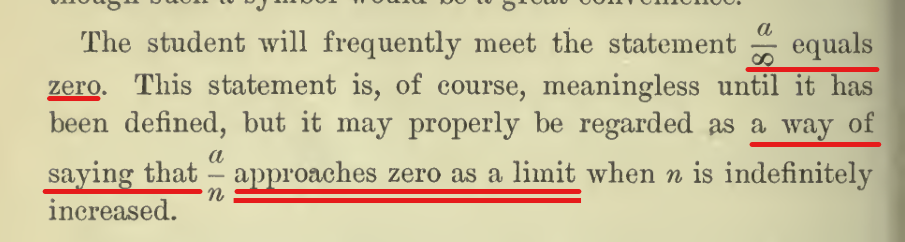
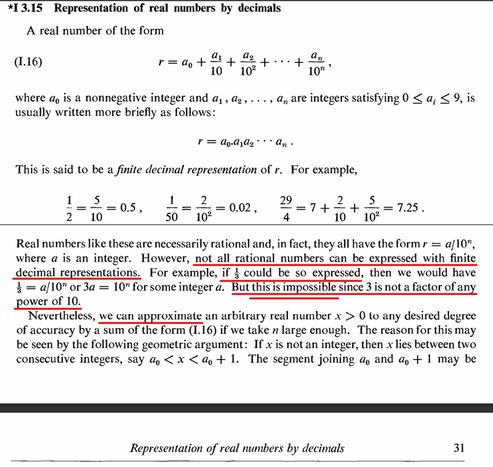
I'm not convinced that the wording here "changed" in the sense it being normal in 1911 and rare now. Euler spoke of recurring decimals as definite, not variable quantities in the 1700s, and the textbook Introduction to Algebra by G. Chrystal first printed in 1898 clearly does so too (first screenshot)
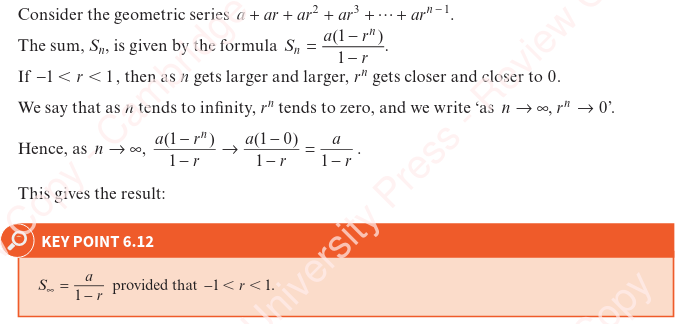
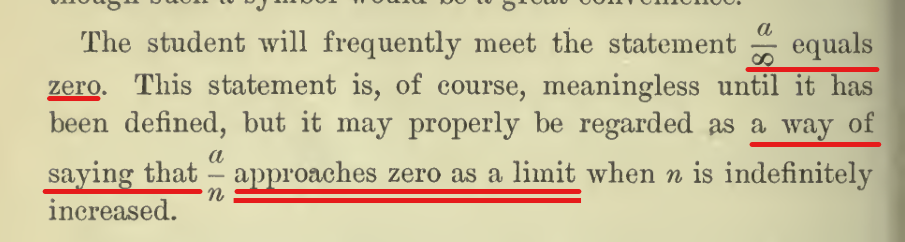
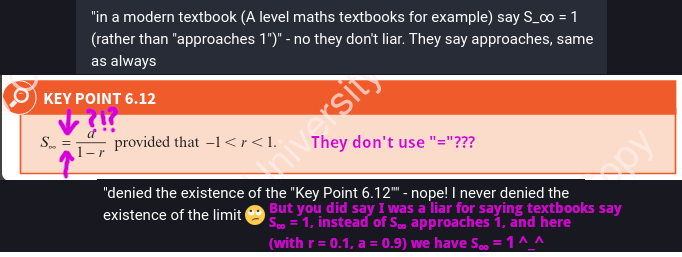
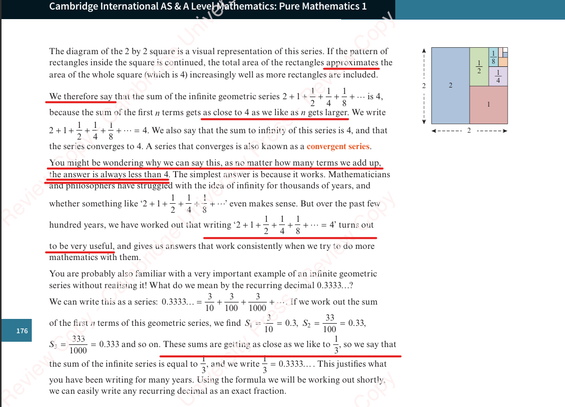
Regarding S_∞ actually I think the language hasn't changed, but that book he's quoting is a little sloppily written here. The second screenshot is the modern development, including the "S_∞ = a/(1-r)", from the A-level textbook he's using.
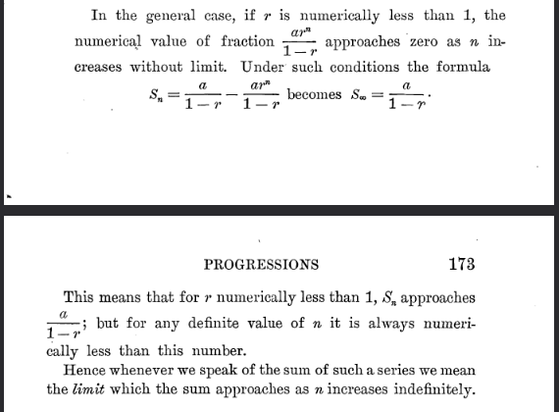
The third screenshot is from the bottom of page 172 of Second Algebra which he clipped, and the top of 173. Notice in fact that the authors abandon the language of "S_∞ approaches..." in favour of giving it a definite value. Their treatment on p173 is in fact quite clear and in contradiction with the Smart Man's conclusion: "when we speak of the sum of the series, we **mean the limit**". From what he says, I don't think he is quite capable of understanding what a mathematician is saying when they say, "by these words we mean this thing", else he wouldn't have underlined all those words which contradict him :P
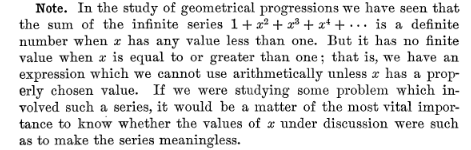
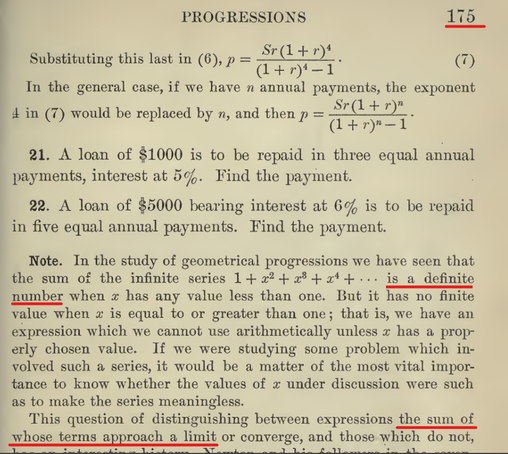
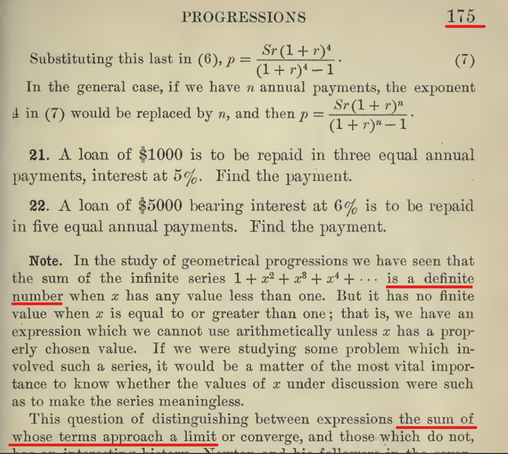
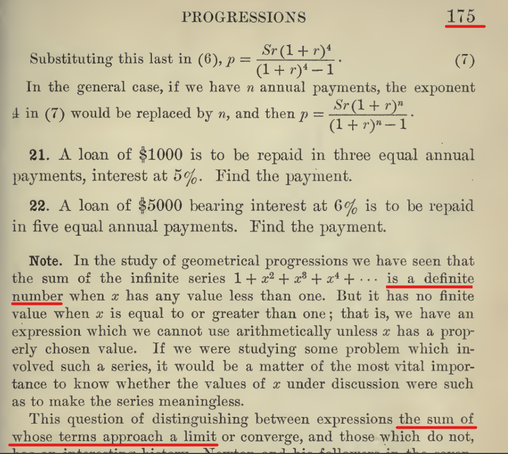
Further to this, on p175 there is the fourth screenshot, which says that (when x < 1), "the sum of the series 1 + x + x² + x³ + ... is a definite number". "Definite numbers" are just themselves; they don't change and cannot "approach" anything.
I am ashamed that I skipped over his screenshot of p176, because that finally actually clarifies what he thinks recurring decimal notation means in a way that his posts dating back to 2024 failed to. Presumably he also thinks infinite summation is similarly a "variable" waiting for you to decide how many terms to add up.
Sadly he doesn't have the ability to explain this: he doesn't write, "0.999... ≠ 1 because the notation on the left does not denote a specific number, but is a placeholder for one of 0.9, 0.99, 0.999, ... and 1 is not any one of those". Instead he ridicules and dodges questions. And sadly, while he'll probably never respond to this way of putting things, even if he did he would not be able to understand or admit that his preferred language, from one textbook written over 100 years ago, is not standard and that in the language used by everyone else, 0.999... denotes a single, definite number, and that number is 1.
I think this way of writing maths invites such imprecise thinking though - do you agree? If we see a symbol used *as a number* the way recurring decimals universally are, then I think it will always lead to people treating them as a particular number.
 💡𝚂𝗆𝖺𝗋𝗍𝗆𝖺𝗇 𝙰𝗉𝗉𝗌📱
 Furbland's Very Cool Mastodon™
 Steffi the Redhead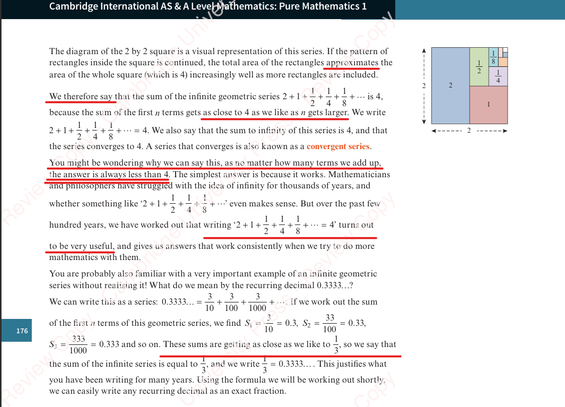
 Fish Face