 Steffi the Redhead
@SmartmanApps @GroupNebula563 @TechDesk @404mediaco @emanuelmaiberg @wikipedia @LucasWerkmeister That's not how ifinity works. You don't have the remaining 1. That also gets divided by 3.
 💡𝚂𝗆𝖺𝗋𝗍𝗆𝖺𝗇 𝙰𝗉𝗉𝗌📱
@fuchsi @GroupNebula563 @TechDesk @404mediaco @emanuelmaiberg @wikipedia @LucasWerkmeister
"You don't have the remaining 1. That also gets divided by 3" - which then also gives a remainder of 1, divide by 3 again, another remainder of 1, ad infinitum. That's EXACTLY how infinity works - a never-disappearing remainder of 1, infinitely repeating 3's. Again, every non-terminating decimal is only an approximation, only terminating decimals are exactly equal to fractions, as per Maths textbooks
@SmartmanApps @GroupNebula563 @TechDesk @404mediaco @emanuelmaiberg @wikipedia @LucasWerkmeister I am not sure that's how it works.
@fuchsi @GroupNebula563 @TechDesk @404mediaco @emanuelmaiberg @wikipedia @LucasWerkmeister
"I am not sure that's how it works" - That's exactly how it works. Sit down with pen and paper and start doing long (or short) division. 3 doesn't go into 1, add a zero. 3 goes into 10 3 times with 1 remainder, repeat ad infinitum. Again, every non-terminating decimal is only an approximation due to a never-disappearing remainder, due to not being a factor of 10
@SmartmanApps @GroupNebula563 @TechDesk @404mediaco @emanuelmaiberg @wikipedia @LucasWerkmeister yeah, but you do that with limit analysis
@fuchsi @GroupNebula563 @TechDesk @404mediaco @emanuelmaiberg @wikipedia @LucasWerkmeister
And the limit is defined as the number it can never reach, hence the name, limit.
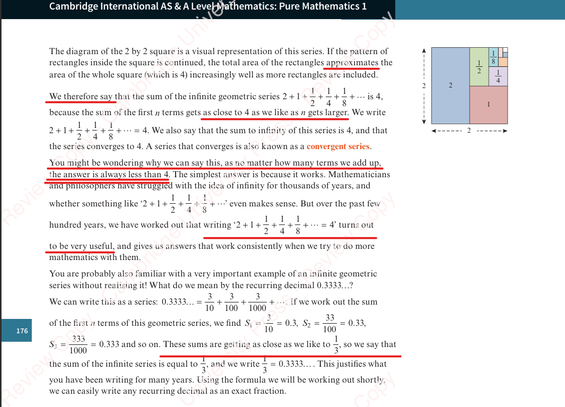
@SmartmanApps @GroupNebula563 @TechDesk @404mediaco @emanuelmaiberg @wikipedia @LucasWerkmeister In your text: read the line with the long term. On the right side you see "=4".
That means if you take the infinite term you can make an integer out of it.
That means if you take the infinite term you can make an integer out of it.
@fuchsi @GroupNebula563 @TechDesk @404mediaco @emanuelmaiberg @wikipedia @LucasWerkmeister
Now read all the underlined parts, especially the double-underlined part. You can lead a horse to water...
"That means if you take the infinite term you can make an integer out of it" - no, had you read it, you would understand that means if you take THE LIMIT you can get an integer out of it. The "infinite term" is still less than it, still less than 4, as per the textbook...
@SmartmanApps @GroupNebula563 @TechDesk @404mediaco @emanuelmaiberg @wikipedia @LucasWerkmeister as far as I understand it it's 4.
@fuchsi @GroupNebula563 @TechDesk @404mediaco @emanuelmaiberg @wikipedia @LucasWerkmeister
"as far as I understand it it's 4" - the limit is 4, yes, the infinite sum isn't - see double-underlined part (I'm starting to think you didn't read any of it and are just a time-waster)
"as far as I understand it it's 4" - the limit is 4, yes, the infinite sum isn't - see double-underlined part (I'm starting to think you didn't read any of it and are just a time-waster)
@SmartmanApps @GroupNebula563 @TechDesk @404mediaco @emanuelmaiberg @wikipedia @LucasWerkmeister And I think you ignored the not underlined parts behind.
@fuchsi @GroupNebula563 @TechDesk @404mediaco @emanuelmaiberg @wikipedia @LucasWerkmeister
"And I think you ignored the not underlined parts behind" - so rather than leave us in any doubt, you decided to confirm you're a time-waster who couldn't take issue with anything the textbooks said and made up an ad hominem instead. Got it. Bye then.
"And I think you ignored the not underlined parts behind" - so rather than leave us in any doubt, you decided to confirm you're a time-waster who couldn't take issue with anything the textbooks said and made up an ad hominem instead. Got it. Bye then.
@SmartmanApps @GroupNebula563 @TechDesk @404mediaco @emanuelmaiberg @wikipedia @LucasWerkmeister Sorry, but I don't have math textbooks in my house. My study time was 20 years ago.
@fuchsi @GroupNebula563 @TechDesk @404mediaco @emanuelmaiberg @wikipedia @LucasWerkmeister
There's plenty of textbooks available for free on the Internet Archive, none of which have been referenced in the Wikipedia page, which is contradicted by what textbooks say https://dotnet.social/@SmartmanApps/115365316775919939 The 2 textbooks I referenced in this thread, which say that infinite decimals are only approximations, and the infinite sum never reaches the limit, are also available for free online, also unreferenced by Wiki
There's plenty of textbooks available for free on the Internet Archive, none of which have been referenced in the Wikipedia page, which is contradicted by what textbooks say https://dotnet.social/@SmartmanApps/115365316775919939 The 2 textbooks I referenced in this thread, which say that infinite decimals are only approximations, and the infinite sum never reaches the limit, are also available for free online, also unreferenced by Wiki
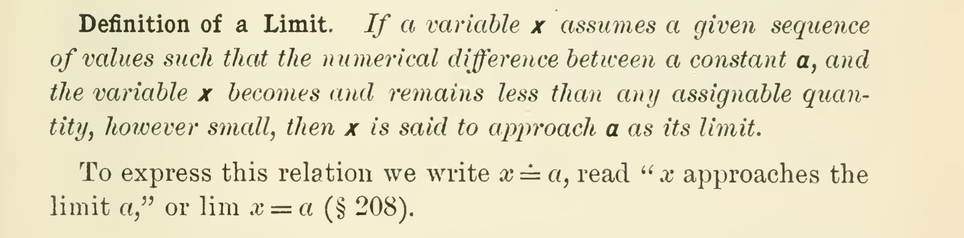
💡𝚂𝗆𝖺𝗋𝗍𝗆𝖺𝗇 𝙰𝗉𝗉𝗌📱 (@[email protected])
Attached: 1 image 4/5 We can see in this textbook, it uses a dot above an equals sign to show "x approaches the limit a", and says we can also write it as "lim x=a". I have also seen textbooks say x:=a, where := means "is defined as". Note that in all 3 cases, the textbook has quite conspicuously never said x=a, only variations on the limit of x is defined as a, which we do so that we have a finite number that we can perform further calculations with...
@SmartmanApps @GroupNebula563 @TechDesk @404mediaco @emanuelmaiberg @wikipedia @LucasWerkmeister Wait, what? Are you saying I should only read books that are not referenced by Wikipedia?
Isn't that a bit extreme from "I would change one sentence about infinity"?
 Fish Face
@fuchsi
He's saying the only textbooks that are correct are the ones that agree with him, of course ;)
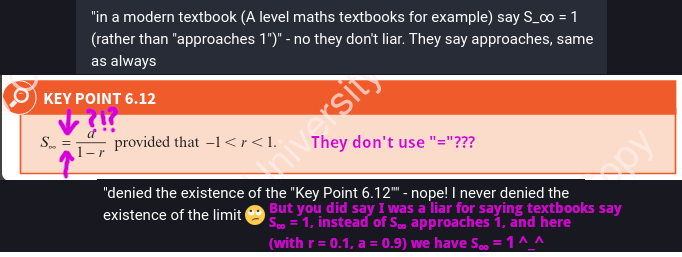
God knows how old the one (or maybe it's more than one) he's using there is; the dotted equal symbol isn't used any more. The symbol S_∞ introduced there has no different meaning than S_n (that is, both are said to "approach" the limit) whereas in a modern textbook (A level maths textbooks for example) say S_∞ = 1 (rather than "approaches 1").
Again he confuses the terms of a sequence with its limit. This is genuinely interesting though, because this textbook uses the ellipsis to mean an unwritten finite number of terms rather than infinitely many, so could really explain why he has this misconception.
@FishFace So I assume math books wording did change?
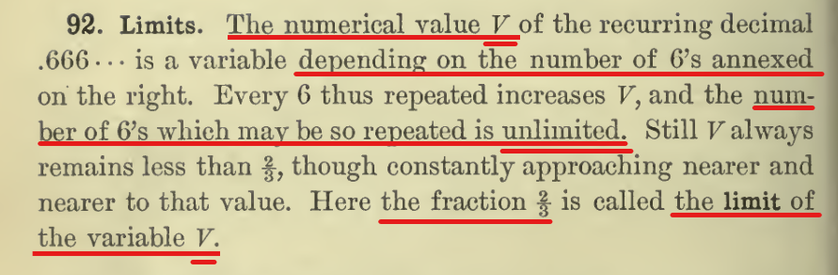
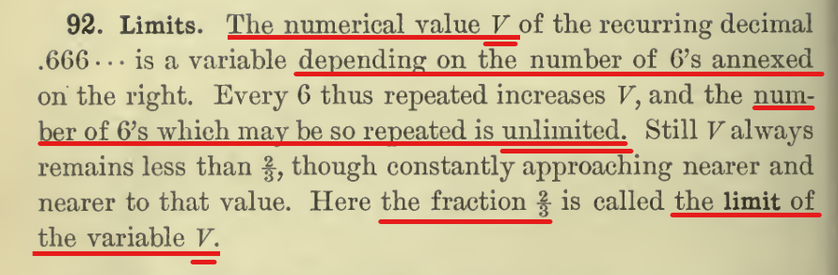
@fuchsi Regarding recurring decimals, yes the language used in that book is very much not standard. Actually we should be clear that, in the language of that book (Second Algebra by Hawkes, Luby and Touton, published 1911), SmartmanApps is correct; in that book 0.999... is not 1, because 0.999... does not represent a real number at all. From his screenshot of p176: "The numerical value of 0.666... is a **variable** depending on the number of 6s annexed to the right". (My emphasis)
So this is where he's coming from: for him, 0.999... has *no* fixed value but is more like a variable symbol that is restricted to taking values in the sequence of finite decimals 0.9, 0.99, 0.999, etc. In normal mathematical language we would say it refers to the sequence (or perhaps set) of such values, because the idea that a variable can take on multiple different values within the same piece of mathematical discourse is unnecessary and confusing. (Because if x can take on multiple values, you are forced to accept the statements "x = 0.9" and "x = 0.99" in the same argument, because they might represent different values of x at different times. Can we therefore conclude that x - x = 0.09? No! You must at all times pay attention to whether your statements about a variable were only true contingently. Normal mathematical argument would enclose such sub-scenarios in conditional language, making this explicit.)
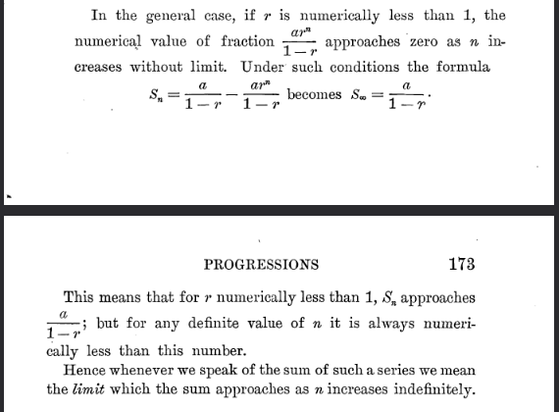
I'm not convinced that the wording here "changed" in the sense it being normal in 1911 and rare now. Euler spoke of recurring decimals as definite, not variable quantities in the 1700s, and the textbook Introduction to Algebra by G. Chrystal first printed in 1898 clearly does so too (first screenshot)
Regarding S_∞ actually I think the language hasn't changed, but that book he's quoting is a little sloppily written here. The second screenshot is the modern development, including the "S_∞ = a/(1-r)", from the A-level textbook he's using.
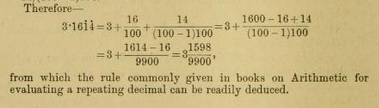
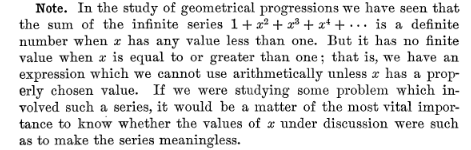
The third screenshot is from the bottom of page 172 of Second Algebra which he clipped, and the top of 173. Notice in fact that the authors abandon the language of "S_∞ approaches..." in favour of giving it a definite value. Their treatment on p173 is in fact quite clear and in contradiction with the Smart Man's conclusion: "when we speak of the sum of the series, we **mean the limit**". From what he says, I don't think he is quite capable of understanding what a mathematician is saying when they say, "by these words we mean this thing", else he wouldn't have underlined all those words which contradict him :P
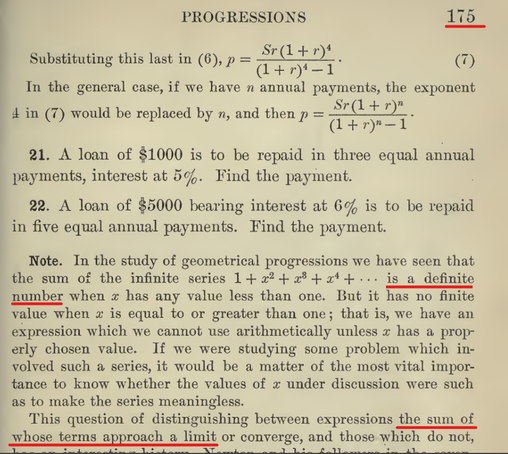
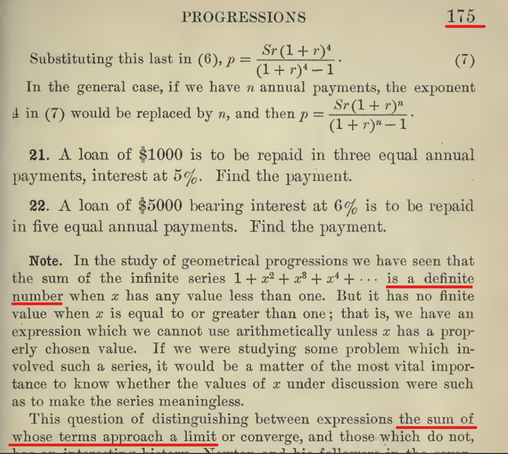
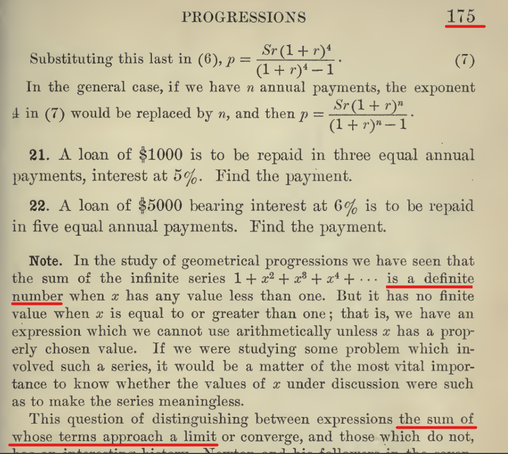
Further to this, on p175 there is the fourth screenshot, which says that (when x < 1), "the sum of the series 1 + x + x² + x³ + ... is a definite number". "Definite numbers" are just themselves; they don't change and cannot "approach" anything.
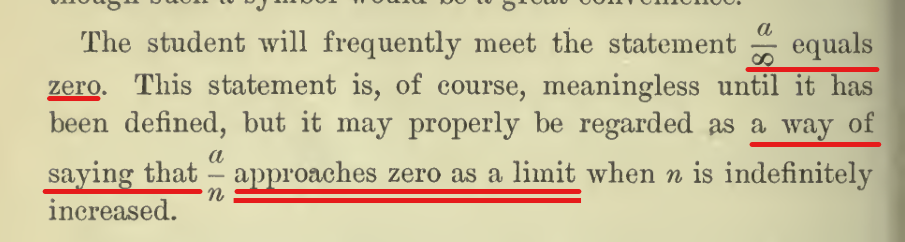
I am ashamed that I skipped over his screenshot of p176, because that finally actually clarifies what he thinks recurring decimal notation means in a way that his posts dating back to 2024 failed to. Presumably he also thinks infinite summation is similarly a "variable" waiting for you to decide how many terms to add up.
Sadly he doesn't have the ability to explain this: he doesn't write, "0.999... ≠ 1 because the notation on the left does not denote a specific number, but is a placeholder for one of 0.9, 0.99, 0.999, ... and 1 is not any one of those". Instead he ridicules and dodges questions. And sadly, while he'll probably never respond to this way of putting things, even if he did he would not be able to understand or admit that his preferred language, from one textbook written over 100 years ago, is not standard and that in the language used by everyone else, 0.999... denotes a single, definite number, and that number is 1.
I think this way of writing maths invites such imprecise thinking though - do you agree? If we see a symbol used *as a number* the way recurring decimals universally are, then I think it will always lead to people treating them as a particular number.
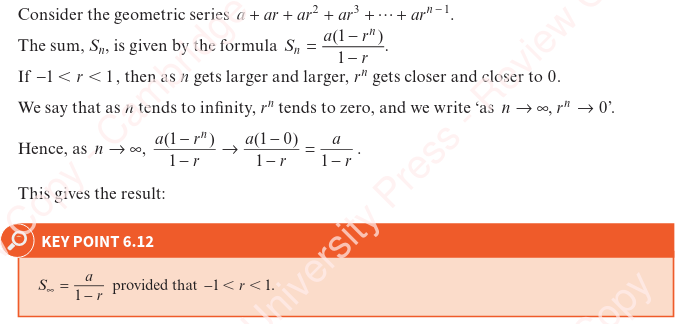
@fuchsi haha, it's very unfortunate that he denied the existence of the "Key Point 6.12" mere minutes before I linked it.
@FishFace I think you both should kiss and make up.
I think you are both more passionate about mathematical problems than I ever was. (Even though I competed in math olympiads as a child.)
@fuchsi @[email protected]
"passionate about mathematical" - I'm passionate about #debunking #Gaslighters and their #bullying. He's just passionate about Gaslighting/bullying people. Note in the following how often he edited out the references which contradict him...
"The numerical value of 0.666... is a **variable** depending on the number of 6s annexed to the right". (My emphasis)" - also your EDIT, where you deliberately omitted V is the Variable being described, hence your lack of a screenshot
@fuchsi @[email protected]
"Notice in fact that the authors abandon the language of "S_∞ approaches..." in favour of giving it a definite value" - notice that your screenshot in fact deliberately omits the very next paragraph, which says that the sum of the terms is approaching the limit 🙄
"when we speak of the sum of the series, we **mean the limit**"" - says person who can't provide a screenshot of them saying that anywhere, given they make the quite clear distinction between them repeatedly
@fuchsi @[email protected]
""Definite numbers" are just themselves; they don't change and cannot "approach" anything" - and, yet again, your screenshot leaves out the very next paragraph, which clearly states "the sum of whose terms approach a limit". Gaslighters gonna gaslight
""Definite numbers" are just themselves; they don't change and cannot "approach" anything" - and, yet again, your screenshot leaves out the very next paragraph, which clearly states "the sum of whose terms approach a limit". Gaslighters gonna gaslight
@fuchsi @[email protected]
""the sum of the series 1 + x + x² + x³ + ... is a definite number". "Definite numbers" are just themselves; they don't change and cannot "approach" anything" - says person who, yet again, left the very next paragraph out of their screenshot, which quite clearly states "the sum of whose terms approach a limit", the limit being the "definite number" being discussed 🙄
"Instead he ridicules and dodges questions" - #EveryAccusationIsAConfession 🙄
@fuchsi @[email protected]
"he'll probably never respond" - why would you think I'd stop debunking your Gaslighting?? 😂
"people treating them as a particular number" - they treat the limit as being the result of the infinite sum because that's what textbooks have been teaching them for more than 100 years, 🙄 whilst making the clear distinction between the two (which you keep editing out of your replies)
"denied the existence of the "Key Point 6.12"" - nope! I never denied the existence of the limit 🙄
@fuchsi @[email protected]
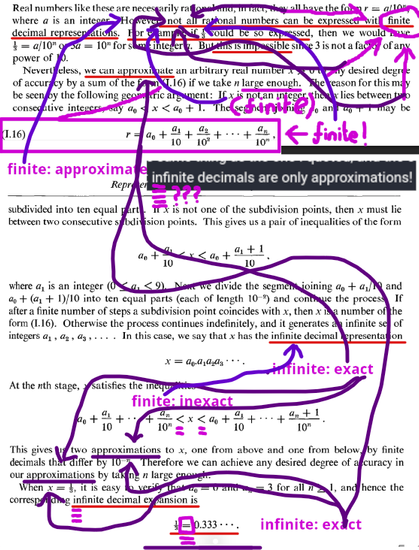
From your other reply "despite my helpful purple annotations ^_^" - I'm pointing out all the times "approximate" and "approximation" are used that you're trying to draw people away from noticing Gaslighter 🙄
P.S. you also need to learn the difference between equals and identically equal
"he hasn't read it" - and you haven't quoted it, so??
"Elsewhere I suggested he doesn't have a maths degree" - because you can't back anything you say up and thus make up lying ad hominems
@fuchsi @[email protected]
P.S. "It would explain his dedication to these old textbooks" - you mean the ones which are out of copyright and are thus available for anyone at all to download for free from the Internet Archive and see for themselves what ALL of the pages say, not just your selective cherry-picking quotes, THOSE "old textbooks"? 😂
P.S. "It would explain his dedication to these old textbooks" - you mean the ones which are out of copyright and are thus available for anyone at all to download for free from the Internet Archive and see for themselves what ALL of the pages say, not just your selective cherry-picking quotes, THOSE "old textbooks"? 😂
@fuchsi @[email protected]
"I don't see how a graduate of a mathematics degree comes away thinking that there is a difference here" - says person who deliberately omitted it in their "quote" 🙄
"since he ignored this question the last time I asked it" - nope, you ignored that I answered it, same as every time, because you have this running false narrative that I can't answer your questions, despite the fact I always do 🙄
@fuchsi @[email protected]
"means that the equality symbol does not have its usual meaning" - I already said that it's usual meaning is DIFFERENT from the meaning of IDENTICALLY EQUAL, and here you are yet again ignoring that I pointed that out to you Gaslighter
"And so does Wikipedia" and so does the textbook, explicitly stating the number of appended 6's is "unlimited"
"No-one believes this extends to the recurring decimal, except you" - and Maths textbooks, and other Maths teachers 🙄
@fuchsi @[email protected]
"It was nice of him to link another textbook" - says Gaslighter outright making stuff up, given I did nothing of the sort 🙄
"in that textbook (p38, screenshot)" - he says, without a screenshot of this mysterious page and book
"(p42, same screenshot)" - there are no screenshots of mine which include 5 whole pages. Pull the other one dude - it's got bells on it
"Now's a good time to make a table of sources in support of writing 0.999... = 1" - in which you lied, as usual
@fuchsi @[email protected]
And in response to this rubbish comment in the screenshot... here's another part of the EXACT SAME TEXTBOOK, saying that the limit APPROXIMATES the infinite sum 🙄
"not a response to what I wrote" - that was in the other 6 posts, you know, the ones you ignored
"That looks pretty consistent to me" - consistent lies
"it's confusing that 0,9999... = 1" - it isn't, as per multiple textbooks, not to mention you can prove it yourself by doing long division of 1/3 and other methods
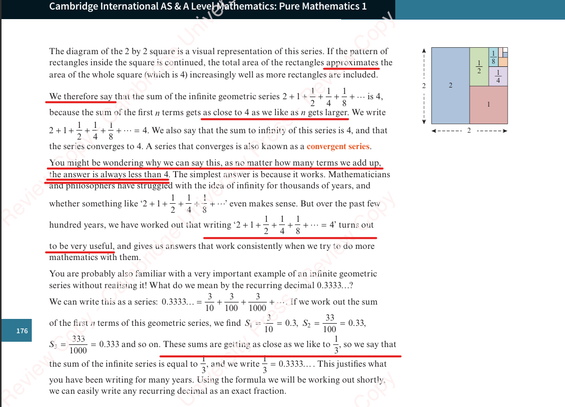
@SmartmanApps "the sum of the series to infinity is 4".
Do you think that's correct or do you think the textbook is wrong?
Do you think that's correct or do you think the textbook is wrong?
@fuchsi
"Do you think that's correct or do you think the textbook is wrong?" - says person who left out the whole previous sentence 🙄 "WE THEREFORE SAY THAT the sum of the infinite geometric series… is 4, because the sum of the first n terms gets AS CLOSE TO 4 AS WE LIKE as n gets larger", and also ignored the latter sentence... "You might be WONDERING WHY we can say this, as NO MATTER HOW MANY TERMS WE ADD UP, THE ANSWER IS ALWAYS LESS THAN 4", AND also ignored the diagram depicting the proof
"Do you think that's correct or do you think the textbook is wrong?" - says person who left out the whole previous sentence 🙄 "WE THEREFORE SAY THAT the sum of the infinite geometric series… is 4, because the sum of the first n terms gets AS CLOSE TO 4 AS WE LIKE as n gets larger", and also ignored the latter sentence... "You might be WONDERING WHY we can say this, as NO MATTER HOW MANY TERMS WE ADD UP, THE ANSWER IS ALWAYS LESS THAN 4", AND also ignored the diagram depicting the proof
@fuchsi
So yes, the textbook is correct - the infinite sum is always less than the limit, but we use the limit in it's place when doing arithmetic. It's not complicated. Every textbook that covers this topic says the same thing in different ways
So yes, the textbook is correct - the infinite sum is always less than the limit, but we use the limit in it's place when doing arithmetic. It's not complicated. Every textbook that covers this topic says the same thing in different ways
@SmartmanApps "the infinite sum is always less than the limit, but we use the limit in it's place when doing arithmetic. "
Isn't that also what Wikipedia and our friend said?
Just in more words?
Edit: and I didn't leave the rest out. I am sorry if it looked that way. I just try to find common ground and go on from there. I don't think it's useful to always write a whole page if we don't find the starting point first.
@fuchsi
"Isn't that also what Wikipedia and our friend said?" - no. The infinite sum is 0.(9), the limit is 1, both say they're equal, but it's literally impossible for them to be equal, as per all the textbooks and proofs. Using the limit in it's place for arithmetic doesn't mean they're equal, any more than using 22/7 for pi now means pi is equal to 22/7. A value you use for a calculation isn't the same as that thing actually having that value in reality
"Isn't that also what Wikipedia and our friend said?" - no. The infinite sum is 0.(9), the limit is 1, both say they're equal, but it's literally impossible for them to be equal, as per all the textbooks and proofs. Using the limit in it's place for arithmetic doesn't mean they're equal, any more than using 22/7 for pi now means pi is equal to 22/7. A value you use for a calculation isn't the same as that thing actually having that value in reality
@SmartmanApps your textbook also says they are equal "The simplest answer is because it works".
The text also says it's strange and "mathematicians and philosophers have struggled with the idea". So you are not alone.
And they conclude that 0,333... = 1/3 (is equal)
They don't say 0,333... < 1/3 (is smaller) or 0,333... ~ 1/3 (is rounded). They explain that they use the symbol "equal" because in infinity there is no difference between both.
And again: the text also sees this contradiction.
@SmartmanApps Another way to say it is: we defined it that way.
Because mathematics is a sort of language for numbers.
We made up new words for this phenomenon: converging series and limit. And we defined both to be equal. Because it works.
Because mathematics is a sort of language for numbers.
We made up new words for this phenomenon: converging series and limit. And we defined both to be equal. Because it works.
@fuchsi
"your textbook also says they are equal" - no it doesn't. "the answer is always less than 4"
"So you are not alone" - I'm not struggling with the idea at all. This has been well-established for a very long time
"And they conclude that 0,333... = 1/3 (is equal)" - no they don't. They conclude we use it in it's place "because it works", just like we can use 22/7 in place of pi if we choose
"They don't say 0,333... < 1/3 (is smaller)" - yes they do. "the answer is always less than 4"...
@fuchsi
You're also ignoring the textbook which explicitly stated that 0.(6) is less than 2/3. Now divide by 2
"Another way to say it is: we defined it that way" - nope. We've defined infinite sums one way, the limit another way
"mathematics is a sort of language for numbers" - no it isn't - it's a tool for calculating things, and sometimes we do things to make the calculations easier, like using 22/7 for pi
"And we defined both to be equal" - no we didn't, just like pi isn't defined as 22/7
@SmartmanApps
"You're also ignoring the textbook which explicitly stated that 0.(6) is less than 2/3. Now divide by 2"
I am not exactly sure what you mean by that.
Yes 0,6 < 2/3
But we are talking about sums that go into infinity.
So you can say
6/10+6/100+6/1000+... = 0,6666... = 2/3
(Not < 2/3 because we don't stop the sum. We take all of it. Until infinity. That's why there are 3 dots "..." behind the term. Because it goes on and on.
Funfact:In Germany you would write a line above the 6.)